Curated ToolThis tool is part of our curated AI directory. We only include tools that meet our standards for relevance, usability and real-world value.

WordPress

WordPress is an open-source content management system for creating and managing websites, blogs, and online stores. It lets users publish content, customize site design with themes, and extend functionality with plugins.
Website BuildersE-commerce Builders

FYAI Score

8.8 / 10

Based on 14,986 reviews

Pricing:

Freemium

Best for:

Bloggers and small businesses building and growing a website

Score Breakdown

  • Ease of use7.4 / 10
  • Features9.3 / 10
  • Pricing9.1 / 10
  • Integrations9.4 / 10
  • Support9.0 / 10

PRODUCT PREVIEW

What this AI tool does

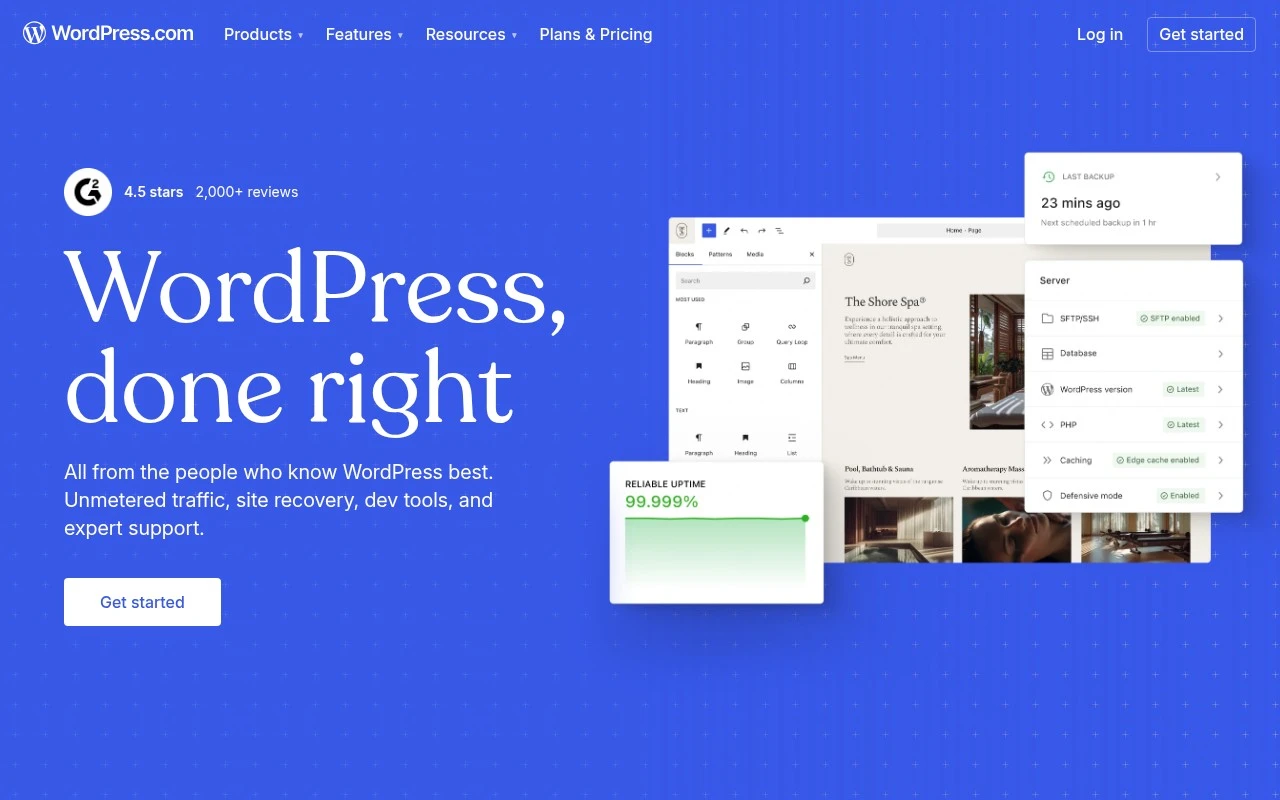
WordPress is a managed website creation, hosting, and publishing platform for individuals, creators, businesses, developers, and enterprises that want to build a web presence on the WordPress ecosystem without managing every infrastructure detail themselves. Through WordPress.com, it combines site-building tools, website hosting, domains, themes, storage, security, and support in one place, while still leaving room to grow into plugins, ecommerce, and developer workflows. For many users, the main appeal is that a site can start simple and become more capable over time. A personal blog, portfolio, landing page, company site, publication, or membership-style content hub can begin with a theme and visual editing, then expand as traffic, content, or business needs increase. This makes the platform less like a single-purpose landing page builder and more like a long-term web foundation. At its core, the experience is shaped by WordPress’s balance between publishing and customization. The editor supports structured pages and posts, while themes define the visual system that site owners can adapt without starting from a blank canvas. For teams that need to build landing page campaigns or maintain content-heavy websites, that combination gives non-technical users practical control while keeping the underlying system familiar to designers and developers. Website hosting is part of the managed WordPress.com story, rather than a separate technical chore. Security, performance, backups, storage, and support are packaged into the platform according to plan level, so users can focus on publishing and managing their website rather than configuring servers. Domains and related setup can also sit near the same workflow, which is useful for small businesses trying to keep web operations centralized. Ecommerce and audience growth extend the platform beyond basic pages. Online store creation is supported through commerce options that let businesses sell products, take payments, and manage a more transactional site experience. Newsletters, subscriptions, and content publishing tools also make it relevant for creators and media projects that need both a website and a repeatable way to reach readers. AI enters the product story through an AI Website Builder and WordPress AI features promoted by the platform. The available positioning suggests support for faster website generation and assisted site creation, although the provided information does not define the exact AI models, prompts, or automation limits in detail. In practical terms, the AI layer appears intended to reduce the blank-page problem for people who want to get a site drafted, structured, or improved more quickly. For developers and larger organizations, the platform can move into more advanced territory. Plugin support, developer tools, and access to the broader WordPress ecosystem allow more technical teams to customize how sites behave, integrate with services, and manage production workflows. Enterprise needs are served through WordPress VIP, which positions the technology for large-scale publishing, governance, security, and performance requirements. The commercial model is plan-based, so WordPress pricing generally depends on how much control, storage, commerce functionality, plugin access, support, and enterprise capability a user needs. That structure reflects the platform’s broad audience, from a new site owner publishing a first page to an organization running a complex digital property. The important distinction is that users are not only paying for a builder, they are choosing a managed environment around the WordPress publishing system. As a category fit, WordPress is best understood as a flexible website platform for people who want ownership of content, room to customize, and a path from simple publishing to sophisticated web operations. It is especially strong when a website needs to combine pages, posts, media, SEO-friendly content, audience tools, and potential commerce in one extensible system. Rather than being only an AI site generator, it is a mature web platform now adding AI-assisted creation to an already broad publishing and hosting foundation.

Use cases

Best for

Website Hosting

Use WordPress.com to host a WordPress site with managed updates, security, storage, domains, and built in support.

Build Landing Page

Build a landing page on WordPress.com using block editor layouts, themes, and custom domains, then publish it to your site.

Website Generation

Generate a new website on WordPress.com with its AI Website Builder, which creates a starter site you can edit and publish.

ANALYSIS

Strengths & limitations

Strengths
  • Best suited to users who want WordPress without managing hosting themselves, because domains, hosting, security, storage, themes, and support are bundled into one managed platform.
  • Strong fit for sites that may grow beyond a simple blog, because WordPress.com supports options such as ecommerce, newsletters, plugins, developer tools, and enterprise WordPress VIP.
  • Accessible for creators and small businesses starting on a budget, because the freemium model lets users begin with a managed WordPress site before moving into paid capabilities.

Limitations
  • Less suitable for teams that need full server-level control, because WordPress.com abstracts much of the hosting environment compared with self-hosted WordPress.
  • Free-tier users may outgrow the platform quickly, because advanced capabilities such as deeper customization, plugins, ecommerce, and developer features are associated with paid options.
  • Less suitable for buyers seeking a dedicated AI app builder, because its AI features sit inside a broader managed WordPress website platform rather than a standalone AI development environment.

Evaluation

FYAI score breakdown

Our structured evaluation across five key criteria

8.8 / 10

Overall score

Based on 14,986 reviews

  • Ease of use7.4 / 10
  • Features9.3 / 10
  • Pricing9.1 / 10
  • Integrations9.4 / 10
  • Support9.0 / 10

What users say

Findings from public reviews, documentation and community sources.

  • Ease of use

    WordPress.com says onboarding requires “No technical setup required” and offers a “Drag, drop” design experience. A Reddit r/webdev discussion includes sentiment that WordPress can become complex when plugins and maintenance enter the workflow.

  • Features

    The WordPress.com pricing page lists built-in hosting, premium themes, unmetered bandwidth, and ecommerce, and the product page references an AI website builder and enterprise options.

  • Pricing

    The WordPress.com pricing page shows a free plan plus paid plans at €4/month Personal, €8/month Premium, and €25/month Business when billed annually. The WordPress.com pricing page lists a free domain for one year, storage amounts, unlimited pages/posts/users/visitors, and support.

  • Integrations

    The WordPress.org plugin directory describes itself as “the largest directory of free” plugins and says it offers “thousands of free plugins to build, customize, and enhance” a site.

  • Support

    The WordPress.com pricing page lists “Free support” from its “expert, friendly Happiness team,” and the Business plan includes “Free 24/7 priority expert support.” WordPress.com surfaces a Support Center, guides, courses, forums, and contact options.

Who is this for?

Best for users who want a website builder that can extend into ecommerce and plugins, the WordPress.com pricing page lists ecommerce and plugin extension, and WordPress.org says there are “thousands of free plugins to build, customize, and enhance” a site. Less suited to users who want a near-zero-maintenance hosted builder, Reddit sentiment reflects that WordPress can become complex when plugins and maintenance enter the workflow.

PRODUCT PREVIEW

Feature highlights

Themes & Editor

Design pages with blocks, themes, and full-site editing—no code.

Secure Managed Hosting

Built-in security, backups, and updates to keep your site protected.

Managed Hosting Built-In

Build and publish with secure hosting, updates, backups, and support.

COMPARE

Discover curated alternatives worth comparing

Compare similar AI tools based on features, pricing and use cases

8.6/ 10Based on 28,442 reviews

Wix AI

Website BuildersE-commerce Builders
Builds a website draft from answers for later customization
Best for:
Small business owners
Pricing
Freemium

7.7/ 10Based on 35 reviews

WeWeb

Hosting & DeploymentApp / No-code Builders
Builds web-app pages, databases, logic, and coded components
Best for:
Startup founders
Pricing
Freemium

7.9/ 10Based on 994 reviews

Webflow

Website BuildersLanding Page Builders
Builds sites, analyzes performance, and improves AEO visibility
Best for:
Marketing teams
Pricing
Freemium

Join millions building their online presence with WordPress. Launch a site you’re proud of and start growing your business today.

FAQ

Frequently asked
questions

Everything you need to know about this AI tool,
its features, pricing, use cases, and limitations.

Who is WordPress best suited for?
WordPress is best suited for people and teams that want a managed WordPress website without running their own hosting stack. It fits bloggers, creators, small businesses, agencies, developers, and enterprises building websites, blogs, newsletters, business sites, ecommerce projects, or larger WordPress deployments on hosted infrastructure.
Is WordPress free, and what do paid plans add?
WordPress uses a freemium model, so users can start for free and upgrade for more advanced website needs. Paid options are typically relevant when you need capabilities such as custom domains, professional email, plugins, ecommerce, developer tools, more storage, or higher levels of managed hosting and support.
How does WordPress compare with other website builders?
WordPress is a strong fit when you want a hosted site built on the WordPress ecosystem rather than a simpler closed website builder. Compared with many alternatives, it offers broad publishing, theme, plugin, and hosting flexibility, but the best choice depends on budget, technical comfort, ecommerce needs, and how much control you want.
How quickly can I set up a website with WordPress?
The main trade-off with WordPress.com is that convenience and managed hosting can come with less server-level control than self-hosted WordPress. Advanced features such as ecommerce, plugins, professional email, and enterprise-grade hosting may require paid options, and buyers should review how its AI website-building features fit their specific workflow.
What should I check about privacy and compliance before using WordPress?
Teams should review WordPress.com’s current privacy, security, data processing, and compliance documentation before using it for regulated or sensitive data. Important checks include where data is hosted, how backups and recovery work, what user permissions are available, and whether the plan supports the governance needs of the organization.