Curated ToolThis tool is part of our curated AI directory. We only include tools that meet our standards for relevance, usability and real-world value.

TickTick

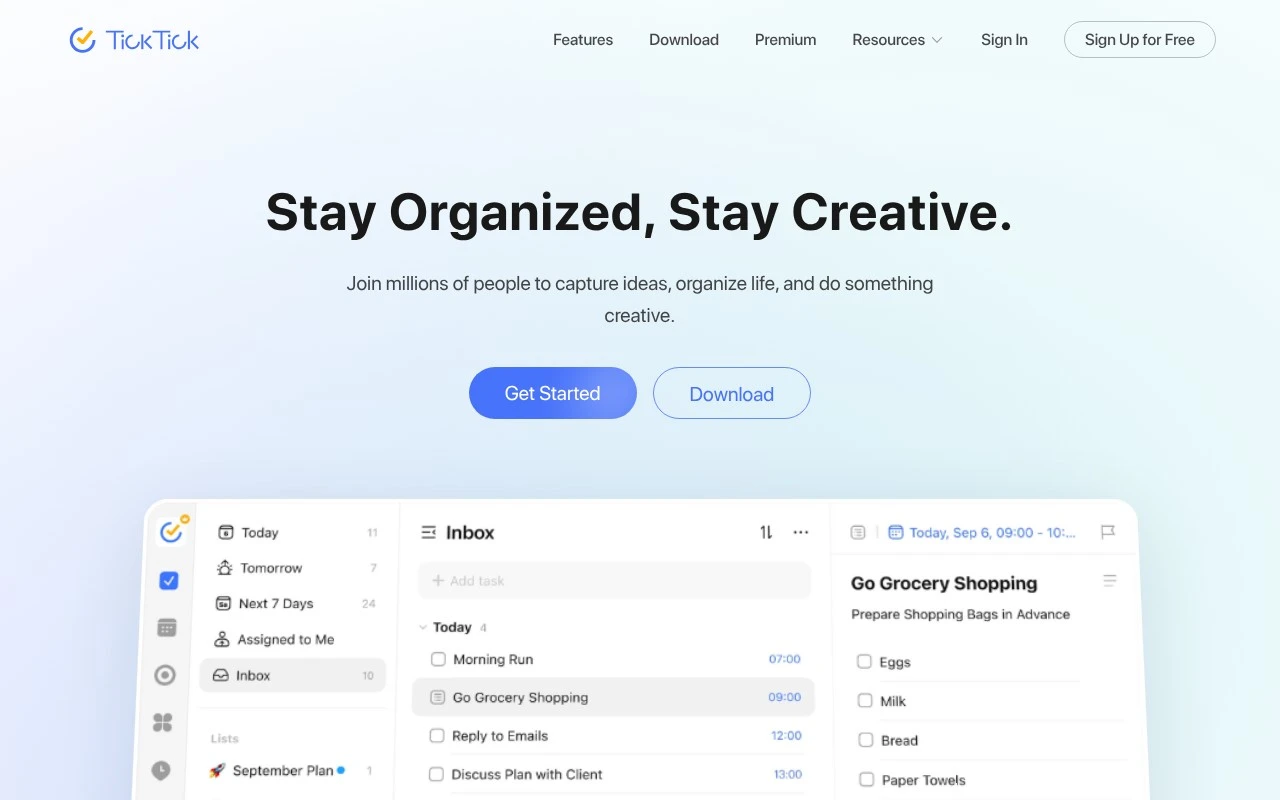
TickTick is a task management and to-do list app for capturing tasks, setting reminders, organizing lists, and planning work with calendar views. It also includes features such as recurring tasks, collaboration, habit tracking, and a built-in Pomodoro timer.
Task & Project ManagementTime & Habit Tracking
FYAI Score

8.7 / 10

Based on 129 reviews

Pricing:

Freemium

Best for:

Individuals juggling tasks, schedules, and habits across devices

Score Breakdown

  • Ease of use9.2 / 10
  • Features9.0 / 10
  • Pricing9.2 / 10
  • Integrations7.4 / 10
  • Support7.9 / 10

PRODUCT PREVIEW

What this AI tool does

TickTick is a productivity and task management app for people who want one place to capture tasks, plan schedules, build habits, and stay focused across daily life and work. TickTick is best at combining practical planning tools, including to-do lists, calendar views, reminders, habit tracking, and focus timers, into a single synced workspace. For individuals, the core value is that everyday commitments do not have to live in separate apps. A user can capture a task, add a due date in natural language, place it on a calendar, set a recurring reminder, and return to it from a phone, computer, tablet, or watch. The app is designed for both quick capture and more structured planning. Schedule planning is a central part of the experience. Calendar views help users see tasks alongside time, while timeline, Kanban, and Eisenhower Matrix views support different planning styles. Someone managing a busy week can shift from a simple list to a visual board or priority matrix without leaving the platform. Habits and focus features give the tool a broader productivity role than a standard to-do list. Habit tracking helps users monitor routines such as exercise, reading, medication, or study, while Pomodoro-style focus timing supports lightweight time tracking and concentrated work sessions. Statistics and countdowns add feedback, making progress more visible over time. Reminders are built for people who need persistence as much as planning. TickTick supports recurring reminders, location-aware planning on supported devices, and constant reminders for tasks that cannot be missed. This makes it useful for deadlines, errands, bills, appointments, and personal routines where a single notification may not be enough. Collaboration is present, but it is intentionally simple. Shared lists and task assignment allow families, roommates, small teams, or project partners to coordinate responsibilities without adopting a heavy project management system. The tool is strongest when collaboration remains close to practical task execution rather than complex enterprise workflow design. Across devices, real-time sync is one of the reasons the app feels dependable. A task created on a laptop can appear on a phone, tablet, or watch, which supports the way many people move between desk work, commuting, meetings, and home responsibilities. Themes and sticky notes add a layer of personalisation for users who want their planning environment to feel more flexible. The product’s character is breadth rather than specialisation. It does not focus only on calendar scheduling, only on habits, or only on focus sessions. Instead, it brings these pieces together so that task management, schedule planning, habit tracking, and daily prioritisation can reinforce each other. TickTick is built for students, professionals, freelancers, families, and personal productivity enthusiasts who want a capable all-in-one organiser without the complexity of a full project management suite. TickTick is especially useful for users who think in both lists and calendars, and who want planning, reminders, routines, and focus support to stay connected in one everyday system.

Use cases

Best for

Task Management

TickTick organizes tasks with lists, calendar and Kanban views, natural language dates, recurring reminders, and shared assignments.

Habit Tracking

Track daily habits by setting goals, scheduling reminders, and reviewing streaks and stats in the habit tracker.

Time Tracking

Measure focused work time using the built in Pomodoro timer and view session statistics to review time spent.

ANALYSIS

Strengths & limitations

Strengths
  • Best suited to users who want tasks, calendars, habits, Pomodoro focus, reminders, and planning views in one app because it reduces the need to combine several separate productivity tools.
  • Useful for fast personal planning because natural-language date recognition can turn typed dates and times into smart reminders with less manual scheduling.
  • Good fit for people working across devices because real-time sync covers phones, computers, tablets, and watches for consistent access to tasks and schedules.
Limitations
  • Less suitable for buyers seeking AI-first productivity automation because TickTick’s automation-like value is mainly natural-language date recognition rather than generative AI or autonomous workflow handling.
  • Less suitable for larger teams that need full project management because its collaboration centers on shared lists and task assignment rather than advanced portfolio, resource, or dependency management.
  • The freemium model can constrain heavier users because some advanced planning, calendar, reminder, or customization needs may require moving to a paid subscription.

Evaluation

FYAI score breakdown

Our structured evaluation across five key criteria

8.7 / 10

Overall score

Based on 129 reviews

  • Ease of use9.2 / 10
  • Features9.0 / 10
  • Pricing9.2 / 10
  • Integrations7.4 / 10
  • Support7.9 / 10

What users say

Findings from public reviews, documentation and community sources.

  • Ease of use

    G2's review signal says users “consistently praise the ease of use and intuitive design,” and TickTick’s own page emphasizes “powerful and intuitive features.”

  • Features

    TickTick’s feature page lists Kanban, timeline, habit tracker, and Pomodoro among its productivity features.

  • Pricing

    TickTick’s pricing page lists the Premium annual plan at “US$35.99,” describes it as “less than US$3/month,” references a free version, and mentions an education discount.

  • Integrations

    TickTick’s feature page names “Google Calendar,” email/browser capture, calendar subscriptions, and integrations “with other apps like Notion.”

  • Support

    TickTick’s feature page surfaces self-serve resources including “Help Center,” “FAQ,” productivity guides, and related resources.

Who is this for?

Best for users who want task planning, calendars, habits, and focus tools in one app, TickTick’s feature page lists to-do lists, calendar views, habit tracker, and Pomodoro. Less suited to users who need a broad integration marketplace, TickTick’s cited integrations include “Google Calendar,” email/browser capture, calendar subscriptions, and integrations “with other apps like Notion.”

PRODUCT PREVIEW

Feature highlights

Smart to-do capture

Quick add tasks with natural dates, recurring rules, and reminders.

Calendar & views

Plan in calendar, Kanban, timeline, or Eisenhower Matrix.

Focus & stats

Pomodoro timers, habit tracking, and progress insights in one app.

COMPARE

Discover curated alternatives worth comparing

Compare similar AI tools based on features, pricing and use cases

7.8/ 10Based on 31 reviews

Wudpecker

Meeting NotesSummarization
Turns recordings into notes, summaries, action items, and Q&A
Best for:
Knowledge workers
Pricing
Freemium

9.0/ 10Based on 1,589 reviews

Toggl Track

Time & Habit Tracking
Tracks time, automates activity capture, and reports team data
Best for:
Operations teams
Pricing
Freemium

8.5/ 10Based on 2,648 reviews

Todoist

Task & Project Management
Captures tasks, organizes schedules, and clarifies action plans
Best for:
Knowledge workers
Pricing
Freemium

Join thousands who plan with clarity. Start using TickTick today to stay on top of priorities and hit every deadline with less stress.

FAQ

Frequently asked
questions

Everything you need to know about this AI tool,
its features, pricing, use cases, and limitations.

Who is TickTick best suited for?
TickTick is best suited for individuals, students, educators, professionals, and small teams that want one app for tasks, schedules, habits, and reminders. It works well for daily planning, study organization, recurring tasks, calendar-based scheduling, habit tracking, Pomodoro sessions, and lightweight shared task lists.
Does TickTick have a free plan, and when would I need to pay?
TickTick uses a freemium pricing model, so users can start for free and pay for expanded productivity features. The free option is suitable for basic task and reminder management, while paid access is typically more relevant for heavier calendar planning, advanced views, filters, statistics, and broader productivity workflows.
How does TickTick compare with other task management apps?
TickTick stands out by combining to-do lists, calendar planning, habit tracking, countdowns, and Pomodoro focus tools in one productivity app. Compared with simpler task managers, it offers more planning views and routines. Compared with full project management platforms, it is better suited to personal productivity and lightweight collaboration.
How quickly can I get started with TickTick?
TickTick is not designed as a broad AI assistant or generative AI workspace. Its automation-like capability is mainly natural-language recognition for dates and times while creating reminders. Teams that need complex project operations, deep workflow automation, or a large integration ecosystem may need to compare it with more specialized platforms.
What should I check about TickTick privacy and compliance before using it?
Buyers should review TickTick’s current privacy, security, data retention, and compliance information before using it for sensitive work. Important checks include how task and calendar data is synced across devices, whether shared lists expose information to collaborators, and whether the app meets any organizational requirements for regulated or confidential data.