Curated ToolThis tool is part of our curated AI directory. We only include tools that meet our standards for relevance, usability and real-world value.

Pixlr

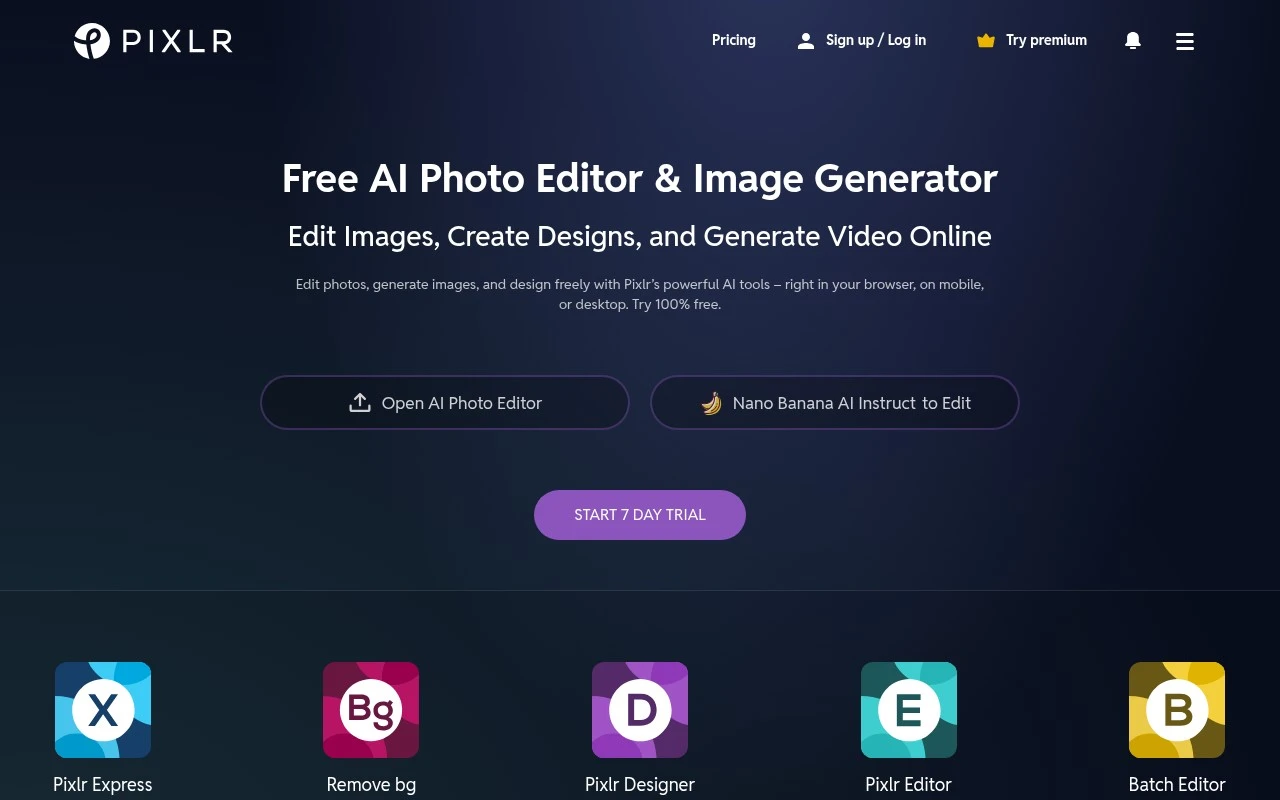
Pixlr is a web-based photo editing and design platform for editing images, creating graphics, removing backgrounds, applying filters, and generating or enhancing visuals with AI-powered tools.
AI Image GeneratorImage Upscaler

FYAI Score

8.1 / 10

Based on 749 reviews

Pricing:

Freemium

Best for:

Creators and marketers editing and generating images fast in-browser

Score Breakdown

  • Ease of use8.2 / 10
  • Features8.2 / 10
  • Pricing8.9 / 10
  • Integrations7.2 / 10
  • Support7.3 / 10

PRODUCT PREVIEW

What this AI tool does

Pixlr is a browser-based AI photo editor and image-generation workspace that combines familiar design tools with generative media features in a no-install interface. Pixlr is built for people who want to edit photos, create graphics, generate images, and clean up visual content without moving into a full desktop creative suite. Its identity is part online Photoshop alternative, part AI creative lab, with tools that range from quick background fixes to text-to-image and text-to-video creation. For casual creators, marketers, students, small businesses, and social media teams, the main appeal is speed. A user can open an image, remove background elements, adjust a composition, add text, generate new assets, and export a finished visual from the same browser tab. Pixlr is especially useful for users who need capable image editing without installing software or learning a professional-grade workflow from scratch. AI generation sits at the center of the newer Pixlr experience. The platform can generate images from prompts, create short videos from text, and use third-party AI models such as Flux, Kling, Recraft, Veo, Stable Diffusion, SDXL, and others depending on the feature and output type. Instead of treating AI as a separate add-on, it places generation beside editing, so a prompt can become a source image, a background, a concept mockup, or a creative starting point. Traditional editing still matters in the product story. Layers, templates, filters, drawing tools, text controls, cutouts, and image adjustment options make it feel closer to a lightweight design editor than a single-purpose AI generator. This is important because many projects do not end at generation. They require cropping, alignment, retouching, color correction, resizing, and export choices before they are ready to publish. Background and object cleanup are among the most practical uses. The remove background workflow helps isolate products, portraits, and social images, while image object removal can clean distractions from a scene without requiring manual cloning skills. Generative fill extends that idea by letting users replace or create missing parts of an image in a way that is guided by the surrounding context. Image enhancement is another part of the platform’s everyday value. Users can upscale image files, reduce noise, sharpen low-quality photos, and improve assets that might otherwise be too small or rough for a presentation, listing, thumbnail, or post. Image outpainting, often described through generative expand, helps extend a composition beyond its original frame, which is useful when adapting images to new aspect ratios. Because it runs in the browser, Pixlr fits well into lightweight creative workflows. It is accessible from common devices, supports fast turnarounds, and avoids the friction of downloading a large editor before starting a task. The free positioning also makes it approachable for occasional users, while more advanced AI features and higher-volume workflows may depend on account limits, credits, or paid access. Pixlr is best at giving non-specialists and semi-professional creators a flexible bridge between photo editing and AI image creation. It is not only a prompt box and not only a legacy editor. The platform’s strength is the way it connects practical edits, generative assets, cleanup tools, collage creation, face swap features, and enhancement controls into one accessible workspace. In the broader creative software landscape, its character is pragmatic rather than cinematic or enterprise-heavy. Designers can use it for quick composites, sellers can prepare product images, creators can make thumbnails and posts, and teams can prototype visual ideas quickly. Pixlr stands out most when the job calls for a finished image or short generated visual faster than a traditional professional editing workflow would allow.

Use cases

Best for

Generate Images

Use Pixlr to generate images from a text prompt with its built in text to image generator in your browser.

Remove Background

Remove a photo background in Pixlr by running the AI background remover and exporting the cutout as a PNG.

Text to Speech

Pixlr does not provide text to speech, so you cannot convert text into spoken audio with this tool.

ANALYSIS

Strengths & limitations

Strengths
  • Best suited to creators and small businesses that need quick browser-based editing because it requires no desktop installation.
  • Useful for mixed design workflows because it combines standard photo editing with AI generation, background removal, object removal, generative fill, upscaling, and denoising in one toolset.
  • Accessible for casual users and teams testing AI design workflows because its freemium model lowers the barrier to getting started.

Limitations
  • Less suitable for offline or high-security editing workflows because Pixlr is primarily a browser-based tool that processes work through an online service.
  • Less suitable for heavy AI-generation users on a tight fixed budget because the freemium model can place meaningful usage or advanced features behind paid access.
  • Less suitable for teams with strict AI vendor governance because its AI features are powered by multiple third-party models rather than a single controlled model stack.

Evaluation

FYAI score breakdown

Our structured evaluation across five key criteria

8.1 / 10

Overall score

Based on 749 reviews

  • Ease of use8.2 / 10
  • Features8.2 / 10
  • Pricing8.9 / 10
  • Integrations7.2 / 10
  • Support7.3 / 10

What users say

Findings from public reviews, documentation and community sources.

  • Ease of use

    Capterra lists Pixlr at 4.4/5 from 119 reviews, and Capterra’s snippet says Pixlr is “fairly easy to use, even for beginners” with a “user-friendly interface.”

  • Features

    Pixlr’s own page lists an “AI photo editor,” “AI image generator,” “AI video maker,” “face swap,” and “20+ editing tools.” Pixlr’s own page also references generative fill, object removal, upscaling, and text-to-music.

  • Pricing

    Pixlr’s pricing page publishes a free option and paid tiers including Plus at $2.49/month, Premium at $9.99/month, and Ultra from $24.99/month. Pixlr’s pricing page references annual discounts, AI-credit allowances, cancellation details, fair-use language, and a policy stating Pixlr is “unable to process any refunds” after payment.

  • Integrations

    Pixlr’s available product information says Pixlr works across web and mobile apps. Pixlr’s blog says Pixlr built a way to connect Pixlr Editor/Express with “Gmail and Google Drive” for opening, editing, and saving images.

  • Support

    Pixlr’s pricing FAQ covers account, subscription, payment, cancellation, refund, and AI-credit questions. Pixlr’s pricing FAQ directs users to email “[email protected]” for upgrade or alternate-payment help.

Who is this for?

Best for creators who want browser-based image editing with AI tools, Pixlr’s own page lists an “AI photo editor,” “AI image generator,” “AI video maker,” “face swap,” and “20+ editing tools.” Less suited to buyers who need refund flexibility after purchase, Pixlr’s pricing page states Pixlr is “unable to process any refunds” after payment.

PRODUCT PREVIEW

Feature highlights

AI Image Generator

Turn prompts into images and variations for posts, ads, and concepts.

Generative Fill

Add, remove, or replace objects with natural-looking results.

Upscale & Denoise

Boost resolution and clean up noise for sharper, clearer photos.

COMPARE

Discover curated alternatives worth comparing

Compare similar AI tools based on features, pricing and use cases

7.2/ 10Based on 2,027 reviews

Pixa

AI Image Generator
Edits and creates pixel-art images in a visual canvas editor
Best for:
Designers
Pricing
Freemium

8.2/ 10Based on 193 reviews

Uizard

UI/UX Design
Converts prompts, screenshots, and sketches into UI prototypes
Best for:
Product teams
Pricing
Freemium

8.2/ 10Based on 56,265 reviews

Topaz Labs

Image UpscalerPhoto Editing
Enhances photos and videos with upscaling, denoising, sharpening
Best for:
Designers
Pricing
Paid only

Create standout visuals in minutes with Pixlr. Start editing, polishing, and sharing images that make your brand look professional today.

FAQ

Frequently asked
questions

Everything you need to know about this AI tool,
its features, pricing, use cases, and limitations.

Who is Pixlr best suited for?
Pixlr is best suited for creators, small businesses, marketers, designers, and general users who need browser-based image editing with built-in AI tools. It fits quick workflows such as removing backgrounds, enhancing images, generating visuals, making collages, editing social posts, and producing lightweight marketing assets without installing desktop software.
Is Pixlr free, and what should I check before upgrading?
Pixlr uses a freemium pricing model, so users can start with free access and upgrade if they need more capacity or features. Before relying on it for regular work, check Pixlr’s current plan details for usage limits, AI credits, export options, file restrictions, and which tools require a paid plan.
How does Pixlr compare with other online image editing tools?
Pixlr stands out as an online editor that combines traditional photo editing with AI image generation, video generation, background removal, object removal, face swap, upscaling, and collage tools. Compared with similar tools, the right choice depends on whether you prioritise quick browser access, AI features, team workflow, offline editing, or professional-grade controls.
How quickly can I get started with Pixlr?
Pixlr may not be the best fit for users who need offline editing, deep professional desktop workflows, or highly specific control over every production step. It offers many AI and media tools, but buyers should verify current plan limits, model availability, export settings, and consistency for their intended workload.
What should teams know about privacy and compliance when using Pixlr?
Teams should review Pixlr’s current privacy, data handling, and compliance terms before uploading sensitive, client, or regulated content. Since Pixlr is browser-based and includes AI media tools, buyers should confirm how files, prompts, generated assets, account data, and retention settings are handled for their organisation’s requirements.