Curated ToolThis tool is part of our curated AI directory. We only include tools that meet our standards for relevance, usability and real-world value.

Pixa

Edits and creates pixel art images with drawing and animation tools.

AI Image Generator
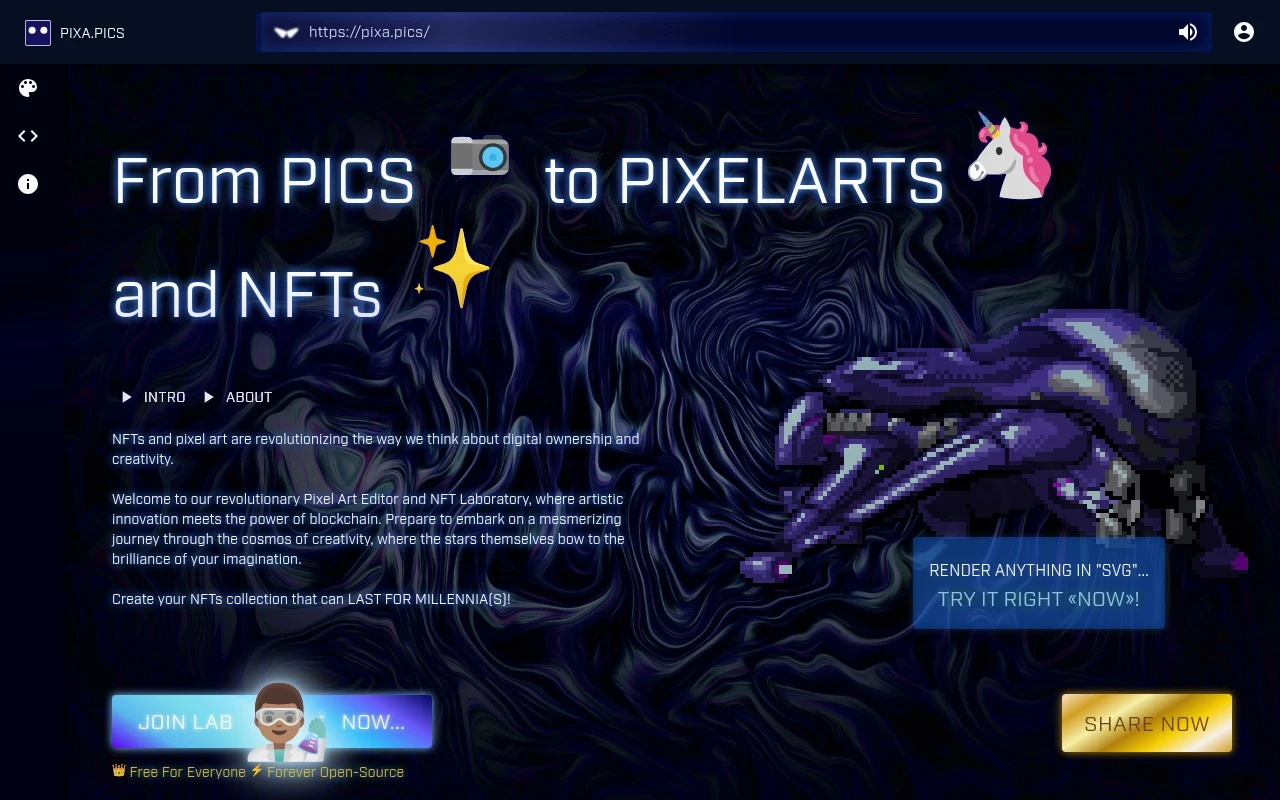
Pixa, at pixa.pics, is presented as a free pixel-art editor and NFT laboratory. The official site describes it as a tool for making pixel art from real-life images, drawing on images, and editing with features such as filters, layers, and a library. No specific AI functionality is described in the available site text.

FYAI Score

7.2 / 10

Based on 2.027 reviews

Pricing:

Freemium

Best for:

Pixel artists turning photos into pixel art

Score Breakdown

  • Ease of use7.0 / 10
  • Features7.0 / 10
  • Pricing7.9 / 10
  • Integrations7.1 / 10
  • Support7.1 / 10

PRODUCT PREVIEW

What this AI tool does

Pixa is an AI tool page intended to help readers understand what the product does and whether it fits their needs. It provides a straightforward overview of the tool’s purpose, typical workflows, and the kinds of problems it is designed to address, without assuming prior knowledge. Because the available details about the introduction and main use case are not defined, this page focuses on general, informational guidance: what to look for in an AI tool, how to evaluate outputs, and what inputs or data you may need to get useful results. As more specifics become available, the description can be refined to reflect the tool’s actual capabilities and the scenarios where it performs best.

Use cases

Best for

Photo to Pixel Art

Pixa converts real-life photos into pixel art by reducing resolution and mapping colors to a pixel grid.

Pixel-Level Image Editing

Draw and edit directly on imported images in a pixel-art canvas using pixel-precise brush and eraser tools.

Layers Filters and Library

Create pixel-art assets using editor features like layers, filters, and a built-in library for reusable elements.

ANALYSIS

Strengths & limitations

Strengths
  • Supports making pixel art from real-life images.
  • Includes image-editing features mentioned by the site, including filters, layers, and a library.
  • The official copy says the editor can be used for free.
Limitations
  • The official site text is very limited, so detailed capabilities are not fully established.
  • No AI-powered feature is described in the provided source.
  • The phrase “NFTs Laboratory” is mentioned but not explained enough to define a concrete NFT workflow.

Evaluation

FYAI score breakdown

Our structured evaluation across five key criteria

7.2 / 10

Overall score

Based on 2.027 reviews

  • Ease of use7.0 / 10
  • Features7.0 / 10
  • Pricing7.9 / 10
  • Integrations7.1 / 10
  • Support7.1 / 10

What users say

Findings from public reviews, documentation and community sources.

  • Ease of use

    Pixa is categorized as an image-design tool.

  • Features

    PricingNow states that Pixa feature depth is reflected in the product itself rather than a dedicated overview page.

  • Pricing

    ZoftwareHub lists a “Free” plan and “Pro $10 Per User Per Month” with “600 AI Credits Monthly,” plus a higher 3,600-credit allowance.

  • Integrations

    A Facebook Setapp group post names “Dropbox and CloudApp services to sync your library” as Pixa image-library connectivity.

  • Support

    Capterra lists “Email/Help Desk, Phone Support, and Chat” for Pixa support. Capterra also has a single public review describing the experience as “deeply disappointing.”

Who is this for?

Best for users comparing low-entry AI image tools. ZoftwareHub lists a “Free” plan and “Pro $10 Per User Per Month” with “600 AI Credits Monthly.” Less suited to teams that need a broad integration ecosystem, the supplied material names “Dropbox and CloudApp services to sync your library” as the image-library connectivity.

PRODUCT PREVIEW

Feature highlights

Photo to Pixel Art

Convert real-life images into pixel art you can refine and export.

Layers & Filters

Edit with layers and filters to iterate fast and stay organized.

Brushes & Library

Draw on images with pixel tools and reuse assets from a library.

COMPARE

Discover curated alternatives worth comparing

Compare similar AI tools based on features, pricing and use cases

8.2/ 10Based on 193 reviews

Uizard

UI/UX Design
Generates editable UI prototypes from prompts, screenshots, or sketche
Best for:
Product teams
Pricing
Freemium

8.2/ 10Based on 56.265 reviews

Topaz Labs

Image UpscalerPhoto Editing
AI upscales, denoises, sharpens, and restores photos and videos
Best for:
Designers
Pricing
Paid only

7.4/ 10Based on 16.399 reviews

Tailor Brands

Logo & Brand Assets
Guides business formation and compliance, tracking filings.
Best for:
Small business owners
Pricing
Freemium

Start creating polished product photos in minutes with Pixa. Upgrade your storefront visuals and turn more browsers into buyers today.

FAQ

Frequently asked
questions

Everything you need to know about this AI tool,
its features, pricing, use cases, and limitations.

Is Pixa a good fit for e-commerce product photos, marketplaces, and social ads?
Pixa is best when you need fast, consistent product images at scale—background removal, clean cutouts, and simple scene changes for catalogs, Shopify listings, and marketplace uploads. It’s a strong choice for small teams that don’t have in-house designers but still need polished visuals. If your workflow depends on complex composites, strict brand art direction, or high-end editorial retouching, you may find it limiting compared with pro design tools.
What’s the difference between Pixa’s free access and its paid plans?
Pixa typically gates higher-volume exports and some premium features behind a subscription, so free usage is mainly for trying the workflow. Paid plans are more practical if you’re updating listings regularly or need consistent output without running into limits. Before committing, check whether your expected export volume and any watermarking or resolution caps fit your publishing needs.
How does Pixa compare with Canva, Adobe Express, and remove.bg for product images?
Compared with Canva or Adobe Express, Pixa is more focused on product-image automation rather than broad design layouts and brand kits. Versus remove.bg, Pixa generally offers a wider set of product-photo workflows beyond just background removal. If you need advanced layer control, typography systems, or complex templates, a general design suite may be the better primary tool with Pixa as a specialist add-on.
How quickly can a team start using Pixa, and what onboarding is required?
Pixa can be less flexible for advanced users who want granular control over lighting, masking, and complex edits. Subscription costs can become noticeable if you’re producing frequent updates across many SKUs. For premium brands that rely on highly controlled studio photography, it may complement—but not fully replace—professional shoots.
What should I know about data handling, privacy, and compliance when using Pixa?
If you’re uploading product photos that include identifiable people, trademarks, or sensitive packaging details, review Pixelcut.ai’s terms and privacy policy to understand storage, retention, and any model-training usage. For regulated industries, confirm where data is processed and whether you can delete assets on request. It’s also worth checking account controls (team access, billing ownership) if multiple staff will upload and export images.