Curated ToolThis tool is part of our curated AI directory. We only include tools that meet our standards for relevance, usability and real-world value.

Microsoft Power Automate

Build and run workflows with AI-assisted creation and OCR

Workflow AutomationDocument Processing
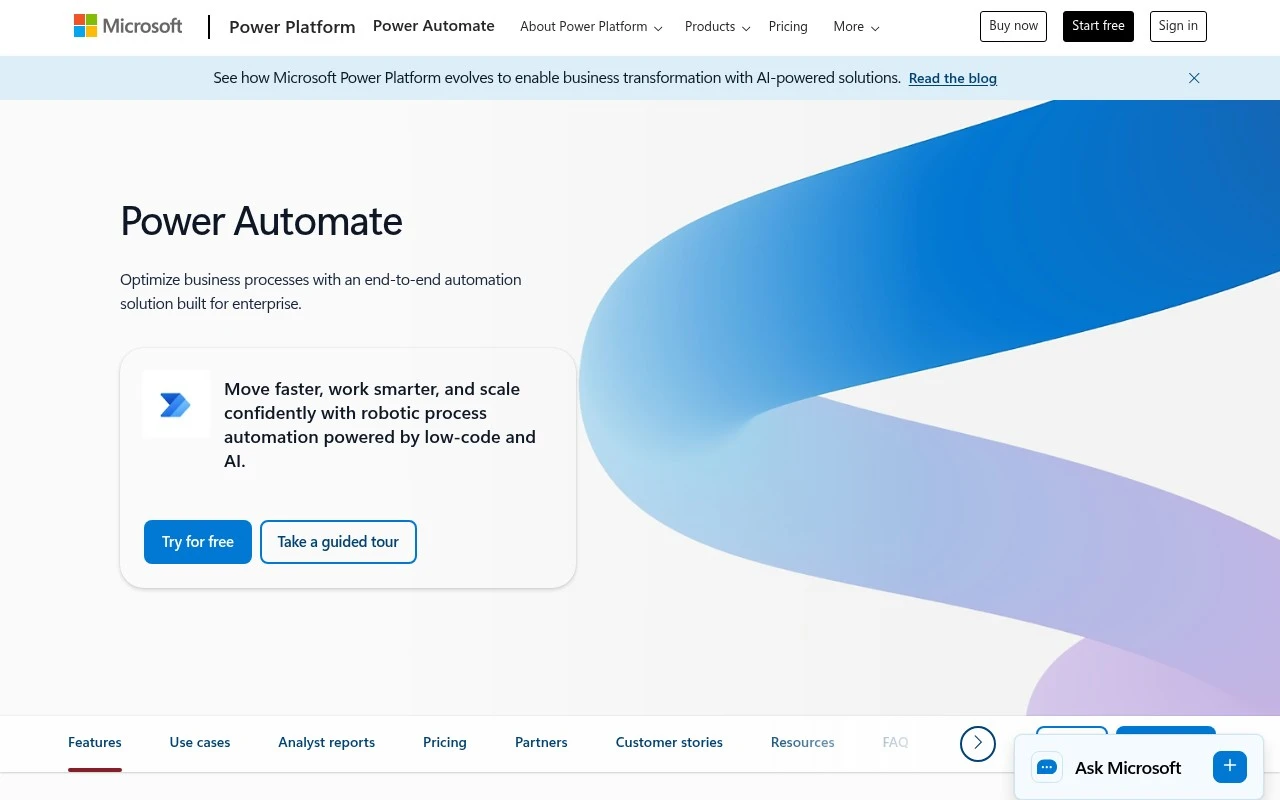
Microsoft Power Automate is Microsoft’s enterprise automation product within the Power Platform. It supports digital process automation, robotic process automation, approvals, document processing, process mining, and orchestration across more than 1,000 connectors, Microsoft 365 apps, custom APIs, desktop applications, and websites. It is aimed at organizations that want low-code automation with enterprise governance, monitoring, and AI assistance through Copilot.

FYAI Score

8.5 / 10

Based on 238 reviews

Pricing:

Freemium

Best for:

IT and operations teams standardizing workflows across Microsoft 365

Score Breakdown

  • Ease of use7.5 / 10
  • Features9.2 / 10
  • Pricing8.5 / 10
  • Integrations9.3 / 10
  • Support8.1 / 10

PRODUCT PREVIEW

What this AI tool does

Microsoft Power Automate is a workflow automation tool that helps connect apps and services so routine tasks can run automatically. It’s commonly used to move information between systems, trigger actions based on events, and reduce manual steps in everyday processes. In practice, it can support scenarios like sending notifications when a form is submitted, saving email attachments to cloud storage, or updating records across business tools. Workflows can be built with pre-made connectors and templates, and can be adjusted as requirements change. This tool is typically used by both technical and non-technical users who want to standardize repeatable processes and improve reliability. It’s most useful when you need consistent, trackable automation across the apps your team already relies on.

Use cases

Best for

Workflow Automation

Automate approvals and recurring business processes by triggering flows from Microsoft 365 events and routing tasks with conditions.

Document Automation

Extract fields from invoices and forms with AI Builder and route the results to SharePoint, Excel, or approval steps.

Integration Automation

Microsoft Power Automate syncs data between apps by connecting APIs and services and mapping fields across triggers and actions.

ANALYSIS

Strengths & limitations

Strengths
  • Combines cloud workflow automation, desktop RPA, process mining, and orchestration in one Microsoft platform.
  • Integrates natively with Microsoft 365 apps such as Teams, Excel, SharePoint, OneDrive, and Power BI, plus a large connector ecosystem.
  • Includes enterprise-oriented controls such as managed environments, data loss prevention, monitoring, governance, attended and unattended RPA, and hosted RPA options.
Limitations
  • Advanced use often depends on Microsoft ecosystem knowledge, connector configuration, licensing choices, and administrative governance.
  • Premium connectors, unattended automation, process licensing, and enterprise-scale scenarios can add cost beyond basic usage.
  • RPA automations for desktop apps and websites may require maintenance when user interfaces, credentials, or application behavior change.

Evaluation

FYAI score breakdown

Our structured evaluation across five key criteria

8.5 / 10

Overall score

Based on 238 reviews

  • Ease of use7.5 / 10
  • Features9.2 / 10
  • Pricing8.5 / 10
  • Integrations9.3 / 10
  • Support8.1 / 10

What users say

Findings from public reviews, documentation and community sources.

  • Ease of use

    Capterra lists Microsoft Power Automate at 4.4/5 across 238 reviews, with one user describing it as a “Great tool for automating repetitive business processes” and another calling it “Promising, but Terrible UI.”

  • Features

    Microsoft's Power Automate features page describes Power Automate as an “end-to-end automation solution” covering AI features, desktop flows/RPA, cloud flows/DPA, and task and process mining.

  • Pricing

    Microsoft's pricing page lists a 30-day free trial, Power Automate Premium at €13.00 user/month, Process at €130.00 bot/month, and Hosted Process at €186.30 bot/month, with plan inclusions compared on the page.

  • Integrations

    Microsoft's Power Automate features page states that users can choose from “more than 1,000 API connectors” or create a “custom API connector,” and it references native Microsoft 365 experiences such as Teams, Excel, and SharePoint.

  • Support

    Microsoft's Power Automate product navigation includes “Documentation,” “Power Automate Support,” and “Power Automate Community.”

Who is this for?

Best for Microsoft 365 teams automating business processes, Microsoft's Power Automate features page references native Microsoft 365 experiences such as Teams, Excel, and SharePoint, plus “more than 1,000 API connectors.” Less suited to teams that want the lowest-cost bot-based automation, Microsoft's pricing page lists Process at €130.00 bot/month and Hosted Process at €186.30 bot/month.

PRODUCT PREVIEW

Feature highlights

1,000+ connectors

Automate across Microsoft 365, SaaS apps, custom APIs, and data.

RPA desktop flows

Automate legacy apps and websites with attended or unattended RPA.

Governance & monitoring

Control access, audit runs, and monitor automation at scale.

COMPARE

Discover curated alternatives worth comparing

Compare similar AI tools based on features, pricing and use cases

9.0/ 10Based on 3.056 reviews

Zapier

Workflow AutomationIntegration Automation
Connects apps to automate multi-step workflows and actions
Best for:
Operations teams
Pricing
Freemium

8.6/ 10Based on 779 reviews

Workato

Workflow AutomationIntegration Automation
Orchestrates workflows across business apps via MCP integrations
Best for:
IT & Security teams
Pricing
Free trial

8.9/ 10Based on 7.771 reviews

Uipath

Workflow AutomationIntegration Automation
Automates workflows with AI agents, robots, and document processing
Best for:
Operations teams
Pricing
Freemium

Join thousands of teams automating busywork with Microsoft Power Automate. Start streamlining approvals, alerts, and handoffs today so your team can focus on higher-value work.

FAQ

Frequently asked
questions

Everything you need to know about this AI tool,
its features, pricing, use cases, and limitations.

What types of automation is Microsoft Power Automate a good fit for?
Microsoft Power Automate is strongest for workflow automation across Microsoft 365, SharePoint, Teams, Outlook, and Dynamics 365, especially for approvals, notifications, and data sync. It’s also a solid choice when you need many prebuilt connectors and want business users to build flows with minimal code. If you need highly custom orchestration, complex branching at scale, or heavy developer-centric CI/CD, you may find other platforms more flexible.
What’s the difference between Microsoft Power Automate’s free capabilities and paid plans?
Most real-world use requires paid licensing because premium connectors (many non-Microsoft services) and higher-capacity features are typically not included in basic entitlements. Some Microsoft 365 plans include limited Power Automate use for standard connectors, but advanced scenarios often require per-user, per-flow, or pay-as-you-go licensing. When comparing tools, map your needed connectors and run volume to the licensing model to avoid surprises.
How does Microsoft Power Automate compare with Zapier, Make, and UiPath?
Compared with Zapier and Make, Microsoft Power Automate usually wins for Microsoft ecosystem integration, governance, and enterprise administration, but can be less straightforward for lightweight cross-app automations. Versus UiPath, Power Automate is generally better for API- and SaaS-based workflows, while UiPath often leads for advanced desktop RPA and complex automation engineering. Your choice typically hinges on whether you prioritize Microsoft-native workflows, broad consumer app automation, or deep RPA.
How quickly can a team get Microsoft Power Automate running in production?
Advanced customization can be constrained compared to developer-first automation platforms, especially for complex logic, testing, and versioning workflows. Costs can rise with premium connectors, high run volumes, or scaling across many users and environments. Performance and reliability are often tied to connector behavior and external system limits, so mission-critical flows may require careful design and monitoring.
What should we know about data privacy, residency, and compliance with Microsoft Power Automate?
Microsoft Power Automate runs within the Microsoft cloud and inherits many Microsoft compliance offerings, but your actual posture depends on tenant settings, region, and which connectors you use. Data can traverse third-party services when using external connectors, so review each connector’s data handling and ensure DLP policies restrict sensitive data movement. For regulated workloads, validate audit logging, retention, and environment governance against your organization’s compliance requirements.