Curated ToolThis tool is part of our curated AI directory. We only include tools that meet our standards for relevance, usability and real-world value.

Automation Anywhere

Automation Anywhere is a robotic process automation platform for building, deploying, and managing software bots that automate repetitive business processes across applications. It supports cloud-based bot development, process discovery, document processing, and orchestration for attended and unattended automation.
Workflow AutomationIntegration Automation

FYAI Score

8.4 / 10

Based on 5,598 reviews

Pricing:

Freemium

Best for:

Enterprise automation teams modernizing mission-critical processes

Score Breakdown

  • Ease of use8.3 / 10
  • Features8.8 / 10
  • Pricing7.5 / 10
  • Integrations8.8 / 10
  • Support9.0 / 10

PRODUCT PREVIEW

What this AI tool does

Automation Anywhere is an enterprise automation platform that combines AI agents, robotic process automation, workflow orchestration, document automation, integration automation, and governance for large-scale business processes. It is designed for organizations that want to automate mission-critical work across departments rather than only speed up isolated desktop tasks. The platform’s current story is built around agentic process automation, where software bots and AI agents can reason over work, use enterprise systems, and operate within controlled business rules. For large organizations, Automation Anywhere is a tool for turning repetitive, rule-based, and data-heavy operations into managed digital workflows. It is especially relevant to IT, finance, healthcare, financial services, manufacturing, customer operations, and shared services teams that need automation to be secure, auditable, and repeatable. The emphasis is not just on building bots, but on running automation as an enterprise capability. At the center of the platform is the combination of classic RPA and newer AI-driven execution. Traditional bots can handle structured tasks such as moving data between applications, completing forms, reconciling records, or performing RPA browser automation. AI agents extend that model by interpreting context, working with unstructured information, and coordinating multi-step processes that previously required more human judgement. Workflow automation gives the platform its broader operating shape. Instead of treating each bot as a standalone script, teams can connect people, systems, approvals, documents, and exceptions into end-to-end processes. This matters for complex work such as invoice processing, employee onboarding, claims handling, service desk triage, revenue operations, and compliance reviews, where a single task is only one part of a larger business flow. Document-heavy operations are another important part of the Automation Anywhere story. The platform can be used to extract, classify, validate, and route information from invoices, forms, claims, contracts, emails, and other business documents. When paired with human review and governance, document automation becomes a way to reduce manual entry while keeping sensitive decisions under control. Integration automation helps the platform connect older systems, modern cloud applications, internal databases, and user interfaces that may not have clean APIs. This is one reason Automation Anywhere is often used in enterprises with mixed technology environments. Bots can work through user interfaces when needed, while integrations and orchestration can create more resilient connections where systems allow it. Governance is one of the defining themes of the platform. Automation Anywhere is built for enterprises that need role-based access, monitoring, auditability, credential controls, lifecycle management, and policy enforcement around automation. That makes it suitable for regulated and high-volume environments where automation must be trustworthy, not just fast. Pre-built AI agents and industry-specific solutions position the tool beyond a blank automation canvas. Teams can start from patterns for functions such as IT operations, finance processes, healthcare administration, banking workflows, and manufacturing support. These packaged starting points help organizations move from individual productivity gains toward standardized automation programs. Business users and technical teams can both participate, but the platform is most powerful when automation is treated as a collaboration between operations experts, developers, automation centers of excellence, and risk owners. Low-code and no-code design tools help non-developers contribute process knowledge, while professional developers can handle integrations, complex logic, and enterprise architecture. This balance is important because many business processes are too domain-specific to be automated well by IT alone. The character of Automation Anywhere is enterprise-grade rather than lightweight personal automation. It is best at structured, repeatable, high-value processes where scale, compliance, and orchestration matter. For organizations building a long-term automation strategy, Automation Anywhere provides a framework for combining RPA, AI agents, workflow automation, and governance into a managed operating layer for business work.

Use cases

Best for

Workflow Automation

Automate end to end business workflows by orchestrating AI agents and RPA bots with approvals, schedules, and governance controls.

Document Automation

Use Automation Anywhere to extract fields from invoices and forms with AI document processing, then validate and route the data to systems.

Integration Automation

Connect apps by triggering automations from APIs, queues, and events, and syncing data between ERP, CRM, and ITSM platforms.

ANALYSIS

Strengths & limitations

Strengths
  • Best suited to large enterprises because it combines AI agents, RPA, workflow orchestration, and governance in one platform for complex business processes.
  • Strong fit for regulated and mission-critical operations because its positioning emphasizes secure, governed end-to-end automation at enterprise scale.
  • Useful for established automation teams because industry-specific solutions and pre-built AI agents can accelerate work in functions such as IT, finance, healthcare, financial services, and manufacturing.

Limitations
  • Less suitable for small teams or simple task automation because the enterprise platform scope can be heavier than they need.
  • The freemium model is best for evaluation because large-scale deployment, governance, and advanced enterprise usage typically require paid plans.
  • Implementation can require significant process analysis, integration work, and change management because the platform targets cross-functional enterprise workflows rather than isolated automations.

Evaluation

FYAI score breakdown

Our structured evaluation across five key criteria

8.4 / 10

Overall score

Based on 5,598 reviews

  • Ease of use8.3 / 10
  • Features8.8 / 10
  • Pricing7.5 / 10
  • Integrations8.8 / 10
  • Support9.0 / 10

What users say

Findings from public reviews, documentation and community sources.

  • Ease of use

    G2 summarizes Automation Anywhere as “easy to use,” says it “integrates well with other tools,” and notes reliable performance for larger workflows. Software Advice notes AA 360 is “easy to install, use & implement.”

  • Features

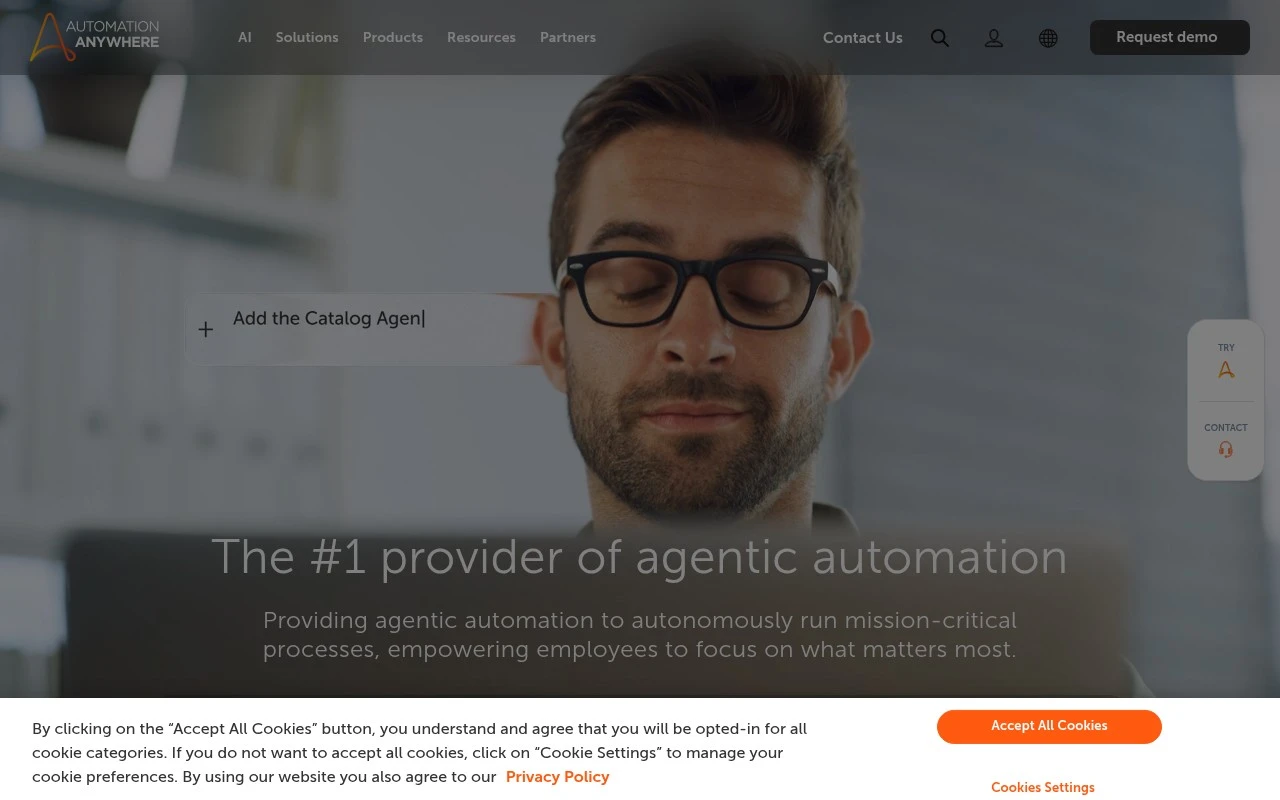
    Automation Anywhere’s homepage positions the product as an enterprise agentic process automation platform combining “AI, Automation, and RPA” for “secure end-to-end enterprise” automation. Automation Anywhere’s homepage references a Process Reasoning Engine, pre-built AI agents, industry solutions, and governance/trust certifications.

  • Pricing

    Software Advice lists Automation Anywhere with a starting price of “$9,000.00 per year” and also lists “Free Trial” and “Free Version.”

  • Integrations

    Automation Anywhere describes its integrations as a “robust ecosystem of pre-built connectors, packaged APIs, and iPaaS integrations” for real-time action and data across systems. G2 summarizes that Automation Anywhere “integrates well with other tools.”

  • Support

    Automation Anywhere’s homepage quotes a customer saying Automation Anywhere had “excellent support” for architecture, design, and user interface. Automation Anywhere’s homepage also quotes “good community support.”

Who is this for?

Best for enterprises automating larger workflows, G2 notes reliable performance for larger workflows, and Automation Anywhere’s homepage positions the platform for “secure end-to-end enterprise” automation. Less suited to buyers seeking fully self-serve pricing, Software Advice lists a starting price of “$9,000.00 per year,” and the provided pricing note says the buying motion is more sales-led than fully self-serve pricing.

PRODUCT PREVIEW

Feature highlights

Agentic automation

Deploy AI agents to execute complex processes with human-in-loop.

RPA + orchestration

Build bots and orchestrate workflows across apps, teams, and systems.

Enterprise governance

Centralized controls, audit trails, and security for regulated ops.

COMPARE

Discover curated alternatives worth comparing

Compare similar AI tools based on features, pricing and use cases

9.0/ 10Based on 3,056 reviews

Zapier

Workflow AutomationIntegration Automation
Connects AI agents to apps, automates workflows, adds IT control
Best for:
Operations teams
Pricing
Freemium

8.6/ 10Based on 779 reviews

Workato

Workflow AutomationIntegration Automation
Connects AI agents to business apps, automates MCP workflows
Best for:
IT & Security teams
Pricing
Free trial

8.9/ 10Based on 7,771 reviews

Uipath

Workflow AutomationIntegration Automation
Automates workflows, extracts data, orchestrates AI agents
Best for:
Operations teams
Pricing
Freemium

See why teams choose Automation Anywhere to eliminate busywork, cut errors, and scale operations faster. Start automating high-volume processes across your business today.

FAQ

Frequently asked
questions

Everything you need to know about this AI tool,
its features, pricing, use cases, and limitations.

Who is Automation Anywhere best suited for?
Automation Anywhere is best suited for large enterprises that need governed automation across mission-critical business processes. It fits operations, finance shared services, IT service management, healthcare, financial services, and manufacturing teams that want to combine RPA bots, AI agents, workflow orchestration, and compliance controls at scale.
Does Automation Anywhere have a free plan, and what do paid plans add?
Automation Anywhere uses a freemium pricing model, allowing some users to start before committing to a larger enterprise deployment. Paid usage is typically more relevant for scaled automation programs that need broader orchestration, governance, security controls, support, and production deployment across teams and systems.
How does Automation Anywhere compare with other workflow automation tools?
Automation Anywhere is more enterprise automation platform than lightweight workflow automation tool. Compared with simpler tools, it is designed for RPA browser automation, document automation, integration automation, AI-assisted process automation, and centralized governance across complex business systems. The right choice depends on scale, compliance needs, and implementation resources.
How quickly can a team get started with Automation Anywhere?
The main trade-off with Automation Anywhere is that it is built for enterprise automation programs, not just small teams seeking a simple workflow tool. Buyers may need a demo or technical review to understand implementation details, agentic workflow design, deployment options, and the total effort required.
How should buyers evaluate Automation Anywhere for data privacy and compliance?
Automation Anywhere is positioned for regulated and complex enterprise environments, with references to certifications and compliance support such as ISO, SOC, HIPAA, and HITRUST. Buyers handling sensitive data should still validate current certifications, data residency options, access controls, audit logging, and responsible AI governance requirements before deployment.