Curated ToolThis tool is part of our curated AI directory. We only include tools that meet our standards for relevance, usability and real-world value.

Winston AI

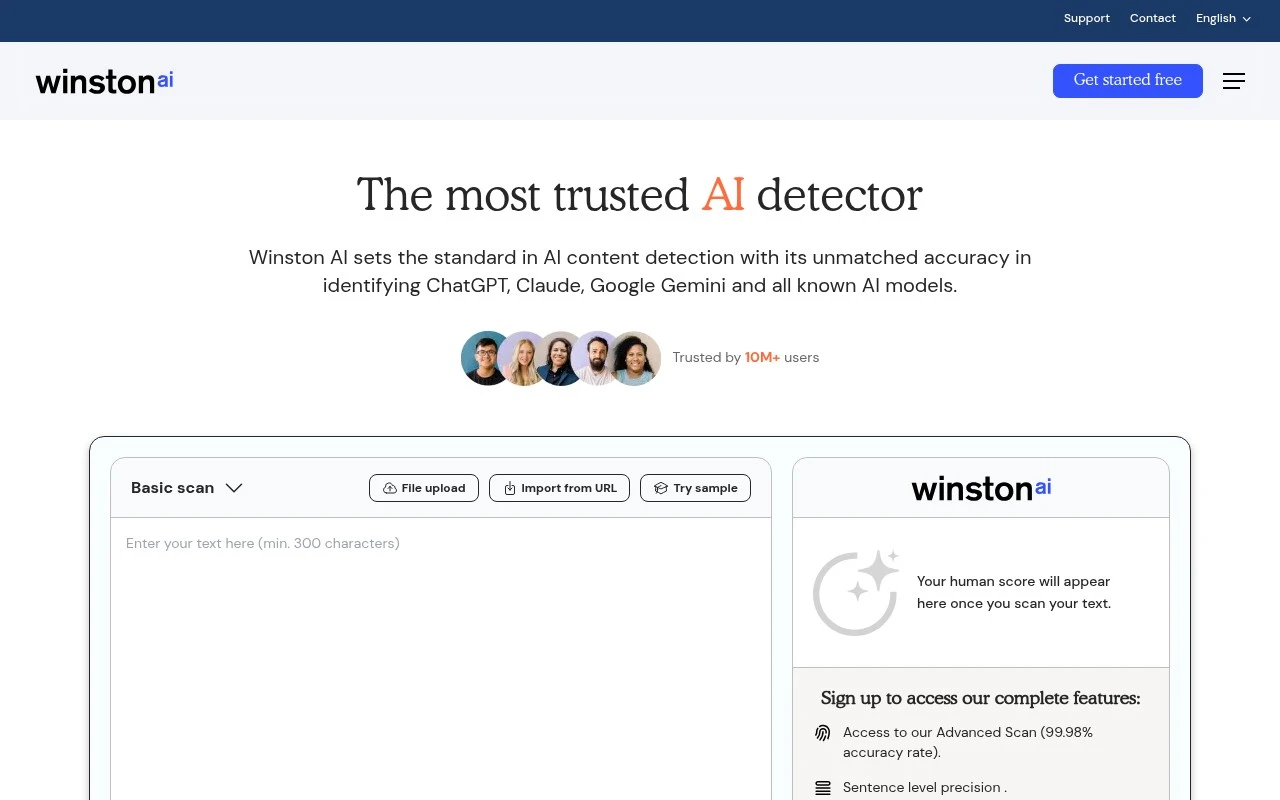
Winston AI is an AI content detection platform that analyzes text to identify whether it was likely generated by AI models. It also supports plagiarism checking and OCR-based document scanning for educators, publishers, and content teams.
Writing & Copy

FYAI Score

8.2 / 10

Based on 34 reviews

Pricing:

Freemium

Best for:

Educators and editors verifying originality in student and web content

Score Breakdown

  • Ease of use7.8 / 10
  • Features7.9 / 10
  • Pricing8.5 / 10
  • Integrations8.8 / 10
  • Support8.4 / 10

PRODUCT PREVIEW

What this AI tool does

Winston AI is an AI content detector and plagiarism checker for educators, publishers, agencies, and businesses that need to assess whether text was likely written by a human or generated by models such as ChatGPT, Claude, Google Gemini, Llama, and other AI systems. The platform is built around content integrity, combining AI detection, plagiarism analysis, and report generation in a workflow that can be used for academic, editorial, and professional review. For teachers and academic teams, the tool provides a way to evaluate student submissions with more context than a simple pass or fail result. Winston AI presents a human and AI likelihood score, then supports that score with sentence-level prediction mapping so reviewers can see which parts of a document appear more suspicious. This makes it useful for institutions that want to guide decisions with evidence rather than rely on a single abstract percentage. At the center of the experience is readability for non-technical users. A reviewer can paste text, upload documents, or process images through OCR, which helps when assignments, scans, screenshots, or mixed-format files need to be checked. Multilingual detection also broadens its relevance beyond English-only workflows, especially for schools, publishers, and international teams handling content in several languages. Winston AI is best at turning AI detection into an inspectable review process, where the score, highlighted passages, plagiarism findings, and supporting report can be shared or archived. Its shareable reports are particularly important in environments where a decision may need to be explained to a student, editor, client, or internal stakeholder. Instead of treating detection as a private result on a screen, the platform creates documentation that can support a repeatable review process. Content teams can use the platform as part of quality control before publishing. In editorial and SEO workflows, the goal is often not to punish the use of AI, but to understand the origin and reliability of a piece of writing before it goes live. By combining AI detection with plagiarism checking, the tool helps reviewers look for both synthetic text patterns and unattributed source overlap in one place. Integrations make Winston AI practical for teams that do not want a separate, isolated checking tool. The Chrome Extension supports quick checks in the browser, while Google Classroom integration aligns with school workflows. WordPress, Zapier, and API access extend the platform into publishing pipelines, automation systems, and custom internal tools where detection needs to happen at scale. Compared with a basic text classifier, the product feels positioned as a verification layer for organizations that need process, records, and collaboration. The value is not only that it predicts whether content may be AI-generated, but that it packages the result into a format people can review, discuss, and act on. That makes it relevant for classrooms, editorial desks, compliance-oriented teams, and agencies managing work from many contributors. In practice, Winston AI serves as a content authenticity workspace rather than a standalone score generator. It helps users move from suspicion to structured evaluation by combining model detection, plagiarism analysis, OCR-based document handling, multilingual coverage, and shareable reporting. For teams facing a steady flow of AI-assisted writing, Winston AI provides a focused way to review content with more consistency and transparency.

Use cases

Best for

AI Text Scanning

Scan pasted text, uploaded files, images, or a URL to detect AI generated writing in the content.

Sentence Level Reports

Review sentence level AI detection highlights and export a shareable report for academic, editorial, or client review.

Plagiarism and Originality Check

Winston AI checks text for plagiarism and originality while also providing AI detection results in the same workflow.

ANALYSIS

Strengths & limitations

Strengths
  • Well suited to educators and publishers because it combines AI likelihood scoring, plagiarism checking, sentence-level mapping, and shareable reports in one review workflow.
  • Useful for varied submission formats because document uploads, image uploads with OCR, and multilingual detection reduce manual preparation before checking content.
  • Fits teams that need originality checks inside existing workflows because it offers integrations such as Chrome Extension, Google Classroom, WordPress, Zapier, and API access.

Limitations
  • Less suitable for decisions that require definitive proof of authorship because AI detection scores are probabilistic and still need human review, context, and clear policy.
  • Less suitable for teams that mainly need writing generation or editing because its core scope is detection, plagiarism review, and originality assessment rather than content creation.
  • Less suitable for high-volume teams trying to stay on free tools because the freemium model makes sustained document checking and advanced workflow needs more likely to require a paid plan.

Evaluation

FYAI score breakdown

Our structured evaluation across five key criteria

8.2 / 10

Overall score

Based on 34 reviews

  • Ease of use7.8 / 10
  • Features7.9 / 10
  • Pricing8.5 / 10
  • Integrations8.8 / 10
  • Support8.4 / 10

What users say

Findings from public reviews, documentation and community sources.

  • Ease of use

    The Winston AI homepage presents a paste-and-scan workflow with a sample scanner, “Get started free,” “No credit card required,” and “Get your results in seconds.” The Winston AI homepage supports text paste, file upload, and URL import as input paths.

  • Features

    The Winston AI homepage lists “Advanced Scan,” “Sentence level precision,” “Plagiarism Checker,” and “Writing Feedback.” The Winston AI homepage also references OCR for documents/images, multilingual detection, AI image/deepfake detection, shareable reports, and team features.

  • Pricing

    The Winston AI pricing page lists a Free plan, Essential at “$10 / month” annually or “$18 / month” monthly, Advanced at “$16 / month” annually or “$29 / month” monthly, and Elite at “$26 / month” annually or “$49 / month” monthly. The Winston AI pricing page explains usage via credits, including “AI detection 1 credit per word” and monthly credit limits.

  • Integrations

    The Winston AI homepage lists “Chrome Extension,” “Google Classroom,” “WordPress,” “Zapier,” and “API” as workflow connections. The Winston AI homepage names Zapier as an integration option.

  • Support

    The Winston AI pricing page includes “Email and Chat support” across plans, including the Free tier. Trustpilot includes a Winston AI snippet that notes a “1-day response policy.”

Who is this for?

Best for educators, publishers, and teams checking originality, Winston AI supports text paste, file upload, URL import, “Plagiarism Checker,” shareable reports, and team features. Less suited to users who need a full copy-generation suite, the listed capabilities focus on AI detection, plagiarism checking, writing feedback, OCR, and integrity workflows rather than copy generation.

PRODUCT PREVIEW

Feature highlights

AI Content Detection

Get a human vs AI likelihood score for any text in seconds.

Sentence-Level Map

See which lines look AI-written with clear, visual predictions.

OCR File Checks

Upload docs or images and scan text via OCR for AI and plagiarism.

COMPARE

Discover curated alternatives worth comparing

Compare similar AI tools based on features, pricing and use cases

7.4/ 10Based on 5 reviews

Chapterly

Copy OptimizationBlog & Article Writing
Refines narrative, characters, and settings for authors
Best for:
Content creators
Pricing
Freemium

7.7/ 10Based on 5,772 reviews

Writesonic

Copy Optimization
Surfaces answer-engine visibility and citation gaps for GEO fixes
Best for:
Marketing teams
Pricing
Freemium

7.6/ 10Based on 266 reviews

Writehuman

AI Detection & Humanizing
Rewrites AI drafts, scans naturalness and detection signals
Best for:
Content creators
Pricing
Freemium

Create on-brand content faster and with more confidence. See why teams choose Winston AI to keep quality high while scaling output.

FAQ

Frequently asked
questions

Everything you need to know about this AI tool,
its features, pricing, use cases, and limitations.

Who is Winston AI best suited for?
Winston AI is best suited for educators, publishers, SEO teams, writers, and organizations that need to assess whether written content is likely human-written, AI-generated, plagiarized, or partially synthetic. It is useful before grading, publishing, accepting submissions, or sending client-facing content for review.
Is Winston AI free, and what do you get with the paid plans?
Winston AI uses a freemium model, with a limited free lite scan and more complete functionality available after signup. The free scan is limited to 2,000 characters and English-only detection, while advanced options such as file uploads, URL import, full assessment, plagiarism checking, and extended analysis require a paid or registered plan.
How does Winston AI compare with other AI detection tools?
Winston AI stands out by combining AI detection, plagiarism checking, sentence-level analysis, OCR, URL import, file uploads, reporting, integrations, and API access in one workflow. Similar tools may focus more narrowly on detection or plagiarism, so the better choice depends on content volume, review process, budget, and reporting needs.
How quickly can a team start using Winston AI?
Winston AI’s main limitation is that AI detection results are likelihood scores, not definitive proof of authorship. Reviewers should treat the results as decision support and examine sentence-level findings, plagiarism indicators, context, and submission history before taking action, especially in academic, HR, legal, or disciplinary settings.
What should buyers check about Winston AI privacy and compliance?
Buyers should review Winston AI’s current data handling, retention, security, and compliance terms before using it with student work, unpublished manuscripts, client content, or confidential documents. Institutions and businesses should confirm who can access submitted content, how reports are stored, and whether the workflow meets their internal privacy requirements.