Curated ToolThis tool is part of our curated AI directory. We only include tools that meet our standards for relevance, usability and real-world value.

Writesonic

Writesonic is an AI writing platform that helps create marketing copy, blog posts, product descriptions, ads, and other business content from user prompts. It also includes chatbot and content optimization features for drafting and refining web-focused text.
Copy Optimization

FYAI Score

7.7 / 10

Based on 5,772 reviews

Pricing:

Freemium

Best for:

Marketing and SEO teams improving AI search visibility and brand mentions

Score Breakdown

  • Ease of use8.2 / 10
  • Features7.4 / 10
  • Pricing7.4 / 10
  • Integrations7.3 / 10
  • Support8.2 / 10

PRODUCT PREVIEW

What this AI tool does

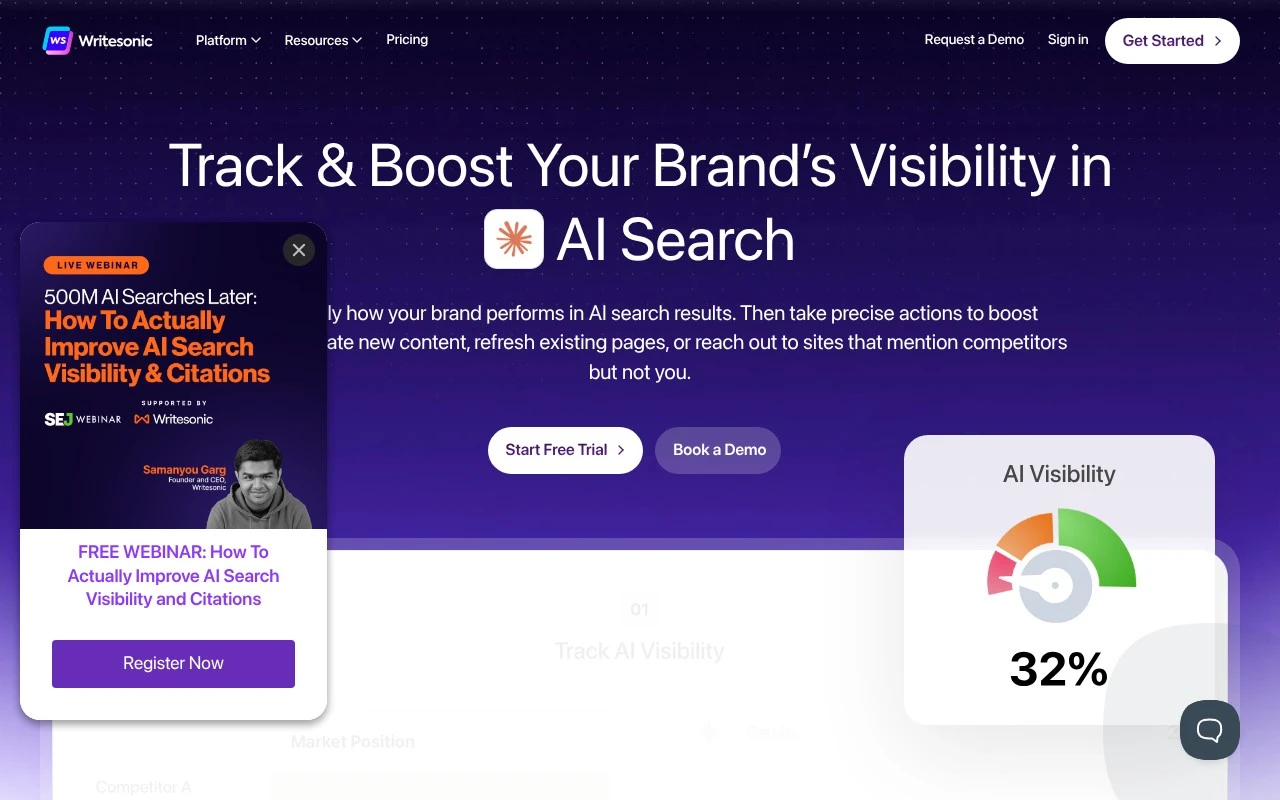
Writesonic is an AI Search Growth Engine for marketing teams, SEO teams, agencies, and brands that want to understand and improve how they appear in AI-generated answers. It is built around the shift from traditional search results to answer engines, where buyers increasingly ask ChatGPT, Gemini, Perplexity, Claude, and similar systems for recommendations, comparisons, and explanations. The platform’s core purpose is to make AI visibility measurable, diagnosable, and actionable. For teams used to ranking reports and keyword dashboards, the problem Writesonic addresses is a new one. A brand may be present on Google yet absent from AI responses, or mentioned in a way that is incomplete, outdated, or less favorable than competitors. The platform monitors these answer environments so teams can see where their brand appears, how often it is cited, which competitors are being surfaced, and what sources shape the answer. AI search visibility tracking is central to the product story. Instead of treating AI answers as a black box, the platform gives marketers a way to observe recurring prompts, brand mentions, sentiment, share of voice, citations, and competitive positioning across AI search and answer engines. This makes it useful for companies that need evidence before investing in generative engine optimization or answer-engine optimization work. Writesonic is best at connecting visibility intelligence with execution, rather than stopping at reporting. It helps teams move from the question, “Why are we missing from AI answers?” to a prioritized set of content, citation, and technical improvements. That connection matters because AI search optimization is not only about publishing more pages, but also about improving the signals that answer engines use to understand, trust, and reference a brand. A typical workflow begins with discovering where a brand is underrepresented or misrepresented. The platform can surface content gaps, weak topical coverage, citation opportunities, and competitor advantages that explain why another company is being recommended more often. Content gap analysis becomes part of a broader visibility strategy, where the goal is not just organic traffic but inclusion in the answers people actually read. Execution support is where the tool’s heritage as an AI writing and content platform still shows. It can help teams produce or improve content intended to answer buyer questions, strengthen topical authority, and align pages with the language used in AI-generated responses. The emphasis is on making content more useful, structured, and discoverable for both search engines and AI answer systems. Technical and citation optimization broaden the scope beyond copywriting. The platform’s positioning recognizes that answer engines rely on source quality, entity clarity, structured information, and repeated signals across the web. For brands, this means AI visibility may depend on clearer brand facts, better source coverage, stronger third-party mentions, and pages that are easier for AI systems to interpret. Agencies and growth teams can use Writesonic to manage AI visibility as an ongoing program. The competitive view is especially relevant for clients and stakeholders because it translates a vague concern, “Are we showing up in AI?”, into measurable share of voice and prioritized recommendations. That makes the platform fit naturally into SEO, content strategy, digital PR, and brand monitoring workflows. The broader character of the platform is strategic rather than purely generative. It is not only a place to draft content, and it is not only an analytics dashboard. It sits between measurement and action, helping teams understand how AI systems perceive their market and then shape the content, citations, and technical signals that can improve that perception. Writesonic is most relevant for organizations that believe AI-generated answers will influence discovery, evaluation, and purchase decisions. Its value is strongest when a team needs to monitor AI search visibility, benchmark competitors, identify gaps, and coordinate improvements across content and SEO operations. In that sense, the platform represents a newer category of growth software, built for the era in which being recommended by an AI assistant can matter as much as ranking on a traditional results page.

Use cases

Best for

AI Search Visibility Tracking

Tracks how often and how favorably your brand appears in AI answers, and benchmarks visibility against competitors over time.

Generative Engine Optimization

Writesonic identifies missing citations, content gaps, and technical issues that reduce AI answer inclusion, then prioritizes fixes to execute.

AI Search Optimization

Surfaces AI visibility issues and provides workflows for content, citation, and technical updates to improve inclusion in AI-generated results.

ANALYSIS

Strengths & limitations

Strengths
  • Best suited to marketing and SEO/GEO teams that need to understand brand presence in AI-generated answers, because it connects visibility monitoring with competitor comparisons.
  • Useful for prioritizing GEO work because it surfaces visibility and citation gaps and turns them into concrete optimization opportunities.
  • Strong fit for teams that want reporting and execution in one workflow because it supports content, citation, and technical optimization activities.

Limitations
  • Less suitable for teams that only need basic copywriting because its current focus is broader AI search visibility and GEO optimization rather than simple content drafting alone.
  • Less suitable as a complete replacement for a full SEO, analytics, or earned media stack because it focuses specifically on AI answer visibility and related optimization workflows.
  • The freemium model can be limiting for agencies or larger teams managing many brands because deeper monitoring and workflow capacity typically require a paid plan.

Evaluation

FYAI score breakdown

Our structured evaluation across five key criteria

7.7 / 10

Overall score

Based on 5,772 reviews

  • Ease of use8.2 / 10
  • Features7.4 / 10
  • Pricing7.4 / 10
  • Integrations7.3 / 10
  • Support8.2 / 10

What users say

Findings from public reviews, documentation and community sources.

  • Ease of use

    A Reddit reviewer described Writesonic as “solid for outlines, quick drafts, and ideation,” and another Reddit summary said Writesonic helps writers with “writer’s block” and “specific content formats.” The same Reddit summary frames Writesonic as a drafting assistant rather than a publish-ready system.

  • Features

    The Writesonic product page says Writesonic can “track” visibility across AI platforms, prioritize fixes through an “Action Center,” rewrite pages for GEO, and add “FAQ blocks” and “comparison tables.” The Writesonic product page also lists AI articles and site audits.

  • Pricing

    The Writesonic pricing page publishes Starter at “$79” per month billed annually, Basic at “$199,” Growth at “$399,” and Enterprise custom. The Writesonic pricing page states “Start free. No credit card needed.”

  • Integrations

    The Writesonic pricing page says lower tiers track “ChatGPT, Gemini, Google AI Overviews,” while Enterprise covers “All 10 AI platforms.” The Writesonic pricing page lists “Looker Studio & other integrations” and SSO/SAML for Enterprise.

  • Support

    The Writesonic pricing page lists “Standard email support” for Starter and Basic and “Priority email support” for Growth. The Writesonic pricing page lists an “AI search strategist” and “dedicated strategy team” for Enterprise.

Who is this for?

Best for content teams focused on AI search visibility, the Writesonic product page says it can “track” visibility across AI platforms, prioritize fixes through an “Action Center,” and rewrite pages for GEO. Less suited to users who only need low-cost drafting help, the pricing page lists Starter at “$79” per month billed annually, while the Reddit summary frames Writesonic as a drafting assistant rather than a publish-ready system.

PRODUCT PREVIEW

Feature highlights

AI Visibility Tracking

Monitor how often and how well your brand appears in AI answers.

GEO/AEO Priorities

See the highest-impact fixes to improve AI search growth faster.

Optimization Workflows

Execute content, citation, and technical updates to boost visibility.

COMPARE

Discover curated alternatives worth comparing

Compare similar AI tools based on features, pricing and use cases

7.4/ 10Based on 5 reviews

Chapterly

Copy OptimizationBlog & Article Writing
Refines narrative, characters, and settings for authors
Best for:
Content creators
Pricing
Freemium

8.8/ 10Based on 846 reviews

Yoast SEO

Content & On-pageTechnical & Audit
Optimizes SEO titles, descriptions, and product content
Best for:
SEO teams
Pricing
Freemium

8.1/ 10Based on 1,124 reviews

Yext

SEO MonitoringAI Search / GEO
Publishes verified business data, tracks AI and search discovery
Best for:
SEO teams
Pricing
Paid

Join thousands of marketers writing high-converting copy in minutes. Start creating on-brand content faster with Writesonic today.

FAQ

Frequently asked
questions

Everything you need to know about this AI tool,
its features, pricing, use cases, and limitations.

Who is Writesonic best suited for?
Writesonic is best suited for marketing, SEO, GEO, earned media, and agency teams responsible for how a brand appears in AI-generated answers. Its strongest fit is tracking visibility, citations, and sentiment across answer engines, then prioritizing content, citation, and technical fixes.
Does Writesonic have a free plan, and what are the limits?
Writesonic uses a freemium pricing model, so some access is available before moving to paid usage. Teams should expect paid plans to matter when they need broader tracking, more workflows, or operational use across markets and platforms. Check writesonic.com for the current plan limits.
How does Writesonic compare with other AI search optimization tools?
Writesonic is positioned around AI search visibility and generative engine optimization rather than only traditional SEO reporting or general AI writing. It competes with tools that track brand presence in answer engines, identify citation gaps, and support optimization workflows. The best choice depends on platform coverage, reporting needs, budget, and team structure.
How hard is it to set up Writesonic for AI search visibility tracking?
Writesonic is strongest for teams with an active marketing or SEO program, not casual users looking only for basic writing help. Buyers should verify which AI visibility, content, citation, and technical workflows are included, because its current positioning differs from its older reputation as a general AI writing tool.
What should teams check about data privacy and compliance before using Writesonic?
Teams should review Writesonic’s current privacy, security, and compliance terms before connecting sensitive brand, website, or performance data. Important checks include data retention, access controls, subprocessors, AI model handling, regional requirements, and whether the platform supports the compliance standards required by the organization.