AthenaHQ
Curated ToolThis tool is part of our curated AI directory. We only include tools that meet our standards for relevance, usability and real-world value.

AthenaHQ

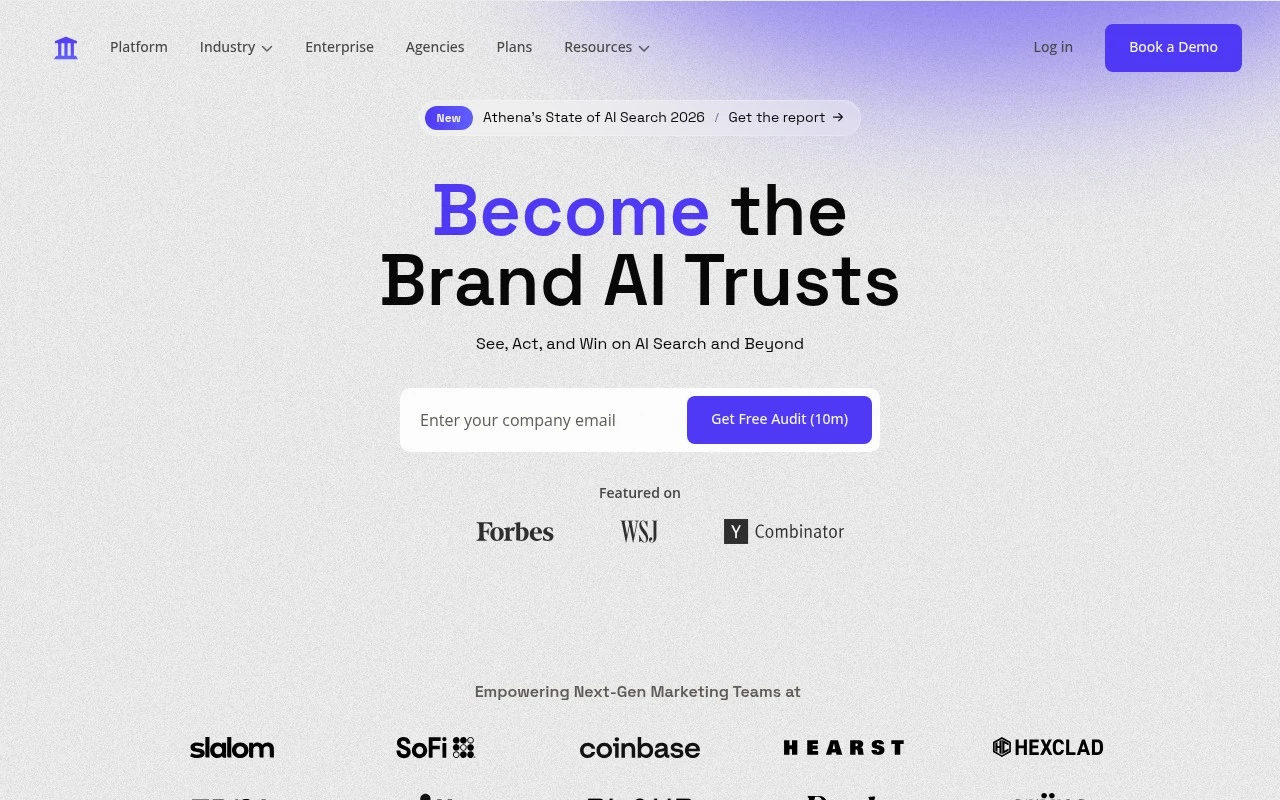
AthenaHQ is an ai search optimization platform that helps brands monitor and improve how they appear in AI-generated answers across search and answer engines. It tracks visibility, citations, and competitor presence to guide content and authority improvements.
Content & On-pageAI Search / GEO

FYAI Score

8.5 / 10

Based on 47 reviews

Pricing:

Freemium

Best for:

Enterprise SEO, PR, and brand teams improving AI search visibility

Score Breakdown

  • Ease of use8.3 / 10
  • Features8.8 / 10
  • Pricing8.1 / 10
  • Integrations8.8 / 10
  • Support8.8 / 10

PRODUCT PREVIEW

What this AI tool does

AthenaHQ
AthenaHQ is an AI search optimization and generative engine optimization platform for commercial and enterprise marketing teams that need to understand how their brand appears in AI-generated answers. AthenaHQ is designed for organizations that want to become trusted, cited sources inside AI search experiences, not just rank in traditional search results. Its core story is about giving brand, SEO, content, PR, and communications teams a clearer view of how generative answer engines interpret their company, category, competitors, and expertise. For marketing leaders, the problem AthenaHQ addresses is visibility in a search environment where the answer may be synthesized rather than clicked. Buyers increasingly ask AI platforms for recommendations, comparisons, summaries, and vendor shortlists, and the brands cited in those answers gain an important new form of authority. The platform helps teams move from guessing what AI systems are saying to monitoring those answers systematically. AI search visibility tracking sits at the center of the product. The platform monitors how a brand appears across major AI platforms and answer engines, giving teams a way to see whether they are mentioned, cited, ignored, or misrepresented in relevant prompts and category queries. This makes AthenaHQ useful for organizations that need evidence of their presence in generative search, especially in competitive B2B, technology, healthcare, finance, and other high-consideration markets. Citation analysis is one of the areas where the tool becomes especially practical. Instead of treating an AI answer as a black box, AthenaHQ helps teams examine which sources are being used to support responses and where their own content is missing from the evidence layer. That matters because improving AI visibility is often less about publishing more pages and more about becoming a clearer, more credible source for the topics that matter. Content gap analysis connects the monitoring layer with action. When the platform finds that competitors are being cited more often, or that answer engines rely on third-party sources instead of owned content, teams can identify where their site, thought leadership, documentation, research, or PR coverage may need strengthening. AthenaHQ is best at turning AI search observations into practical recommendations for content, SEO, PR, and brand strategy. Competitor analysis gives the product a broader strategic role. Teams can compare how their brand is framed against rivals, where competitors are receiving more visibility, and which topics are shaping the AI-generated narrative in their market. In categories where buyers ask AI tools for vendor comparisons or shortlist advice, this kind of insight can influence both positioning and demand generation. Sentiment analysis adds another layer by helping organizations understand not only whether they appear, but how they are described. A brand may be visible in AI answers while still being framed in a limited, outdated, or unfavorable way. By surfacing tone, themes, and recurring language, the platform helps teams decide whether the issue is content, reputation, messaging, or source quality. Report generation makes the platform more usable for cross-functional teams. AI visibility is relevant to executives, SEO teams, communications leads, and product marketers, but each group needs a different level of detail. Reporting helps translate monitoring and analysis into shareable evidence, making it easier to track progress and justify work across content, PR, and digital strategy. Unlike general SEO tools, the platform is not positioned primarily around keyword rankings, backlinks, or creator workflows. Its focus is AEO and GEO for organizations that care about how AI systems summarize their market and choose which sources to trust. AthenaHQ fits best when a company already has a serious marketing operation and needs a dedicated way to manage its presence in generative answer environments. Teams evaluating AthenaHQ pricing are likely to be comparing it with enterprise SEO, brand intelligence, and digital visibility platforms rather than lightweight content tools. The value proposition is strongest for organizations where AI search visibility can affect pipeline, reputation, analyst perception, or category leadership. In that context, AthenaHQ functions as an intelligence layer for the new search landscape, helping teams measure where they stand and decide what to improve next.

Use cases

Best for

Generative Engine Optimization

AthenaHQ monitors brand mentions and citations in AI answers, then surfaces content gaps for AEO and GEO work.

Competitor Analysis

AthenaHQ compares AI answer visibility, citations, and source coverage across competing brands.

Sentiment Analysis

It analyzes AI-generated brand mentions to flag positive, neutral, or negative framing in answers.

ANALYSIS

Strengths & limitations

Strengths
  • Strong fit for AI search teams because it tracks brand visibility, mentions, citations, and competitors across 11+ major LLM and AI search platforms.
  • Useful for action-oriented marketing teams because it combines monitoring with content gap analysis, citation source analysis, optimization recommendations, and AI-focused PR workflows.
  • Relevant for leadership reporting because it includes executive dashboards, ROI tracking, competitive intelligence summaries, and board-ready AI visibility reporting.

Limitations
  • Less suitable for teams that only need traditional SEO rank tracking because AthenaHQ is focused on AI search visibility, LLM citations, and generative answer coverage.
  • Less suitable for very early-stage brands with little content authority because the workflow depends on improving cited sources, content depth, and brand presence that AI systems can recognize.
  • Less suitable for teams that need guaranteed coverage of niche or proprietary AI systems because the listed coverage centers on major AI platforms, with additional models handled by request.

Evaluation

FYAI score breakdown

Our structured evaluation across five key criteria

8.5 / 10

Overall score

Based on 47 reviews

  • Ease of use8.3 / 10
  • Features8.8 / 10
  • Pricing8.1 / 10
  • Integrations8.8 / 10
  • Support8.8 / 10

What users say

Findings from public reviews, documentation and community sources.

  • Ease of use

    AthenaHQ describes its AEO/GEO Manager view as a “Command Center” for “End-to-end GEO workflow management.” AthenaHQ says the product replaces “manual tracking across scattered tools” with a “Unified command center for all GEO activities.”

  • Features

    AthenaHQ lists “Cross-platform AI visibility tracking (11+ LLMs),” “Automated content optimization recommendations,” “Citation source analysis and link building,” and brand sentiment monitoring.

  • Pricing

    The AthenaHQ pricing page lists a Free plan with “$25 free credit” and “300 credits,” a Starter plan at “$295/month” with “3,600 credits,” and custom Enterprise pricing. The AthenaHQ pricing page says “API access and extra credits are optional add-ons billed on top of the Starter subscription,” with add-on pricing handled via contact.

  • Integrations

    The AthenaHQ integrations page lists Google Analytics, Search Console, WordPress, Shopify, ChatGPT, Claude, and MCP. The AthenaHQ pricing page also names GA4/GSC, Shopify/Webflow, BI tools such as “Tableau, Power BI, Looker,” and API access as an add-on.

  • Support

    The AthenaHQ pricing page includes “Dedicated Slack channel,” “2-hour SLA,” “White-glove setup and enablement,” and a “Certified GEO/SEO Specialist.”

Who is this for?

Best for teams managing AEO/GEO across multiple workflows, with AthenaHQ describing its AEO/GEO Manager as a “Command Center” for “End-to-end GEO workflow management.” Less suited to teams that need Starter pricing to include API access, because the AthenaHQ pricing page says “API access and extra credits are optional add-ons billed on top of the Starter subscription.”

PRODUCT PREVIEW

Feature highlights

AI Search Optimization

Monitor brand visibility across leading generative answer engines

Content Gap Analysis

See which topics, sources, and pages can earn more AI citations

Competitor Reporting

Generate reports on share of voice, citations, and sentiment trends

COMPARE

Discover curated alternatives worth comparing

Compare similar AI tools based on features, pricing and use cases

8.7/ 10Based on 1,129 reviews

Profound

AI Search / GEO
Monitors AI search visibility, flags gaps, drafts campaigns
Best for:
Marketing teams
Pricing
Enterprise

8.8/ 10Based on 846 reviews

Yoast SEO

Content & On-pageTechnical & Audit
Optimizes SEO titles, descriptions, and product content
Best for:
SEO teams
Pricing
Freemium

8.1/ 10Based on 1,124 reviews

Yext

SEO MonitoringAI Search / GEO
Publishes verified business data, tracks AI and search discovery
Best for:
SEO teams
Pricing
Paid

AthenaHQ

See why marketing teams choose AthenaHQ to grow trusted visibility in AI answers and turn generative search into a measurable brand channel.

FAQ

Frequently asked
questions

Everything you need to know about this AI tool,
its features, pricing, use cases, and limitations.

Who is AthenaHQ best suited for?
AthenaHQ is best suited for commercial and enterprise marketing teams that need to track and improve how their brand appears in AI-generated answers. It is especially relevant for AEO, GEO, SEO, PR, content, brand, and agency teams managing mentions, citations, recommendations, sentiment, competitors, and executive reporting.
Does AthenaHQ have a free plan?
AthenaHQ uses a freemium pricing model, so teams can expect some level of free access with paid options for broader or more advanced use. Buyers should review AthenaHQ’s current pricing details on athenahq.ai to confirm limits around platform coverage, reporting, workflows, users, and enterprise features.
How does AthenaHQ compare with other AI search visibility tools?
AthenaHQ competes in the AI search optimization and generative engine visibility category, with a focus on brand mentions, citations, recommendations, competitors, sentiment, and reporting across major AI platforms. The right choice depends on whether a team needs AI answer tracking, traditional SEO rank tracking, PR monitoring, or executive-level performance reporting.
How much setup work does AthenaHQ require?
AthenaHQ is likely to require initial setup around brands, competitors, target topics, reporting needs, and the AI platforms a team wants to monitor. Marketing teams should plan for onboarding time to align tracked queries, citation sources, content gaps, and executive dashboards with their internal AI search optimization goals.
What are the main limitations of AthenaHQ?
AthenaHQ is less suitable for teams that only need traditional SEO rank tracking because its core focus is AI search visibility and LLM answer coverage. It may also be less useful for very early-stage brands with limited content authority, or teams that require guaranteed coverage of niche or proprietary AI systems.
What should buyers check about AthenaHQ’s data privacy and compliance?
Buyers should confirm AthenaHQ’s current data handling, privacy, security, and compliance terms directly with the vendor before using it for sensitive brand or competitive intelligence workflows. Enterprise teams should ask about user access controls, data retention, vendor subprocessors, audit requirements, and how uploaded or monitored business data is protected.