Curated ToolThis tool is part of our curated AI directory. We only include tools that meet our standards for relevance, usability and real-world value.

Yext

Manages verified business data for search and AI discovery.

SEO MonitoringAI Search / GEO
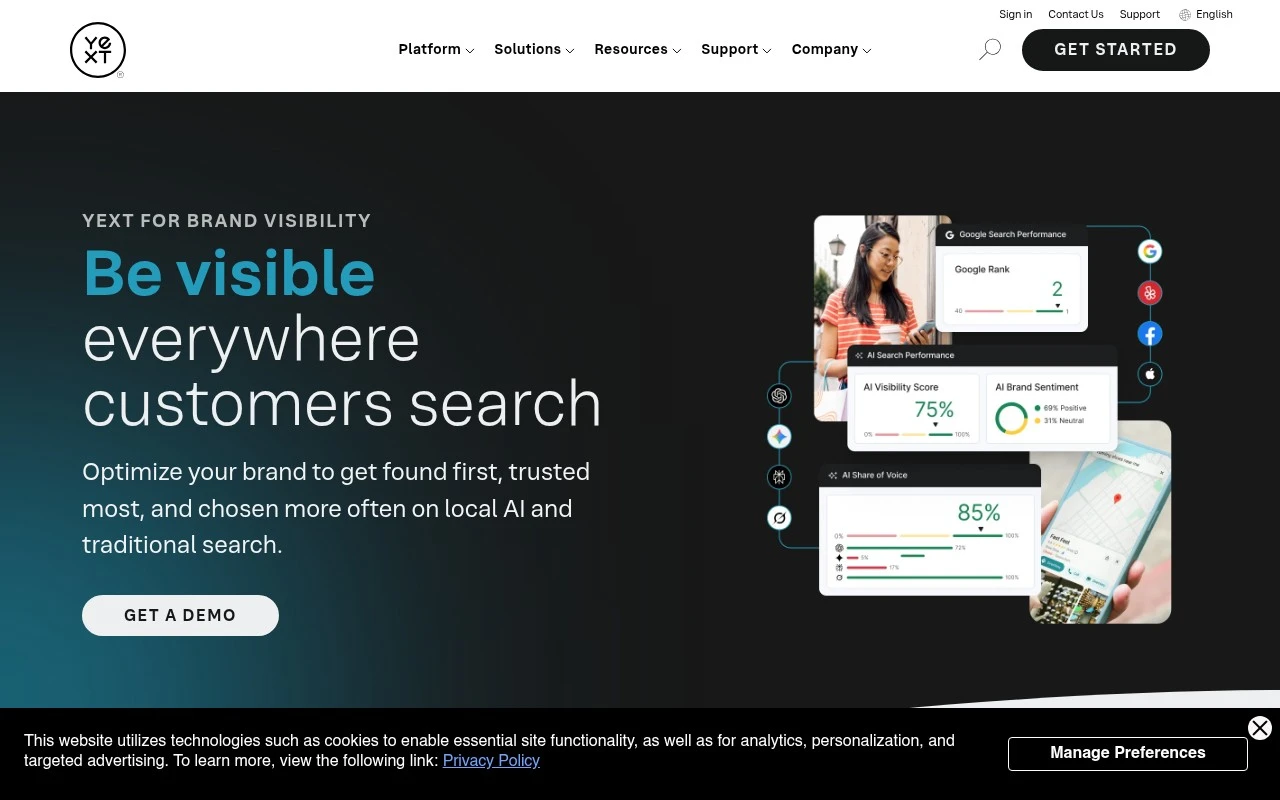
Yext provides a platform for enterprises to organize verified brand data and use it across listings, local pages, reviews, social content, website search, and AI discovery channels. Its current positioning emphasizes “agentic marketing”: using structured data, visibility intelligence, and distribution to help brands control what customers and AI systems find about them across many locations and touchpoints.

FYAI Score

8.1 / 10

Based on 1.124 reviews

Pricing:

Paid

Best for:

Enterprise multi-location brands managing listings, reviews, and AI discovery

Score Breakdown

  • Ease of use7.1 / 10
  • Features8.9 / 10
  • Pricing7.6 / 10
  • Integrations9.4 / 10
  • Support7.7 / 10

PRODUCT PREVIEW

What this AI tool does

Yext is a platform used by organizations to manage how their business information appears across online channels. It helps keep details like names, addresses, phone numbers, hours, and other key facts consistent, which can reduce confusion for customers and support accurate discovery in search and map experiences. Teams often use it to coordinate updates across many locations or brands, monitor where information is published, and respond when listings or pages need corrections. It can also support workflows for maintaining location data over time, making it easier to keep public-facing information aligned with internal records.

Use cases

Best for

Local SEO

Sync verified location data to Google, Apple, and directories, and publish local pages to keep NAP consistent for local SEO.

Competitor Analysis

Use Yext Visibility Intelligence to compare your listings, reviews, and local presence against competitors across search and directory sites.

Rank Tracking

Track local search rankings for each location and keyword over time, and monitor changes after listing or page updates.

ANALYSIS

Strengths & limitations

Strengths
  • Strong fit for enterprises that need consistent location data across many external publishers, maps, directories, review platforms, and AI/search channels.
  • Combines data management, visibility monitoring, reputation tools, local pages, social publishing, and website search in one platform rather than treating them as isolated tasks.
  • Distinct focus on verified Knowledge Graph data as the foundation for AI search visibility and agent-driven content or distribution workflows.
Limitations
  • The official positioning is enterprise-oriented, so it may be more platform than a small business or single-location organization needs.
  • Best suited to brands with structured location, advisor, branch, or service data; teams without that complexity may not benefit from the full platform.
  • The public page makes broad claims about AI visibility and competitive intelligence, but implementation details, pricing, and measurable results would need vendor review.

Evaluation

FYAI score breakdown

Our structured evaluation across five key criteria

8.1 / 10

Overall score

Based on 1.124 reviews

  • Ease of use7.1 / 10
  • Features8.9 / 10
  • Pricing7.6 / 10
  • Integrations9.4 / 10
  • Support7.7 / 10

What users say

Findings from public reviews, documentation and community sources.

  • Ease of use

    A Reddit discussion describes Yext as giving users “a dashboard that keeps listings consistent across all the…”

  • Features

    Yext’s website lists “Listings,” “Knowledge Graph,” “Reviews,” and Scout for AI search visibility and competitor monitoring. Yext’s website says the platform helps manage “verified data, visibility insights, and direct distribution.”

  • Pricing

    TrustRadius lists “Emerging,” “Essential,” “Complete,” and “Premium,” with Emerging “Billed at $199 Annually” and Essential “Billed at $449 Annually.”

  • Integrations

    Yext’s integrations page describes “apps, connectors, and data sources,” “MCP and API access,” and a “global network of 200+ third-party publishers including Google, Apple, Amazon Alexa, and Bing.” Yext’s integrations page names Salesforce, Freshdesk, Drupal, and Google Looker Studio.

  • Support

    Yext’s website navigation includes “Help Center,” “Documentation,” and “Guides.” Yext describes Documentation as a “one-stop-shop for getting started guides, product reference and API docs.”

Who is this for?

Best for teams that need centralized listings and AI search visibility work, Yext’s website lists “Listings” and Scout for AI search visibility and competitor monitoring. Yext is less suited to buyers who need a simple universal public rate card. TrustRadius lists “Emerging,” “Essential,” “Complete,” and “Premium,” while enterprise pricing is handled through packages rather than a simple universal public rate card.

PRODUCT PREVIEW

Feature highlights

Brand Data Graph

Centralize verified location and brand facts for consistent accuracy.

Listings Distribution

Publish updates across major directories and maps from one place.

Visibility Intelligence

Track search presence and spot issues impacting local and AI discovery.

COMPARE

Discover curated alternatives worth comparing

Compare similar AI tools based on features, pricing and use cases

8.8/ 10Based on 846 reviews

Yoast SEO

Content & On-pageTechnical & Audit
Generates and optimizes SEO titles, descriptions, and content
Best for:
SEO teams
Pricing
Freemium

7.7/ 10Based on 5.772 reviews

Writesonic

Copy Optimization
Monitors brand visibility in answer engines and flags citation gaps
Best for:
Marketing teams
Pricing
Freemium

8.2/ 10Based on 22 reviews

Whitespark

SEO MonitoringLocal SEO
Local SEO tools for citation building, rank tracking, and audits
Best for:
SEO teams
Pricing
Paid

Join brands improving local visibility with trusted business info everywhere. Start driving more calls, visits, and leads with Yext today.

FAQ

Frequently asked
questions

Everything you need to know about this AI tool,
its features, pricing, use cases, and limitations.

When is Yext a good fit, and when should I pick a different local SEO tool?
Yext is a strong fit for multi-location brands that need consistent business data (hours, categories, attributes) pushed to many directories and want centralized review monitoring. It’s less compelling if you only manage one location, don’t need broad directory coverage, or your priority is link building and content-led SEO rather than listings. If your market has low local search volume, the ROI can be harder to justify versus lighter-weight tools.
Does Yext have a free plan, and what do you lose without a paid subscription?
Yext is typically sold as a paid subscription, and any free access is usually limited to demos or trials rather than an ongoing free tier. Without a subscription, you generally won’t get automated syncing of listings across the network or ongoing suppression of duplicate/inaccurate data. Budget alternatives may offer cheaper citation management but with fewer integrations or less control.
How does Yext compare with BrightLocal, Moz Local, and Semrush Local for listings management?
Yext is often chosen for enterprise-scale listing distribution and tighter control over data updates across a large publisher network. BrightLocal tends to be more cost-effective for agencies and SMBs, with strong reporting and citation services, while Moz Local is simpler but may have narrower workflow depth. Semrush Local can be attractive if you already use Semrush for broader SEO, but Yext may offer more mature listings governance for complex location footprints.
How quickly can I get Yext live, and what onboarding effort should I expect?
Cost is a common sticking point for smaller businesses compared with DIY or lower-priced listing tools. Some users find the platform’s breadth adds complexity, and you may need process discipline to keep location data accurate. Also, if local competition is low, the incremental benefit of broad directory syncing can be limited.
What should I know about Yext data handling, privacy, and compliance before purchasing?
Yext primarily manages business location data and may process customer-generated content like reviews, so you should confirm what data types are stored and how long they’re retained. For regulated industries, ask about access controls, audit logs, and whether Yext supports your requirements for GDPR/CCPA workflows and data subject requests. Also verify how data is shared with third-party publishers and what happens to listings if you end the subscription.