Curated ToolThis tool is part of our curated AI directory. We only include tools that meet our standards for relevance, usability and real-world value.

Chapterly

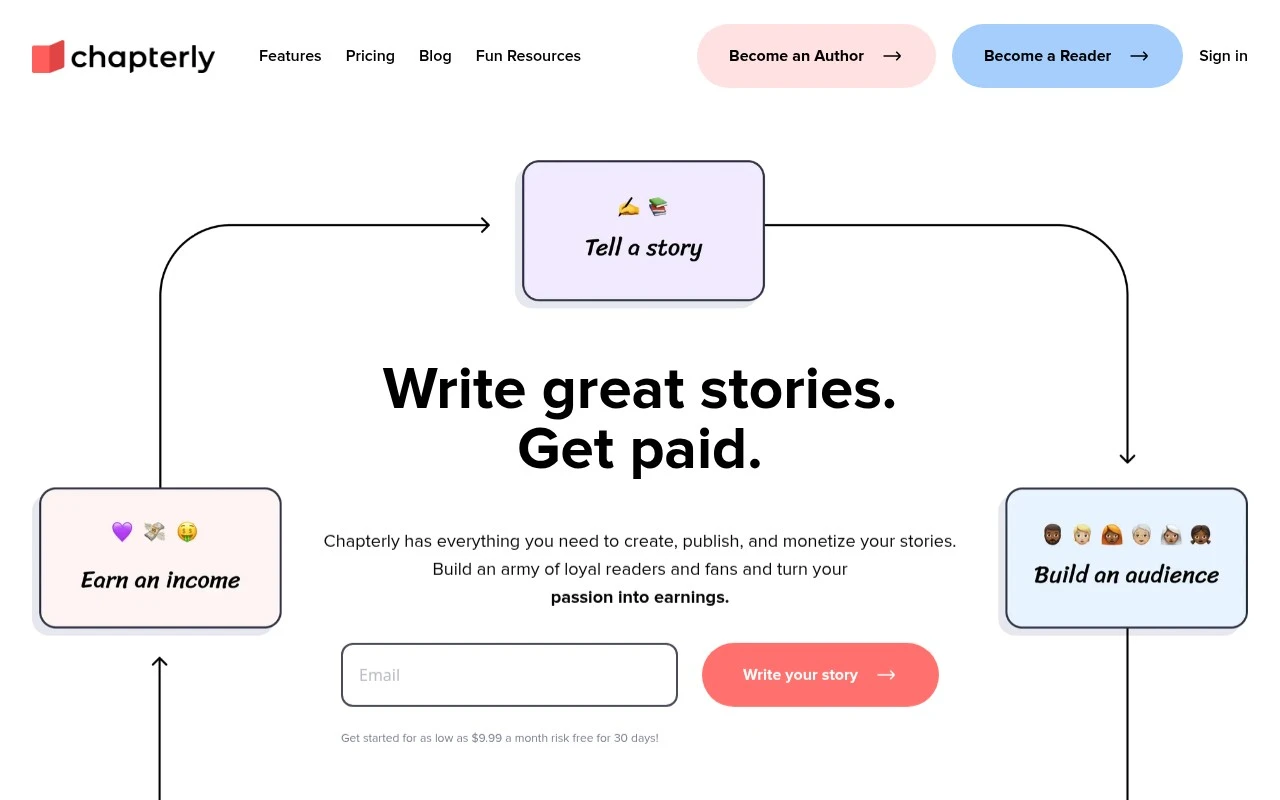
Chapterly is an AI-assisted writing platform for authors to plan, draft, and revise books. It supports manuscript organization with outlining, chapter management, and guided content generation.
Copy OptimizationBlog & Article Writing

FYAI Score

7.4 / 10

Based on 5 reviews + FYAI product analysis

Pricing:

Freemium

Best for:

Fiction authors publishing and monetizing serialized stories and books

Score Breakdown

  • Ease of use7.1 / 10
  • Features7.4 / 10
  • Pricing8.1 / 10
  • Integrations7.1 / 10
  • Support7.2 / 10

PRODUCT PREVIEW

What this AI tool does

Chapterly is a subscription-based writing, publishing, and monetization platform for authors who want one place to draft stories, prepare books, reach readers, and earn from their work. Chapterly is built around the full lifecycle of authorship, from long form content creation and story development to reader engagement and sales, rather than treating writing as a standalone document-editing task. For authors managing multiple projects, the platform functions as a structured creative workspace. It supports project syncing and backups, which helps writers move between devices and protect ongoing manuscripts without relying on scattered files. Import support also makes it easier to bring existing drafts into the app, so the platform can fit into an author’s current workflow rather than requiring a clean start. Its AI assistant, Chap, is designed to help with the storytelling process rather than replace the author. Writers can use Chap to refine scenes, improve pacing, develop characters, and rewrite content when a passage needs a different tone or clearer flow. The value of this approach is that AI support sits close to the manuscript, where it can help shape creative decisions while leaving authors in control of the final voice. Publishing is a central part of the product story. Chapterly gives authors a route to share stories and books with readers from within the same environment where they write and revise. This makes the platform especially relevant for serialized fiction writers, independent novelists, and creators who want a direct connection between production and publication. Reader engagement is also part of how the platform positions itself. Instead of focusing only on file creation or manuscript formatting, it connects writing with an audience experience through features that support discovery, following, and ongoing reader relationships. For authors building a readership over time, that connection can be as important as the writing tools themselves. Monetization gives Chapterly a commercial layer for creators who want to earn from their stories. The platform supports revenue through tips, subscriptions, and book sales, giving authors several ways to turn reader interest into income. This makes it more than a writing app, since it combines creative production with creator-economy mechanics. Ownership matters in any publishing platform, and Chapterly states that authors retain copyright to their work. That position is important for writers who want to use hosted tools and AI-assisted editing while preserving control over their intellectual property. It helps frame the platform as an author service rather than a rights-acquisition model. In practice, Chapterly is best suited to writers who want a combined writing studio, AI storytelling assistant, publishing channel, and monetization system. It is not merely a place to type chapters, it is a platform for building a writing practice around drafts, revisions, readers, and revenue. For authors who prefer an integrated environment over a patchwork of separate apps, it offers a focused path from idea to published work.

Use cases

Best for

Long Form Content Creation

Use Chapterly to draft and organize long form stories in synced projects with backups and import support across devices.

Rewrite Content

Use Chap, Chapterly’s AI assistant, to rewrite passages by refining tone, pacing, and dialogue while keeping your plot intact.

ANALYSIS

Strengths & limitations

Strengths
  • Best suited to independent fiction authors because it combines drafting, publishing, reader engagement, and monetization in one workflow.
  • Helpful for writers who want AI-assisted refinement because Chap focuses on narrative, characters, and settings while keeping the author in control of the manuscript.
  • Useful for authors managing ongoing projects because syncing, backups, and import support reduce friction when moving between writing and publishing tasks.

Limitations
  • Less suitable for writers who want an AI system to generate an entire book because Chapterly positions Chap as an assistant rather than a full manuscript-writing tool.
  • Less suitable for teams focused on marketing copy, technical documentation, or business content because the platform is built around stories, books, authors, and readers.
  • Less suitable for authors who want to avoid platform dependency because reader engagement and monetization are centered on Chapterly’s own publishing ecosystem.

Evaluation

FYAI score breakdown

Our structured evaluation across five key criteria

7.4 / 10

Overall score

Based on 5 reviews + FYAI product analysis

  • Ease of use7.1 / 10
  • Features7.4 / 10
  • Pricing8.1 / 10
  • Integrations7.1 / 10
  • Support7.2 / 10

What users say

Findings from public reviews, documentation and community sources.

  • Ease of use

    Chapterly says publishing is “incredibly easy” and stories can go live “with just a few clicks,” and Chapterly says its Windows, Mac, Android, and iOS apps sync projects across devices. On Reddit, one user said they were “not a fan of using chapterly to format and write my book.”

  • Features

    Chapterly’s homepage lists AI writing help via “Chap,” story creation, publishing, and monetization through “reader tips, subscriptions, and book sales.” Chapterly’s homepage also references imports, unlimited stories, cloud backup, and edit recovery.

  • Pricing

    Chapterly’s pricing page says pricing starts at “$9.99/mo +10% of the income you earn on Chapterly.” Chapterly’s pricing page also lists a 30-day risk-free trial and says all features are included for one subscription fee.

  • Integrations

    Chapterly’s homepage says the product is available on “Windows and Mac computers, and Android and iOS mobile devices.” Chapterly’s homepage also says projects sync across devices, existing stories can be imported, and writing is backed up to cloud storage.

  • Support

    Chapterly’s homepage includes a FAQ and directs users to a help center for more help. Chapterly’s homepage says cancellation is available “at any time with the click of a button,” and Trustpilot shows 2.6/5 from 5 reviews.

Who is this for?

Best for authors who want writing, publishing, and monetization in one workflow. Chapterly lists AI writing help via “Chap” and monetization through “reader tips, subscriptions, and book sales.” Less suited to authors avoiding revenue share, the pricing page says pricing starts at “$9.99/mo +10% of the income you earn on Chapterly.” Less suited to workflows built around external app automation, the cited connectivity centers on Windows, Mac, Android, and iOS apps, cross-device sync, imports, and cloud backup.

PRODUCT PREVIEW

Feature highlights

Chap AI Assistant

Refine plot, pacing, and character beats as you write.

Sync & Backups

Keep projects synced across devices with reliable backups.

Monetize Your Work

Earn via tips, subscriptions, and book sales—keep your copyright.

COMPARE

Discover curated alternatives worth comparing

Compare similar AI tools based on features, pricing and use cases

7.7/ 10Based on 5,772 reviews

Writesonic

Copy Optimization
Surfaces answer-engine visibility and citation gaps for GEO fixes
Best for:
Marketing teams
Pricing
Freemium

7.6/ 10Based on 266 reviews

Writehuman

AI Detection & Humanizing
Rewrites AI drafts, scans naturalness and detection signals
Best for:
Content creators
Pricing
Freemium

8.4/ 10Based on 126 reviews

Writer.com

Copy OptimizationAd & Sales Copy
Delegates content and business workflows to governed AI agents
Best for:
Marketing teams
Pricing
Freemium

Bring your team’s drafts, edits, and approvals into one smooth workflow. Start writing faster and publishing with confidence in Chapterly today.

FAQ

Frequently asked
questions

Everything you need to know about this AI tool,
its features, pricing, use cases, and limitations.

Who is Chapterly best suited for?
Chapterly is best suited for fiction writers, aspiring authors, and independent storytellers who want to write, publish, build an audience, and monetize in one platform. It fits serialized stories and book projects especially well, with tools for drafting, editing, reader engagement, tips, subscriptions, and book sales.
Does Chapterly have a free plan, and what do paid plans add?
Chapterly uses a freemium pricing model, so users can start with a free option and upgrade for additional platform access. Paid use is relevant for authors who need more complete writing, publishing, cloud sync, backup, and monetization capabilities. Current plan details should be checked directly on chapterly.com.
How does Chapterly compare with other writing and publishing tools?
Chapterly differs from many writing tools by combining drafting, publishing, audience-building, and monetization in one author-focused platform. Similar tools may focus more narrowly on manuscript writing, AI-assisted editing, or publishing workflows. The better choice depends on whether a writer needs a full reader community and revenue setup.
How hard is it to get started with Chapterly?
Chapterly’s main trade-offs are its subscription model, revenue share on monetization, and the limited role of its AI assistant. Chap is positioned as a collaborative writing helper for refining narrative, characters, and settings, not as a system that writes an entire book for the author.
Is Chapterly safe for storing unpublished writing?
Chapterly states that authors retain copyright and that it does not claim ownership of users’ writing. Writers storing unpublished manuscripts should still review Chapterly’s current privacy policy, terms, backup practices, and account security options, especially if they are handling commercially sensitive drafts or collaborative publishing projects.