Curated ToolThis tool is part of our curated AI directory. We only include tools that meet our standards for relevance, usability and real-world value.

TextCortex

TextCortex is an AI writing and knowledge assistant that supports drafting, rewriting, summarizing, and internal search across connected company documents and apps.
Writing & Copy

FYAI Score

8.6 / 10

Based on 872 reviews

Pricing:

Freemium

Best for:

Enterprise teams governing and deploying AI agents across the org

Score Breakdown

  • Ease of use8.8 / 10
  • Features8.6 / 10
  • Pricing7.7 / 10
  • Integrations9.3 / 10
  • Support8.6 / 10

PRODUCT PREVIEW

What this AI tool does

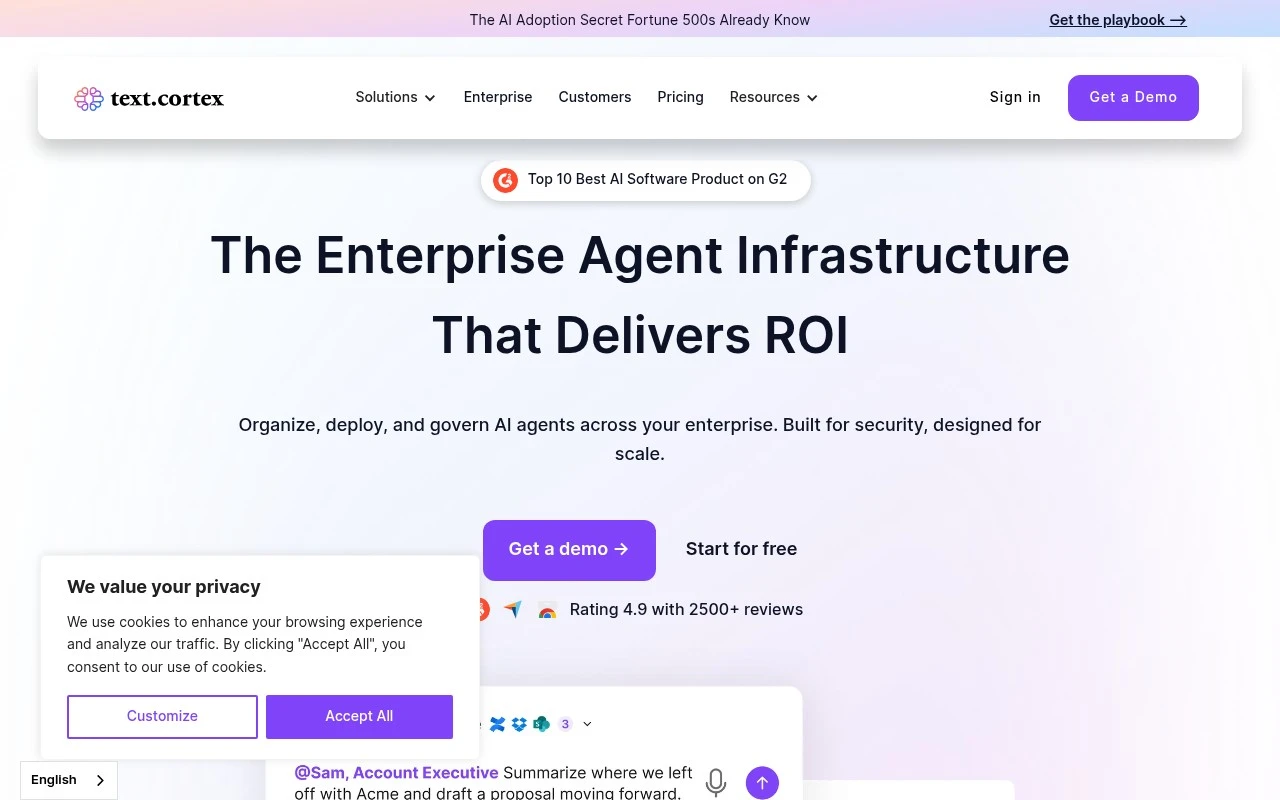
TextCortex is enterprise AI infrastructure for organizations that want to build, deploy, and govern AI agents on top of their internal knowledge and workplace workflows. Rather than presenting itself as another standalone chatbot, TextCortex focuses on giving teams a controlled environment where AI assistants can search company information, automate routine processes, and operate inside the tools employees already use. For enterprises dealing with scattered AI adoption, the platform addresses a familiar problem: employees are often experimenting with generic AI tools without shared controls, approved data access, or consistent output quality. TextCortex is designed for companies that want the benefits of generative AI while keeping model access, knowledge sources, and agent behavior under central oversight. At the center of the product is a no-code visual agent builder that lets business and operations teams create AI agents without needing to write software from scratch. This makes agent building more accessible to departments such as sales, support, HR, marketing, and internal operations, while still allowing technical teams to shape how agents connect to systems and follow company rules. Internal search is one of the platform’s defining ideas. TextCortex connects AI agents to internal knowledge so employees can ask questions across company documents, policies, wikis, and other approved sources instead of manually hunting through fragmented repositories. In practice, this turns knowledge base search into a conversational layer that can produce answers, summaries, and next steps grounded in organizational context. Workflow automation extends the product beyond question answering. Agents can be configured to handle repeatable tasks, trigger processes, and run on a schedule, which makes the platform relevant for teams that want AI to do more than draft text on request. The value is strongest when internal search and automation work together, for example when an agent retrieves the right policy, summarizes it for a requester, and initiates the next operational step. Governance is a major part of the TextCortex story. The platform is model-agnostic, giving organizations access to major AI models while avoiding dependence on a single provider or unmanaged employee accounts. This positioning matters for companies that need visibility into which models are used, how agents are deployed, and what information they can access. Deployment is built around existing workplace habits rather than forcing users into a separate destination. Agents can be made available through tools such as Slack, Microsoft Teams, and a browser extension, so employees can interact with approved AI assistance where work is already happening. This workplace integration helps make centralized AI feel less like a new portal and more like a shared capability across the organization. Compared with a simple writing assistant or generic chatbot subscription, TextCortex is broader and more infrastructure-oriented. Its purpose is not only to generate content, but to organize how AI agents are created, connected to internal knowledge, automated, and governed across a company. TextCortex is best at serving organizations that need a managed AI layer for internal search, workflow automation, and repeatable agent deployment. For buyers evaluating a TextCortex review or comparing TextCortex pricing with more basic AI tools, the key question is whether the organization needs centralized AI operations rather than individual productivity features. The platform makes the most sense when multiple teams need trusted access to company knowledge, reusable agents, and governance around model use. In that context, it is positioned less as a writing app and more as an enterprise control layer for practical AI adoption.

Use cases

Best for

Agent Building

Build and govern AI agents with TextCortex using a no code visual builder and model agnostic access to major LLMs.

Workflow Automation

Automate tasks by triggering agent workflows on schedules and deploying them in Slack, Teams, or the browser extension.

Internal Search

Search internal knowledge sources through connected enterprise search to ground agent responses in company content.

ANALYSIS

Strengths & limitations

Strengths
  • Centralized governance is a strong fit for mid-to-large organizations because teams can deploy AI agents without relying on scattered personal AI accounts.
  • The no-code visual builder helps non-developer teams create workflow-specific agents while still giving IT and AI transformation teams a central way to manage adoption.
  • Internal knowledge connections and workplace deployments make it useful for recurring knowledge-work workflows because agents can operate inside tools such as Slack, Teams, and the browser.

Limitations
  • Less suitable for individuals or small writing teams because its enterprise agent infrastructure and governance features are heavier than a simple copywriting assistant.
  • Broad organizational use will usually outgrow the freemium entry point because governance, integrations, and larger-scale deployment needs typically sit in paid usage.
  • Rollout requires upfront work on knowledge connections, workflow design, and governance policies, so teams without clear process owners may take longer to get practical results.

Evaluation

FYAI score breakdown

Our structured evaluation across five key criteria

8.6 / 10

Overall score

Based on 872 reviews

  • Ease of use8.8 / 10
  • Features8.6 / 10
  • Pricing7.7 / 10
  • Integrations9.3 / 10
  • Support8.6 / 10

What users say

Findings from public reviews, documentation and community sources.

  • Ease of use

    Capterra lists TextCortex at 4.7/5 from 237 reviews and highlights an “intuitive and user-friendly interface” that makes content generation “seamless and efficient.” TextCortex product pages emphasize no-code agent building.

  • Features

    The TextCortex pricing page lists “Model Hub,” “Knowledge Search,” “Data Analysis,” and custom agents. The TextCortex pricing page also references connectors, deep research, image generation, and enterprise controls.

  • Pricing

    The TextCortex pricing page lists a Free plan, a 14-day trial, and Premium at “$29.99 / user/month,” while Enterprise is handled via “Let’s talk.” Software Advice’s snippet notes the “price is too high.”

  • Integrations

    The TextCortex integrations page says TextCortex works on “30.000+ platforms” and can connect with “5000+ more apps via Zapier or Make,” with named examples including Webflow, Monday.com, WordPress, WhatsApp, and Trello. The TextCortex pricing FAQ states that TextCortex offers a Text Generation API.

  • Support

    The TextCortex pricing page says the Enterprise tier includes “Priority support.” The TextCortex homepage describes TextCortex as providing “a hands-on partner” plus an AI adoption framework.

Who is this for?

Best for teams that want AI writing across many work surfaces, TextCortex says it works on “30.000+ platforms” and connects with “5000+ more apps via Zapier or Make.” Less suited to buyers who need fully self-serve enterprise pricing, the pricing page lists Premium at “$29.99 / user/month,” while Enterprise is handled via “Let’s talk.”

PRODUCT PREVIEW

Feature highlights

No-code agent builder

Design and deploy AI agents visually, without engineering bottlenecks.

Model-agnostic AI

Use multiple leading models in one governed workspace and workflow.

Enterprise governance

Central controls for access, knowledge use, and safe agent deployment.

COMPARE

Discover curated alternatives worth comparing

Compare similar AI tools based on features, pricing and use cases

7.4/ 10Based on 5 reviews

Chapterly

Copy OptimizationBlog & Article Writing
Refines narrative, characters, and settings for authors
Best for:
Content creators
Pricing
Freemium

7.7/ 10Based on 5,772 reviews

Writesonic

Copy Optimization
Surfaces answer-engine visibility and citation gaps for GEO fixes
Best for:
Marketing teams
Pricing
Freemium

7.6/ 10Based on 266 reviews

Writehuman

AI Detection & Humanizing
Rewrites AI drafts, scans naturalness and detection signals
Best for:
Content creators
Pricing
Freemium

Create on-brand marketing copy faster and ship more campaigns with less effort. See why teams choose TextCortex to turn ideas into publish-ready content.

FAQ

Frequently asked
questions

Everything you need to know about this AI tool,
its features, pricing, use cases, and limitations.

Who is TextCortex best suited for?
TextCortex is best suited for enterprises and mid-to-large organizations that want to roll out governed AI agents across internal workflows. It fits AI transformation, IT, operations, sales, proposal, and knowledge-work teams that need agents to use company knowledge, automate recurring tasks, and operate inside existing workplace tools.
Does TextCortex have a free plan, and when would a team need a paid plan?
TextCortex uses a freemium pricing model, so teams can start with a free option and move to paid plans as needs grow. Larger deployments typically need paid access for broader agent usage, governance, integrations, and organization-level rollout. Check textcortex.com for current plan details and limits.
How does TextCortex compare with other AI writing or agent tools?
TextCortex is more focused on enterprise AI agents than a simple AI writing assistant. It combines no-code agent building, company knowledge access, external knowledge, multiple AI models, workflow automation, and workplace integrations. The right fit depends on team size, governance needs, budget, and whether the priority is writing support or operational automation.
How much setup effort does TextCortex usually require?
TextCortex may be broader than necessary for small teams that only need basic writing assistance. Its public positioning is enterprise-focused, with less visible detail on exact pricing, implementation scope, and technical limits. Reported savings and productivity results should be evaluated against a buyer’s own workflows, data quality, and adoption plan.
How does TextCortex handle data privacy and compliance?
TextCortex positions itself around enterprise governance, GDPR compliance, ISO and SOC 2 certification, zero data training, and European data sovereignty. Organizations handling sensitive data should still verify current certifications, data residency options, access controls, retention terms, and vendor agreements before connecting internal documents, wikis, or business systems.