Curated ToolThis tool is part of our curated AI directory. We only include tools that meet our standards for relevance, usability and real-world value.

Sudowrite

Sudowrite is an AI writing assistant for fiction writers that helps brainstorm plot ideas, draft and revise scenes, and expand descriptions within a manuscript workflow.
Copy Optimization

FYAI Score

8.2 / 10

Based on 26 reviews

Pricing:

Free trial

Best for:

Fiction writers drafting novels and short stories

Score Breakdown

  • Ease of use8.3 / 10
  • Features8.6 / 10
  • Pricing8.5 / 10
  • Integrations7.2 / 10
  • Support7.8 / 10

PRODUCT PREVIEW

What this AI tool does

Sudowrite is an AI writing partner built specifically for fiction writers who want help developing stories, improving prose, and moving from idea to draft. Sudowrite is best understood as a creative co-writer for novels, short stories, screenplays, and narrative experiments, rather than a general-purpose document generator. Its strengths sit in the messy middle of writing, where an author needs momentum, alternatives, texture, or a new way into a scene. For writers starting with only a premise, the platform can help turn fragments into a workable story shape. It supports brainstorming around characters, conflicts, settings, titles, names, plot turns, and thematic directions, then helps organize those ideas into outlines and chapters. This makes it useful not only for drafting, but for the earlier creative stage where a story is still being discovered. At the drafting stage, suggested prose is where the tool becomes most visibly collaborative. A writer can continue a scene, ask for a more vivid description, expand a passage that feels rushed, or explore different ways a moment might unfold. Sudowrite is particularly strong at helping fiction writers overcome blank-page friction without forcing them into a rigid template or a purely formulaic workflow. Revision is treated as part of the creative process, not just as cleanup. Authors can rewrite content at the sentence or paragraph level, adjust tone, add sensory detail, tighten pacing, or rework awkward transitions. Instead of only correcting grammar, the tool is designed to offer possibilities, giving the writer several directions they can accept, reject, or adapt in their own voice. A fiction-first interface separates Sudowrite from more generic AI writing products. Projects, chapters, focus mode, themes, and story-planning tools reflect how novelists and narrative writers actually work over time. The workspace is built around continuity, scenes, and creative context, so the author is not simply prompting into an empty chat box. Feedback features add another layer for writers who want an outside perspective before sharing a draft with beta readers or editors. The tool can surface issues around pacing, clarity, emotional impact, and reader engagement, giving authors a way to examine a scene from a fresh angle. Sudowrite does not replace editorial judgment, but it can make self-revision more structured and less solitary. Because it is aimed at fiction, the platform is best suited to users who care about story craft, voice, atmosphere, and narrative development. It can support professional authors, hobbyists, self-publishers, students, and anyone building a long-form creative project. Sudowrite is less about producing finished text in one click and more about helping a writer keep going, make choices, and shape raw imagination into readable scenes.

Use cases

Best for

Fiction Prose Continuation

Generates or continues scenes from your draft using provided character notes, tone, plot context, and style cues.

Novel Outlining and Bibles

Sudowrite helps plan novels with outline, story bible, plot point, character arc, theme, and brainstorming workspaces.

Draft Revision and Polish

Rewrites or expands passages, adds descriptive detail, gives feedback, and suggests word choices to refine your draft.

ANALYSIS

Strengths & limitations

Strengths
  • Best suited to fiction writers because its project, chapter, focus mode, theme, and planning structure matches story workflows rather than generic document editing.
  • Useful across the full story-development process because it can support brainstorming, outlining, drafting, rewriting, expansion, description, and draft feedback in one workspace.
  • Helpful for overcoming stalled scenes because continuation, expansion, and rewrite tools give writers multiple prose directions without leaving the manuscript context.

Limitations
  • Less suitable for business, academic, or general marketing writing because the product is organized around fiction projects and storytelling rather than broad document automation.
  • Requires active author oversight because generated prose, feedback, and story suggestions can drift from the writer’s intended voice, canon, or plot logic.
  • The free-trial model is less suitable for writers who need ongoing no-cost drafting because sustained use depends on moving beyond the trial.

Evaluation

FYAI score breakdown

Our structured evaluation across five key criteria

8.2 / 10

Overall score

Based on 26 reviews

  • Ease of use8.3 / 10
  • Features8.6 / 10
  • Pricing8.5 / 10
  • Integrations7.2 / 10
  • Support7.8 / 10

What users say

Findings from public reviews, documentation and community sources.

  • Ease of use

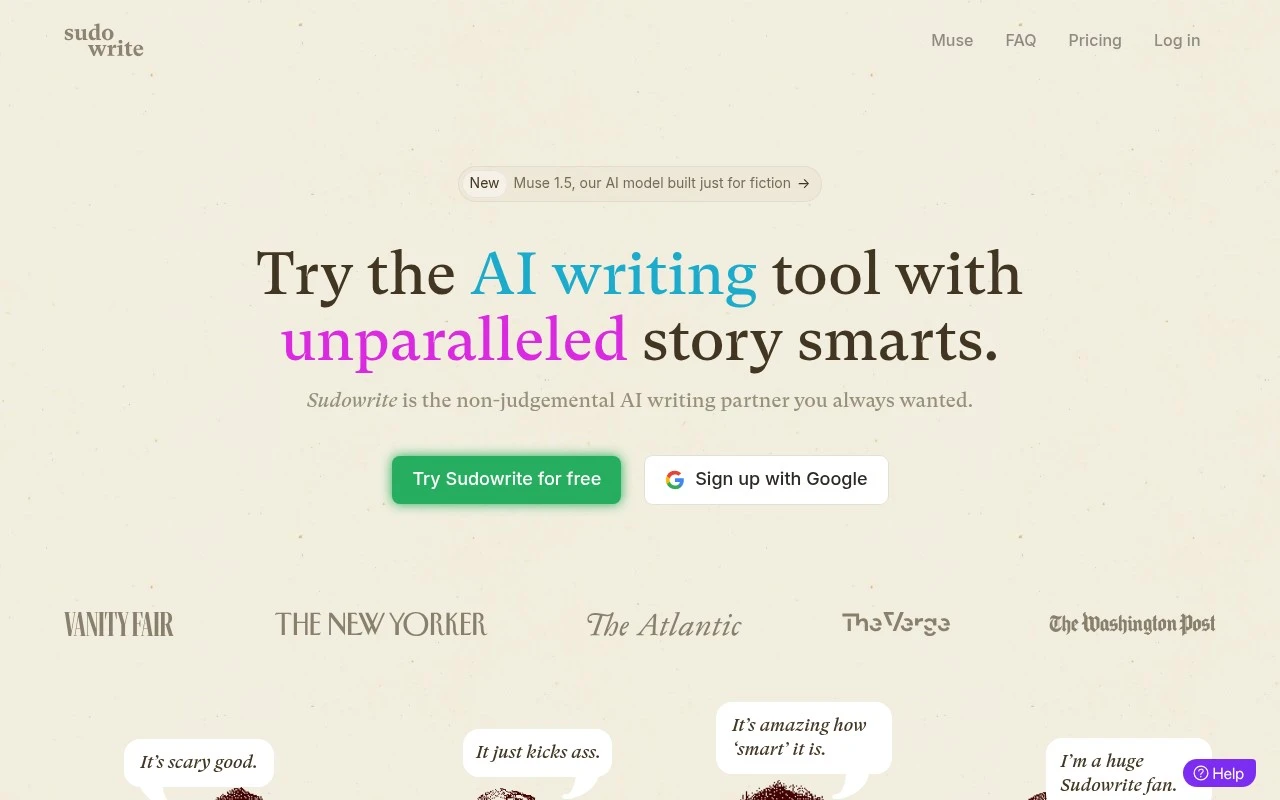
    Sudowrite’s site presents “Try Sudowrite for free,” “Sign up with Google,” and an 11-minute demo for onboarding. A Reddit user says Sudowrite “seems the easiest of all the other AI tools.”

  • Features

    Sudowrite’s product page lists Story Bible from “idea, to outline, to beating out chapters,” Canvas, Visualize, and “1,000+” plugins. Sudowrite’s product page also lists Write suggestions, Expand, Rewrite, Feedback, and Brainstorm for fiction-writing workflows.

  • Pricing

    Sudowrite’s pricing page shows monthly tiers at $10, $22, and $44 with clear credit limits, “Start Free Trial,” “No credit card, cancel anytime,” rollover on Max, and an “EZ Cancel Guarantee.” A Reddit user says Sudowrite was “absolutely worth the cost.”

  • Integrations

    Sudowrite’s docs say “Sudowrite Plugins allow you to create powerful, custom AI functions.” A Sudowrite page references “over 1000 custom-built tools.”

  • Support

    Sudowrite’s pricing page includes an FAQ section, an embedded “Sudowrite Simplified” demo video, and the support statement “If not, we’re only an email away.” Trustpilot lists a 3.2/5 rating from 26 reviews.

Who is this for?

Best for fiction writers who want help moving from premise to draft, Sudowrite’s product page lists Story Bible from “idea, to outline, to beating out chapters,” plus tools such as Write suggestions, Expand, Rewrite, and Feedback. Less suited to users who need broad third-party app connections, the cited connectivity facts center on Sudowrite Plugins and “over 1000 custom-built tools,” so the workflow is framed around Sudowrite’s plugin ecosystem.

PRODUCT PREVIEW

Feature highlights

Outline to chapters

Go from idea to outline and scenes with fiction-first planning.

Continue any scene

Generate next beats and prose that match your voice and tone.

Draft feedback

Get critique on pacing, clarity, and character consistency.

COMPARE

Discover curated alternatives worth comparing

Compare similar AI tools based on features, pricing and use cases

7.4/ 10Based on 5 reviews

Chapterly

Copy OptimizationBlog & Article Writing
Refines narrative, characters, and settings for authors
Best for:
Content creators
Pricing
Freemium

7.7/ 10Based on 5,772 reviews

Writesonic

Copy Optimization
Surfaces answer-engine visibility and citation gaps for GEO fixes
Best for:
Marketing teams
Pricing
Freemium

7.6/ 10Based on 266 reviews

Writehuman

AI Detection & Humanizing
Rewrites AI drafts, scans naturalness and detection signals
Best for:
Content creators
Pricing
Freemium

Join thousands of writers using Sudowrite to break blocks and finish stronger drafts. Start writing with more confidence and momentum today.

FAQ

Frequently asked
questions

Everything you need to know about this AI tool,
its features, pricing, use cases, and limitations.

Who is Sudowrite best suited for?
Sudowrite is best suited for fiction writers who want AI support for developing, drafting, expanding, and revising stories. It is particularly relevant for novelists, fiction authors, screenwriters, and storytellers working with characters, plot points, story bibles, scene structure, tone, and prose feedback.
Does Sudowrite have a free plan or only paid plans?
Sudowrite offers a free trial, so writers can test the fiction-writing workflow before committing to a paid plan. For current plan limits, usage allowances, and subscription details, users should check Sudowrite’s pricing page, since AI writing tools often vary limits by plan.
What should I compare when looking at tools like Sudowrite?
When comparing Sudowrite with similar AI writing tools, focus on whether you need fiction-specific planning and drafting rather than general-purpose writing. Sudowrite is built around story bibles, character-aware prose, scene expansion, rewriting, brainstorming, visualisation, and draft feedback, while broader tools may suit business or marketing content better.
How quickly can a writer get started with Sudowrite?
Sudowrite’s main trade-off is that it is optimized for fiction, not business writing, academic work, or general content marketing. Its AI-generated prose, plot suggestions, and feedback still need author review, editing, and creative judgment, and writers should not treat outputs as publication-ready without revision.
What privacy or compliance questions should I ask before using Sudowrite?
Writers considering Sudowrite should review how the platform handles manuscript text, prompts, drafts, and account data before uploading sensitive or unpublished work. Buyers should check Sudowrite’s current privacy policy, data retention terms, model training practices, export options, and any compliance claims that matter for their publishing or contractual obligations.