Curated ToolThis tool is part of our curated AI directory. We only include tools that meet our standards for relevance, usability and real-world value.

Neuroflash

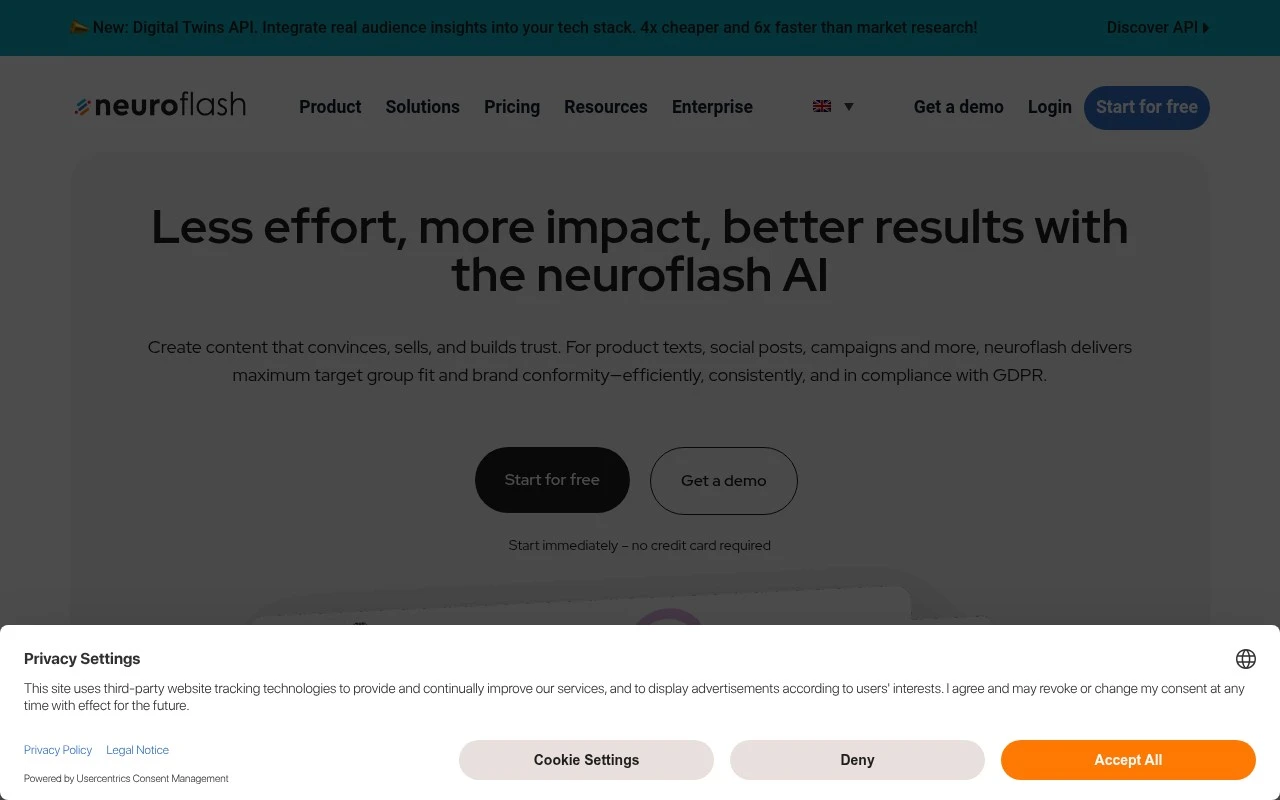
Neuroflash is an AI writing platform for creating and optimizing marketing content such as ads, product descriptions, social posts, and long-form copy. It supports conversion copywriting with brand voice controls, SEO workflows, and content performance analysis.
Copy OptimizationSocial Media Captions

FYAI Score

8.8 / 10

Based on 1,669 reviews

Pricing:

Freemium

Best for:

Marketing teams creating and validating campaigns before launch

Score Breakdown

  • Ease of use9.3 / 10
  • Features9.1 / 10
  • Pricing7.9 / 10
  • Integrations8.3 / 10
  • Support9.1 / 10

PRODUCT PREVIEW

What this AI tool does

Neuroflash is an AI content and audience-intelligence platform for marketing teams that want to generate, test, and improve campaigns before they go live. It brings together generative AI for copy, brand voices, campaign concepts, and images with audience simulation, making it especially relevant for conversion copywriting, positioning work, and data-informed creative decisions. At its center is the idea that marketers should not only create faster, but also understand how different audiences may respond. The platform’s Digital Twins simulate feedback from target groups using a foundation of more than 1 million real survey profiles. This gives teams a way to evaluate messages, creative angles, and campaign ideas before spending budget on production or media. For content teams, the tool supports the everyday work of turning briefs into usable marketing assets. Users can generate headlines, create sales copy, draft landing page text, write product descriptions, and shape social media content creation around a consistent tone. Rather than treating each output as a one-off prompt result, the platform is built around repeatable marketing workflows and brand-aligned communication. Brand consistency is a major part of the Neuroflash story. Neuroflash helps companies define and apply brand voices so that AI-generated content sounds closer to the organization’s intended style, vocabulary, and positioning. This matters for teams that need to create email campaign drafts, ad copy, website messaging, and social posts without losing coherence across channels. Creative production also extends beyond text. The platform can generate images to support campaign ideation, visual brainstorming, and content production, which makes it useful for teams that want both copy and creative directions in one environment. It is not positioned simply as an image generator, but as a broader marketing workspace where visual and verbal ideas can be developed together. Audience feedback is where Neuroflash is most distinctive compared with many general-purpose AI writing tools. Neuroflash is best at combining AI content generation with simulated target-audience evaluation, so marketers can compare different messages, identify likely objections, and refine creative choices before launch. This can be useful for campaign planning, concept testing, ad messaging, product positioning, and other decisions where the wording and audience fit both matter. Marketing managers, agencies, copywriters, and growth teams are the clearest users. A small team might use it to speed up campaign creation and improve first drafts, while a larger organization might use it to standardize brand language and support more evidence-based creative decisions. Agencies can use the platform to explore multiple angles quickly, then bring audience-backed recommendations into client discussions. European positioning is also part of the platform’s character. Neuroflash emphasizes GDPR-oriented hosting and European data protection expectations, which can be important for organizations that are cautious about where marketing and customer-related data is processed. For companies with stricter compliance requirements, this may be as important as the creative feature set. Integration options make the tool more relevant for teams that want AI inside existing systems rather than a separate writing tab. API and MCP options point toward a more connected workflow, where content generation, brand guidance, and audience intelligence can be embedded into broader marketing operations. That makes Neuroflash more than a standalone copy generator for teams building structured AI processes. The overall value of the platform is not just speed, although speed is clearly part of it. Its stronger promise is that marketing work can become more iterative, more brand-aware, and more audience-informed before public launch. For teams comparing AI writing platforms, Neuroflash stands out as a marketing-focused system that connects creation with simulated validation rather than stopping at content generation.

Use cases

Best for

Conversion Copywriting

Use Neuroflash to draft landing page headlines and CTAs, then test variants with Digital Twins for simulated audience feedback.

Generate Images

Generate marketing images in Neuroflash by prompting its AI image tool and iterating on style and brand fit.

Social Media Content Creation

Create social posts in Neuroflash using brand voice templates, then refine messaging with Digital Twins before scheduling.

ANALYSIS

Strengths & limitations

Strengths
  • Best suited to marketing teams that want creation and validation in one workflow because it combines campaign copy, brand voices, images, and audience feedback in the same platform.
  • Useful for agencies and strategists because Digital Twins can provide fast simulated reactions from target audiences before ideas are taken into production or media spend.
  • A strong fit for European teams and integrated marketing stacks because it emphasizes GDPR-oriented hosting and offers API and MCP options for workflow integration.

Limitations
  • Less suitable for teams that need statistically valid primary research because Digital Twins simulate audience reactions rather than replacing live customer interviews, panels, or A/B tests.
  • Less suitable for general-purpose writing teams outside marketing because its workflows are centered on campaigns, copy, brand voice, images, and audience prediction.
  • Freemium access is best for trial and light use because larger teams and heavier content or testing workflows typically need paid capacity.

Evaluation

FYAI score breakdown

Our structured evaluation across five key criteria

8.8 / 10

Overall score

Based on 1,669 reviews

  • Ease of use9.3 / 10
  • Features9.1 / 10
  • Pricing7.9 / 10
  • Integrations8.3 / 10
  • Support9.1 / 10

What users say

Findings from public reviews, documentation and community sources.

  • Ease of use

    GetApp reports that “92%” of reviewers who discuss intuitiveness are positive and that users say neuroflash is “easy to use, with an intuitive interface.” The neuroflash product page emphasizes “No training, no setup” and starting a first Digital Twins conversation “in under two minutes.”

  • Features

    The neuroflash pricing page lists “Content Creation,” “Image Generation,” “Digital Twins,” and “SEO/GEO,” plus “Over 100 ready-made workflows.” The neuroflash pricing page also lists 90+ content templates, a document editor, web search, and multiple AI model tiers.

  • Pricing

    The neuroflash pricing page lists Essential at “42€/month,” Pro at “84€/month per user,” Enterprise custom pricing, and a “7-day free trial.”

  • Integrations

    The neuroflash pricing page lists “API & MCP access,” Chrome and Firefox extensions, Unsplash royalty-free images, and Seobility SEO analysis. The neuroflash pricing page says MCP can be used “inside Claude, Cursor, etc.,” and Make lists Neuroflash as connectable with other apps for automation.

  • Support

    The neuroflash pricing page includes “Guides & Tutorials,” “neuroflash certification,” and for Enterprise a “Dedicated Account Manager,” “Training sessions,” and “Prompt Workshop & Creation.”

Who is this for?

Best for marketing teams that want one workspace for copy, visuals, search, and brand workflows, the neuroflash pricing page lists “Content Creation,” “Image Generation,” “SEO/GEO,” brand voices, and “Over 100 ready-made workflows.” Less suited to users who only need a low-entry paid copywriting plan, the Essential plan starts at “42€/month,” while Pro is listed at “84€/month per user” and Enterprise uses custom pricing.

PRODUCT PREVIEW

Feature highlights

Brand Voice Copy

Generate ads, emails, and posts that match your brand voice.

Digital Twin Testing

Simulate target-audience feedback using 1M+ survey profiles.

GDPR-Ready Hosting

European hosting options designed for privacy-focused teams.

COMPARE

Discover curated alternatives worth comparing

Compare similar AI tools based on features, pricing and use cases

7.4/ 10Based on 5 reviews

Chapterly

Copy OptimizationBlog & Article Writing
Refines narrative, characters, and settings for authors
Best for:
Content creators
Pricing
Freemium

7.7/ 10Based on 5,772 reviews

Writesonic

Copy Optimization
Surfaces answer-engine visibility and citation gaps for GEO fixes
Best for:
Marketing teams
Pricing
Freemium

7.6/ 10Based on 266 reviews

Writehuman

AI Detection & Humanizing
Rewrites AI drafts, scans naturalness and detection signals
Best for:
Content creators
Pricing
Freemium

Create on-brand marketing copy in minutes with Neuroflash. Start publishing faster, stay consistent, and spark new ideas for every campaign.

FAQ

Frequently asked
questions

Everything you need to know about this AI tool,
its features, pricing, use cases, and limitations.

Who is Neuroflash best suited for?
Neuroflash is best suited for marketing teams that need to create brand-aligned content and estimate audience reaction before launch. It fits use cases such as campaign copy, ad text, landing page messaging, email ideas, social media content, image generation, and concept testing with AI-based Digital Twins.
Does Neuroflash have a free plan, and when would a paid plan make sense?
Neuroflash uses a freemium pricing model, so teams can typically start with free access before moving to paid usage. A paid plan is more relevant when a team needs higher usage limits, broader workflow access, collaboration features, brand voice support, API or MCP access, or regular audience validation.
How does Neuroflash compare with other AI writing tools?
Neuroflash differs from many AI writing tools by combining content generation with audience-intelligence features. Instead of only helping users generate headlines, ads, emails, or sales copy, it also lets teams test ideas and messaging against AI-based Digital Twins that are described as grounded in real survey-profile data.
How quickly can a team get started with Neuroflash?
The main limitation of Neuroflash is that its audience feedback is predictive, not a replacement for live customer research or real campaign performance data. It is also mainly designed for marketing, branding, and content workflows, so it may be less useful for broader non-marketing AI tasks.
What should teams check about Neuroflash data privacy and compliance?
Teams should review Neuroflash’s current privacy, security, and compliance documentation before using it with sensitive customer, campaign, or research data. Important checks include how prompts and uploaded content are handled, whether data may be used for model improvement, access controls, retention settings, and any required contractual terms.