Curated ToolThis tool is part of our curated AI directory. We only include tools that meet our standards for relevance, usability and real-world value.

Jenni AI

Jenni AI is an AI writing assistant for academic work that helps users draft, paraphrase, and refine essays and research papers, with features for citation generation and source-based autocomplete.
Blog & Article Writing

FYAI Score

7.8 / 10

Based on 151 reviews

Pricing:

Freemium

Best for:

Students and researchers writing cited academic papers and theses

Score Breakdown

  • Ease of use7.2 / 10
  • Features7.7 / 10
  • Pricing8.5 / 10
  • Integrations7.9 / 10
  • Support7.9 / 10

PRODUCT PREVIEW

What this AI tool does

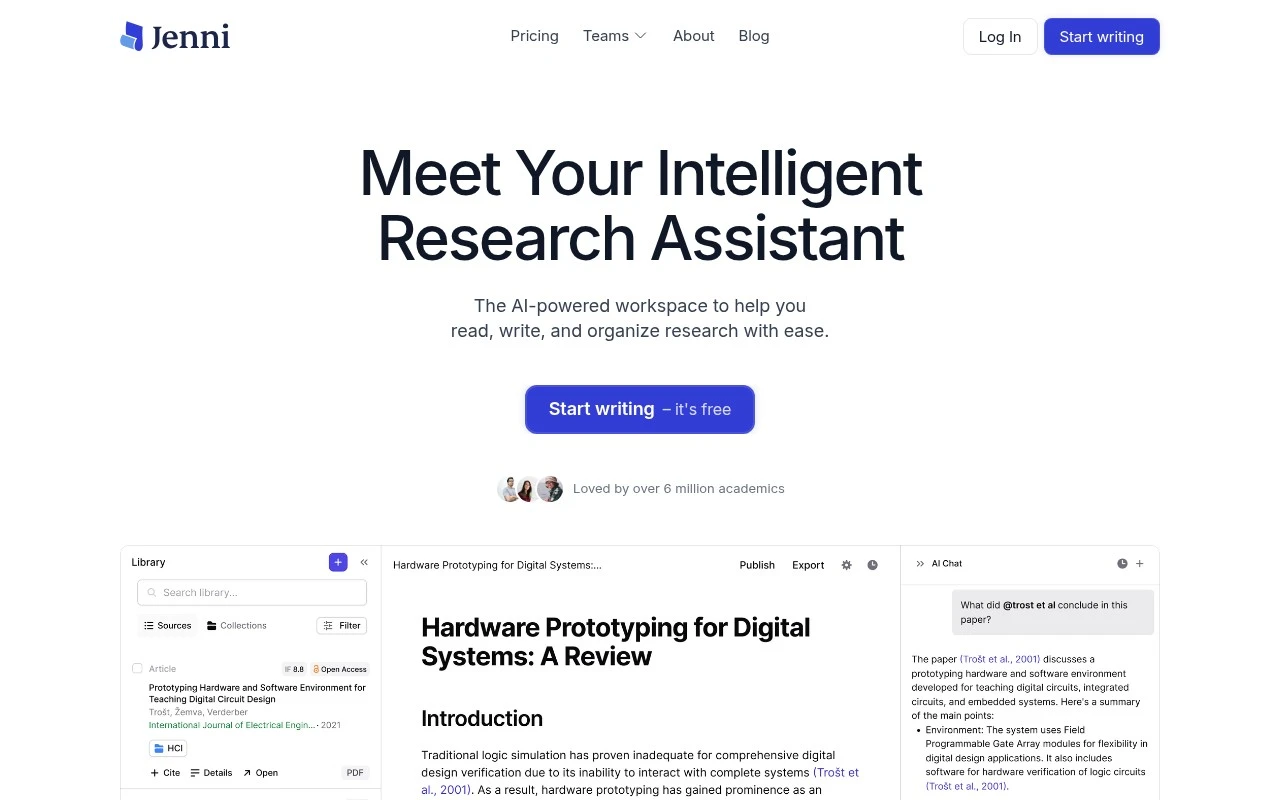
Jenni AI is an academic writing assistant for students, researchers, and knowledge workers who need to draft research-based documents with sources close at hand. It is built less like a general chatbot and more like a writing workspace, combining a document editor with source management, academic search, AI autocomplete, cited chat, and export tools. The result is a tool for moving from reading and evidence gathering to structured writing without constantly switching between tabs. For users working on essays, literature reviews, research papers, theses, reports, or grant-style writing, the platform helps keep the writing process anchored in evidence. Instead of asking an AI model to generate generic prose in isolation, users can bring in papers, PDFs, and references, then use those sources as the basis for drafting and revision. This makes it especially useful when the quality of the final text depends on traceable support rather than quick idea generation. A source-first workflow is the main idea behind the product. Academic search helps users discover relevant papers, while the personal library keeps important material available inside the same workspace as the draft. Knowledge base search adds another layer by helping users find information across their saved sources, so a paragraph can be shaped around material the user has already collected rather than a vague memory of where a claim appeared. The writing experience is designed to reduce friction during long form content creation. AI autocomplete can suggest the next phrase, sentence, or passage in the document editor, which is helpful when a writer knows the argument but needs help turning notes into coherent prose. Because the assistance appears inside the draft, it supports an incremental writing style rather than forcing the user to copy answers out of a separate chat window. Cited chat gives the assistant a more academic character than ordinary conversational AI. Users can ask questions about their sources, request explanations, or explore how a paper relates to a topic, while keeping citations visible as part of the answer. This is important for research writing because it makes the relationship between generated text and supporting material easier to inspect. Citation tools are part of the same end-to-end workspace. The platform can help insert citations, manage references, and prepare research-based writing for export, which matters when a project must move from draft to submission-ready document. Rather than treating citation as a final formatting chore, the tool makes source use part of the writing process from the beginning. Jenni AI is best at helping users produce structured academic and research-informed writing where sources, citations, and drafting need to stay connected. It is not positioned as a general-purpose creativity suite or a casual chatbot for every task. Its strength is the combination of reading, source organisation, assisted drafting, and citation-aware writing in one focused environment. In practice, the tool fits people who already have research material but need a more guided way to turn it into polished work. A student can use it to develop an essay with citations, a researcher can use it to organise references while drafting, and a professional can use it to prepare evidence-backed reports. The broader story of Jenni AI is a shift from AI as a blank prompt box to AI as a research writing companion built around sources.

Use cases

Best for

Long Form Content Creation

Jenni AI drafts and expands academic documents with AI autocomplete while inserting citations from your saved sources.

Knowledge Base Search

Search your source library and academic papers, then use cited chat to answer questions with linked references.

ANALYSIS

Strengths & limitations

Strengths
  • Best suited to source-based academic writing because the editor, source library, search, chat, autocomplete, and citation tools sit in one workspace.
  • Useful for research-grounded drafting because cited autocomplete and cited chat help writers build text around scholarly sources rather than generic AI responses.
  • Strong fit for students and researchers managing papers because imported or discovered sources can be questioned, cited, and carried into drafts without constant tool switching.

Limitations
  • Less suitable for general marketing, sales, or creative copy because the workflow is optimized for academic sources, citations, and research-backed writing.
  • Not a full replacement for a dedicated reference manager or institutional publishing workflow because its core value is AI-assisted drafting inside a writing workspace.
  • Heavy users are likely to outgrow the free tier because Jenni AI follows a freemium model with fuller usage tied to paid access.

Evaluation

FYAI score breakdown

Our structured evaluation across five key criteria

7.8 / 10

Overall score

Based on 151 reviews

  • Ease of use7.2 / 10
  • Features7.7 / 10
  • Pricing8.5 / 10
  • Integrations7.9 / 10
  • Support7.9 / 10

What users say

Findings from public reviews, documentation and community sources.

  • Ease of use

    A Reddit user in r/WritingWithAI says Jenni AI “suggestions often feel generic,” “structure help is hit or miss,” and “citations feel unreliable.”

  • Features

    Jenni’s home page says users can “drag in PDFs, import from Zotero or Mendeley,” search “200M+ papers,” use AI autocomplete grounded in sources, and generate citations in “10,000+ styles.”

  • Pricing

    Jenni’s pricing page lists a Free plan, Plus at “$12 /month,” and Pro at “$29 /month,” with “10 AI Autocompletes/day” on Free, “5,000 Autocompletes/month” on Plus, and unlimited AI autocomplete on Pro. A Reddit user in r/WritingWithAI says Jenni AI output can feel “robotic, generic, and sometimes even inaccurate.”

  • Integrations

    Jenni’s home page says users can “import from Zotero or Mendeley,” search Semantic Scholar, PubMed, arXiv, and CrossRef, and export to .docx, LaTeX, or HTML.

  • Support

    Jenni’s pricing page says Plus includes “Live chat support,” while Pro includes “Priority support.”

Who is this for?

Best for academic writers who need source-centered drafting, because Jenni’s home page says users can search “200M+ papers,” import from Zotero or Mendeley, and generate citations in “10,000+ styles.” Less suited to users who want minimal review and correction work, because a Reddit user in r/WritingWithAI says “suggestions often feel generic,” “structure help is hit or miss,” and “citations feel unreliable.”

PRODUCT PREVIEW

Feature highlights

AI Autocomplete

Keep writing with smart suggestions that match your academic tone.

Academic Search

Find relevant papers and sources without leaving your workspace.

Cited Chat & Library

Chat with sources and manage citations from one organized library.

COMPARE

Discover curated alternatives worth comparing

Compare similar AI tools based on features, pricing and use cases

7.4/ 10Based on 5 reviews

Chapterly

Copy OptimizationBlog & Article Writing
Refines narrative, characters, and settings for authors
Best for:
Content creators
Pricing
Freemium

7.7/ 10Based on 5,772 reviews

Writesonic

Copy Optimization
Surfaces answer-engine visibility and citation gaps for GEO fixes
Best for:
Marketing teams
Pricing
Freemium

7.6/ 10Based on 266 reviews

Writehuman

AI Detection & Humanizing
Rewrites AI drafts, scans naturalness and detection signals
Best for:
Content creators
Pricing
Freemium

Write faster without losing your voice. Start with Jenni AI today and turn rough ideas into polished content your audience wants to read.

FAQ

Frequently asked
questions

Everything you need to know about this AI tool,
its features, pricing, use cases, and limitations.

Who is Jenni AI best suited for?
Jenni AI is best suited for students, researchers, academics, and writers producing source-based academic work. Its strongest fit is drafting essays, research papers, abstracts, and literature reviews where inline citations need to be linked back to scholarly sources, rather than general marketing, creative, or business writing.
Is Jenni AI free, and what do paid plans add?
Jenni AI uses a freemium pricing model, so users can start with a free option and upgrade for more complete access. Paid access is typically relevant for people who need heavier academic drafting, source management, citation workflows, or longer-form research writing beyond the limits of a free plan.
How does Jenni AI compare with other academic writing tools?
Jenni AI stands out most for combining academic drafting, source-grounded autocomplete, paper-library chat, and citation management in one workspace. Other writing tools may be broader or more flexible for general content creation, while Jenni AI is more focused on research-backed writing that depends on imported or discovered scholarly sources.
How quickly can I get started with Jenni AI?
Jenni AI’s main limitation is that its usefulness depends heavily on the quality and relevance of the sources a user adds or selects. It is built for academic and research writing, so it is less appropriate for broad creative, sales, or marketing content, and users should still verify claims against original papers.
What should I check about privacy and compliance before using Jenni AI?
Users handling sensitive research, unpublished manuscripts, or institutional data should review Jenni AI’s current privacy, data retention, and compliance terms before uploading documents. Key checks include how files are processed, whether content may be used to improve models, access controls, export options, and any institution-specific requirements for research data.