Curated ToolThis tool is part of our curated AI directory. We only include tools that meet our standards for relevance, usability and real-world value.

GPTZero

GPTZero is an AI text detection tool that analyzes writing to estimate whether it was produced by a human or generated by AI. It is commonly used by educators, publishers, and organizations to review documents for AI-generated content.
AI Detection & Humanizing

FYAI Score

8.0 / 10

Based on 135 reviews

Pricing:

Freemium

Best for:

Educators and institutions reviewing AI use in student writing

Score Breakdown

  • Ease of use8.0 / 10
  • Features8.2 / 10
  • Pricing7.2 / 10
  • Integrations9.1 / 10
  • Support7.8 / 10

PRODUCT PREVIEW

What this AI tool does

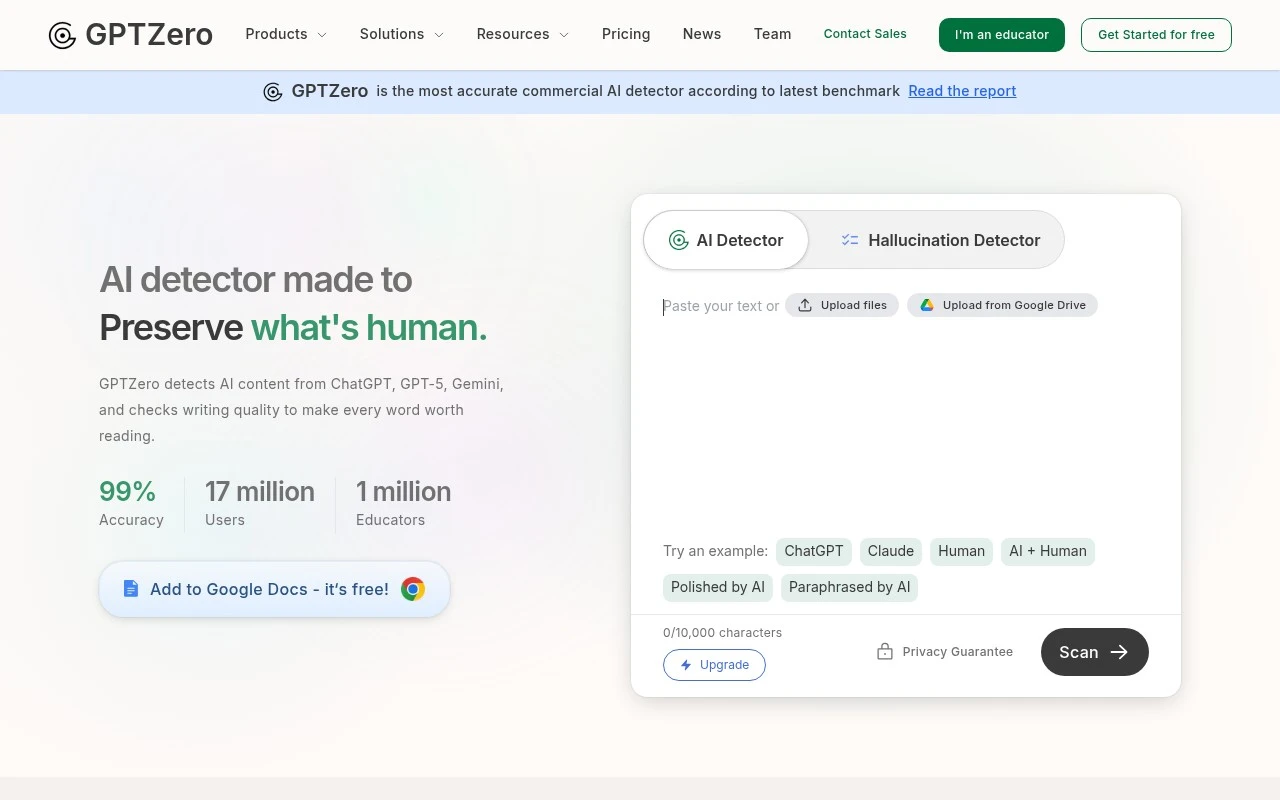
GPTZero is a web-based AI detector that helps educators, institutions, publishers, employers, legal teams, and professional writers identify text likely produced by generative AI systems. It is built around AI content detection, but its broader purpose is to support responsible review of writing rather than reduce decisions to a single score. At its core, the platform analyzes submitted text through a proprietary multi-step detection model. Instead of presenting detection as a simple yes-or-no result, it highlights patterns across a document and can surface sentence-level signals that help reviewers understand where AI-generated writing may be present. For educators, GPTZero is especially suited to academic environments where teachers need a consistent way to review student work. The platform is positioned as a support tool for academic integrity, giving instructors structured reports they can use alongside context, drafts, classroom expectations, and student conversations. Writing verification adds a different layer to the story. Rather than only scanning a finished essay, the tool can help document how a piece of writing was created, including reports with video replay that show the writing process. This makes it useful in situations where process matters as much as the final text. Beyond classrooms, GPTZero serves professional settings where authorship, originality, and trust are important. Publishers can use it to review submitted material, hiring teams can assess writing samples, legal professionals can examine documents, and organizations can create policies around acceptable AI use in workplace writing. Advanced scans extend the platform beyond basic AI detection. Plagiarism checking, hallucination detection, and AI writing feedback connect the tool to the wider problem of evaluating text quality, source reliability, and originality. These capabilities make the platform more of a writing review environment than a standalone detector. Integrations and institution-focused workflows are central to how GPTZero fits into real organizations. Connections with education and workplace tools help teams bring detection and verification into existing review processes, which is important for schools, universities, and companies that need repeatable standards across many users. Accuracy is treated as a review signal rather than an automatic verdict. The platform can help flag text that deserves closer attention, but its strongest use is when reviewers combine detection results with human judgment, policy, assignment context, and evidence of the writing process. The product’s character is practical and governance-oriented. GPTZero is best at turning AI content detection into a structured review workflow for people who need to make careful decisions about authorship, originality, and responsible AI use in writing.

Use cases

Best for

AI Text Detection

Paste text or upload a document to estimate whether it was generated by large language models.

Sentence-Level AI Review

GPTZero highlights sentences with AI likelihood and provides an overall score for mixed human and AI writing.

Workflow Integrations

Connect GPTZero via Google Docs, Classroom, Canvas, Chrome, Zapier, or API to run AI detection in existing workflows.

ANALYSIS

Strengths & limitations

Strengths
  • Strong fit for educators and institutions because it combines AI detection with sentence-level analysis, writing verification reports, and workflow features for reviewing student work.
  • Useful for professional content review because it supports plagiarism checking, hallucination detection, and AI writing feedback alongside AI-origin signals.
  • Practical for teams that need evidence beyond a single score because writing-process replay and structured reports can support more transparent review conversations.

Limitations
  • Less suitable for decisions that require certainty because AI detection is probabilistic and should be treated as review support rather than proof of authorship.
  • Less useful for teams working mainly with non-text or highly formatted content because GPTZero is centered on written text analysis and writing-process verification.
  • The freemium model fits trials and light scanning, but schools, publishers, or teams with recurring review volume should plan for paid usage as needs grow.

Evaluation

FYAI score breakdown

Our structured evaluation across five key criteria

8.0 / 10

Overall score

Based on 135 reviews

  • Ease of use8.0 / 10
  • Features8.2 / 10
  • Pricing7.2 / 10
  • Integrations9.1 / 10
  • Support7.8 / 10

What users say

Findings from public reviews, documentation and community sources.

  • Ease of use

    The GPTZero page says users can “simply paste your text to instantly get an overall AI score and advanced sentence by sentence detection.” The GPTZero FAQ describes getting started in “3 easy steps.”

  • Features

    The GPTZero page lists AI detection for “ChatGPT, GPT-5, Gemini,” sentence-level detection, Advanced Scan, and writing reports/video replay. The GPTZero page also lists plagiarism checking, AI writing feedback, LMS use, and API access.

  • Pricing

    The GPTZero pricing page shows annual/monthly options, “Enterprise and Team Plans,” shared team credits, and unified billing. The GPTZero pricing page also describes an API path with “View Pricing” / “Contact Sales.”

  • Integrations

    The GPTZero integrations page lists LMS integrations for “Google Classroom” and “Canvas.” The GPTZero integrations page says the developer API includes ready-to-use code in “17 different languages” and Zapier connects GPTZero with “thousands of the most popular apps.”

  • Support

    The GPTZero FAQ says “you can talk to our customer service team,” and the GPTZero integrations page offers scheduled implementation chats for schools and organizations.

Who is this for?

Best for educators, schools, and organizations that need AI-detection workflows connected to coursework. GPTZero lists LMS integrations for “Google Classroom” and “Canvas,” plus sentence-level detection. Best for teams with technical workflows, the integrations page says the developer API includes ready-to-use code in “17 different languages.” Less suited to buyers who need paid-tier amounts shown directly before engaging sales, the pricing page uses annual/monthly selectors, “Enterprise and Team Plans,” and an API path with “View Pricing” / “Contact Sales.”

PRODUCT PREVIEW

Feature highlights

AI Text Detection

Flags text likely written by generative AI with detailed scoring.

Sentence Insights

Sentence-level analysis to pinpoint where AI-like writing appears.

Verification Reports

Shareable reports with writing replay to support academic integrity.

COMPARE

Discover curated alternatives worth comparing

Compare similar AI tools based on features, pricing and use cases

7.4/ 10Based on 5 reviews

Chapterly

Copy OptimizationBlog & Article Writing
Refines narrative, characters, and settings for authors
Best for:
Content creators
Pricing
Freemium

7.7/ 10Based on 5,772 reviews

Writesonic

Copy Optimization
Surfaces answer-engine visibility and citation gaps for GEO fixes
Best for:
Marketing teams
Pricing
Freemium

7.6/ 10Based on 266 reviews

Writehuman

AI Detection & Humanizing
Rewrites AI drafts, scans naturalness and detection signals
Best for:
Content creators
Pricing
Freemium

Join educators and creators using GPTZero to verify originality with confidence. Check writing in minutes and protect integrity today.

FAQ

Frequently asked
questions

Everything you need to know about this AI tool,
its features, pricing, use cases, and limitations.

Who is GPTZero best suited for?
GPTZero is best suited for educators, institutions, editors, publishers, hiring teams, legal teams, and organizations that need to review whether submitted writing is likely AI-generated. It is especially relevant when teams need overall AI-content scoring, sentence-level signals, and supporting evidence for follow-up review rather than a simple yes-or-no result.
Can I use GPTZero for free, or do I need a paid plan?
GPTZero uses a freemium model, with free access available and paid upgrades for expanded capabilities. The free text box shown on the site has a 10,000-character limit, so users reviewing longer documents, higher volumes, integrations, or more advanced workflows should expect to evaluate paid options on gptzero.me.
What should I compare GPTZero against when looking at other AI content detectors?
GPTZero should be compared with other AI-content detection tools on accuracy approach, sentence-level analysis, workflow integrations, document limits, pricing model, and review features beyond detection. The right alternative depends on whether the main need is classroom review, editorial screening, applicant assessment, API-based checking, or organization-wide policy enforcement.
How quickly can a team start using GPTZero?
GPTZero’s main limitation is that AI detection is probabilistic and should not be treated as definitive proof of misconduct or authorship. Its results are most useful as review signals, especially when paired with writing history, drafts, assignment context, interviews, plagiarism checks, and human judgment for high-stakes decisions.
What privacy or compliance questions should buyers ask about GPTZero?
Buyers should review GPTZero’s current data handling, retention, access controls, integrations, and compliance documentation before submitting sensitive student, applicant, legal, or unpublished content. Schools and organizations should also confirm how user permissions, document storage, audit needs, and applicable privacy requirements are handled in their specific deployment.