Curated ToolThis tool is part of our curated AI directory. We only include tools that meet our standards for relevance, usability and real-world value.

GPTHuman

GPTHuman is an AI text humanization tool that rewrites AI-generated content to make it read more naturally and less like machine-written text. It is commonly used to refine drafts from systems like ChatGPT for a more human style.
AI Detection & Humanizing

FYAI Score

7.7 / 10

Based on 22 reviews

Pricing:

Freemium

Best for:

Students and writers polishing AI drafts into natural-sounding text

Score Breakdown

  • Ease of use7.7 / 10
  • Features7.5 / 10
  • Pricing8.4 / 10
  • Integrations7.2 / 10
  • Support7.4 / 10

PRODUCT PREVIEW

What this AI tool does

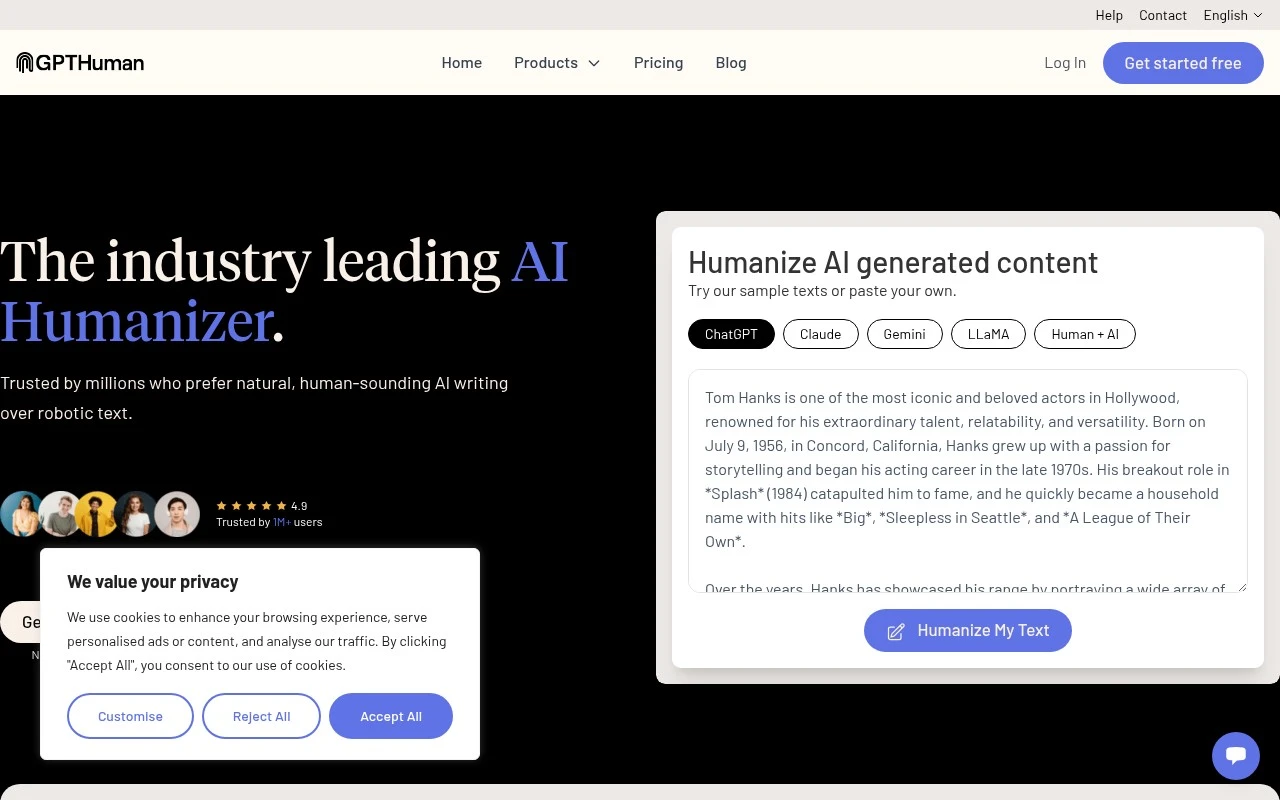
GPTHuman is an AI text humanization platform that rewrites machine-generated writing into content that reads more naturally, fluently, and plausibly human. GPTHuman is designed for users who start with output from tools such as ChatGPT, Claude, Gemini, or other large language models and want to reshape that draft into text with more varied rhythm, tone, and expression. At its core, the platform sits between an AI writer, a paraphrasing tool, and an AI detector workflow. Instead of only correcting grammar or swapping synonyms, it focuses on changing the texture of AI-generated prose, making sentences feel less formulaic and more aligned with everyday writing patterns. This makes it especially relevant for people who use generative AI as a first draft engine but do not want the final result to sound mechanical. For students, marketers, freelancers, bloggers, and business teams, GPTHuman is positioned as a practical editing layer for AI-assisted writing. GPTHuman is best at taking draft-like AI output and converting it into more natural content while letting users choose tones, modes, and writing styles that fit the intended audience. That positioning makes it less of a blank-page writing assistant and more of a refinement platform for text that already exists. The platform’s strongest public message is its focus on AI detector bypassing. Its official positioning refers to avoiding detection by tools such as GPTZero, Turnitin, Originality.ai, and Copyleaks, which places it in the more controversial part of the AI writing market. A responsible GPTHuman review should note that this capability may be useful for legitimate editing and privacy-conscious workflows, but it also requires users to follow academic, editorial, workplace, and legal policies. A built-in AI detector gives the workflow a feedback loop. Users can rewrite text, check how it may be classified, and revise again without moving between multiple tools. This matters because AI text humanization is often judged not only by readability, but also by whether the result avoids obvious machine-writing patterns such as repetitive transitions, overly balanced sentence structures, and generic phrasing. Multilingual support broadens the tool beyond English-only rewriting. The platform presents itself as suitable for working across many languages, which can help international users adapt AI-generated text for different regions, tones, and communication contexts. In practice, that makes it useful for global content teams, non-native English writers, and anyone producing writing for audiences in more than one language. API access gives GPTHuman a production-oriented side. Rather than being limited to a web editor for individual rewrites, the platform can be connected to larger workflows where humanization is applied at scale. That may appeal to agencies, SaaS products, content operations, or internal tools that need to process repeated AI-generated drafts through a consistent rewriting layer. The main caveat is that human-like text is not the same as high-quality, accurate, or ethical text. Users still need to verify facts, preserve meaning, check citations, and make sure the final output reflects their own intent. Humanization can improve surface style, but it should not replace subject expertise, transparent authorship practices, or careful editorial review. In a crowded market of AI rewriters, paraphrasers, and detector-focused utilities, GPTHuman stands out for combining generation, rewriting, tone control, detector checking, multilingual use, and API deployment around one central promise. GPTHuman is a humanizer for people who rely on AI-generated drafts but want the finished writing to feel less automated and more naturally composed.

Use cases

Best for

Tone Rewriting Modes

Paste AI text into GPTHuman and rewrite it using modes like standard, college, PhD, balanced, or enhanced.

Prompted Content Generation

Generate short or long content from a prompt with settings aimed at producing human-like, detector-resistant wording.

Detection and API Workflows

Use the built-in AI detector or developer API to check text and re-humanize it inside automated writing workflows.

ANALYSIS

Strengths & limitations

Strengths
  • Combines rewriting, prompt-based generation, tone selection, and humanization in one writing workflow, which suits users who want to refine AI-assisted drafts without switching tools.
  • Includes a built-in AI detector, which helps writers check revised text in the same platform before publishing or submitting it.
  • Supports many languages and offers an API, which makes it useful for publishers or developers who need humanization workflows beyond one-off manual editing.

Limitations
  • Its strong focus on bypassing AI detectors makes it less suitable for schools, publishers, or teams that require transparent disclosure of AI-assisted writing.
  • The freemium model is less suitable for high-volume users because heavier rewriting, detection, or API usage is likely to require a paid plan.
  • It is focused on humanizing and generating text rather than managing the full writing lifecycle, so teams needing deep research, citation management, approvals, or editorial collaboration may need additional tools.

Evaluation

FYAI score breakdown

Our structured evaluation across five key criteria

7.7 / 10

Overall score

Based on 22 reviews

  • Ease of use7.7 / 10
  • Features7.5 / 10
  • Pricing8.4 / 10
  • Integrations7.2 / 10
  • Support7.4 / 10

What users say

Findings from public reviews, documentation and community sources.

  • Ease of use

    The GPTHuman homepage describes a workflow where users can “paste your own” text, click “Humanize My Text,” and then use steps labeled “Enter Your Content or Prompt,” “Choose Your Tone and Mode,” and “Verify and assess your content.” Reddit sentiment includes a user saying GPTHuman “helps make the text sound more natural, less robotic.”

  • Features

    The GPTHuman homepage lists “Multi-Tone Voice Adaptation,” “Guaranteed undetectable AI,” “Multi-Language Human Writing” in 80 languages, and an included “AI Detector.” The GPTHuman homepage also lists plagiarism-free output and generation of human-like content from scratch.

  • Pricing

    The GPTHuman pricing page lists a Free tier at “$0/month” for 300 words, Starter at “$15/month” for 25,000 words/month, Plus at “$25/month” for 60,000 words/month, and Unlimited at “$49/month” with yearly discounts shown. The GPTHuman pricing page says “Unlimited” is “subject to abuse guardrails.”

  • Integrations

    The GPTHuman AI Humanizer API page says users can “Integrate GPTHuman’s industry-leading AI humanization technology into your products, workflows, or platforms” through its API.

  • Support

    The GPTHuman site surfaces “Help” and “Contact,” and the GPTHuman developer section includes “Read the docs” for API users. Trustpilot lists a 4/5 rating from 22 reviews for GPTHuman.

Who is this for?

Best for users who need AI-humanized writing in multiple languages, the GPTHuman homepage lists “Multi-Language Human Writing” in 80 languages and steps for choosing tone and mode. GPTHuman can also fit developer workflows because the API page says users can integrate its AI humanization technology into products, workflows, or platforms. Less suited to teams looking for a broad native integration ecosystem, the integration fact provided is API-based access, so workflow connections may depend on API implementation.

PRODUCT PREVIEW

Feature highlights

AI Text Humanizer

Rewrite AI output into more natural, human-like writing.

AI Detector Check

Scan text with a built-in detector to gauge AI-likeness.

API for Workflows

Automate humanization and rewriting in production pipelines.

COMPARE

Discover curated alternatives worth comparing

Compare similar AI tools based on features, pricing and use cases

7.4/ 10Based on 5 reviews

Chapterly

Copy OptimizationBlog & Article Writing
Refines narrative, characters, and settings for authors
Best for:
Content creators
Pricing
Freemium

7.7/ 10Based on 5,772 reviews

Writesonic

Copy Optimization
Surfaces answer-engine visibility and citation gaps for GEO fixes
Best for:
Marketing teams
Pricing
Freemium

7.6/ 10Based on 266 reviews

Writehuman

AI Detection & Humanizing
Rewrites AI drafts, scans naturalness and detection signals
Best for:
Content creators
Pricing
Freemium

Start publishing sharper marketing copy in less time. See why teams choose GPTHuman to turn ideas into campaigns that convert.

FAQ

Frequently asked
questions

Everything you need to know about this AI tool,
its features, pricing, use cases, and limitations.

Who is GPTHuman best suited for?
GPTHuman is best suited for people who already use AI writing tools and want the output to read more naturally. Typical users include students, academic writers, content creators, freelance writers, SEO publishers, and developers who need rewriting, prompt-based generation, AI detection checks, or humanization through an API.
Is GPTHuman free, or do I need a paid plan?
GPTHuman uses a freemium model, so users can start with free access while heavier or more advanced use may require paid access. Before relying on it for regular work, check gpthuman.ai for current limits on word count, generations, detector use, API access, and any paid-plan restrictions.
How does GPTHuman compare with other AI humanizer tools?
GPTHuman stands out by combining AI text rewriting, prompt-based content generation, tone and mode controls, a built-in AI detector, multilingual support, and an API. Similar tools may focus more narrowly on paraphrasing or detection, so the best choice depends on volume, workflow, budget, and acceptable compliance risk.
How quickly can I start using GPTHuman?
The main trade-off with GPTHuman is that claims about passing AI detectors should not be treated as guaranteed. AI detector results can vary, and using a humanizer to avoid disclosure may be inappropriate in academic, hiring, publishing, legal, or compliance-sensitive settings where originality and authorship rules matter.
Is GPTHuman safe to use with private or sensitive text?
Users handling sensitive text should review GPTHuman’s privacy terms, data retention practices, and API policies before uploading confidential material. Teams should confirm how submitted content is stored, whether it may be used for service improvement, who can access it, and whether the tool fits their compliance obligations.