Curated ToolThis tool is part of our curated AI directory. We only include tools that meet our standards for relevance, usability and real-world value.

Contentbot

Contentbot is an AI writing platform for generating and editing marketing copy, blog content, landing pages, ads, and emails. It includes tools to rewrite content, paraphrase text, and support long-form drafting workflows.
Copy OptimizationAd & Sales Copy

FYAI Score

7.9 / 10

Based on 134 reviews

Pricing:

Paid only

Best for:

Marketers and creators producing high-volume written content

Score Breakdown

  • Ease of use7.5 / 10
  • Features8.0 / 10
  • Pricing7.8 / 10
  • Integrations9.0 / 10
  • Support7.6 / 10

PRODUCT PREVIEW

What this AI tool does

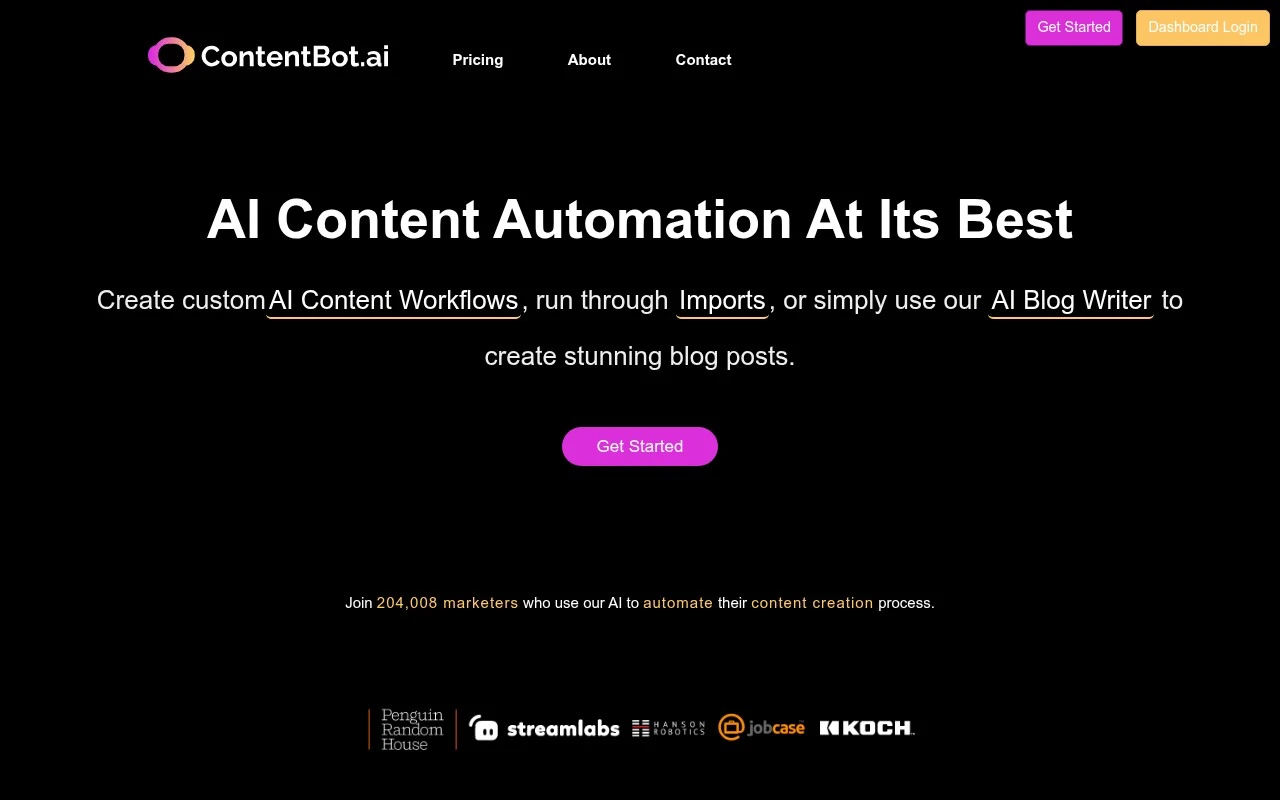
Contentbot is an AI writing and content automation platform for marketers, founders, agencies, and creators who need to produce written marketing content at scale. Contentbot is best at turning repeatable content tasks, such as drafting blog posts, rewriting content, creating landing page copy, and generating product descriptions, into faster AI-assisted workflows. For teams that publish frequently, the platform sits between a conventional AI copywriter and a lightweight automation system. It is not only a blank prompt box for one-off text generation, but a workspace for building repeatable processes around content production. That makes it especially relevant when the challenge is not writing a single piece, but keeping up with a steady content calendar. The AI Blog Writer is one of the clearest examples of its positioning. A marketer can use it to write blog post drafts, expand outlines, develop sections, or move from an idea to a longer-form article with less manual setup. The value is not that the tool replaces editorial judgment, but that it reduces the time spent getting from topic to usable first draft. Flows give the product a more operational character than many basic AI writing tools. These reusable workflows let users chain writing steps together, so a process such as researching a topic, producing variations, rewriting content for a different audience, and preparing copy for publication can become more structured. For agencies and content teams, this workflow automation angle is often the difference between occasional AI assistance and a repeatable production system. Import features extend that same idea to larger batches of work. Instead of prompting item by item, users can run prompts across datasets, which is useful for ecommerce catalogs, SEO pages, localization tasks, or large-scale copy refreshes. A team that needs to generate product description variants across many products can approach the task as a batch operation rather than a long series of manual requests. Contentbot is designed for written marketing output, including blog content, ad copy, landing page copy, product descriptions, social snippets, and multilingual text. It is most useful where the desired result follows a recognizable format and can be improved through editing, brand guidance, and human review. The platform’s strength is volume and repeatability, not simply novelty. Multilingual support also broadens its role for businesses that publish across markets. Content can be drafted or adapted for different languages, helping teams localize campaigns and product messaging more efficiently. As with any AI writing system, the strongest results usually come when a person reviews tone, accuracy, cultural fit, and compliance before publishing. In a Contentbot review, the most important point is that the product is aimed at marketers who treat content as an ongoing pipeline. Solo creators may use it to move faster, while agencies and growth teams may value the ability to standardize recurring copy tasks. It is less about crafting a single perfect sentence and more about creating a repeatable engine for marketing text. Compared with general-purpose chatbots, the platform is more focused on content operations. Its templates, blog-writing tools, Flows, and Import capability are organized around practical marketing deliverables rather than open-ended conversation. That focus helps users move from prompt experimentation toward defined outputs that can fit into a publishing or campaign workflow. Contentbot is ultimately a productivity tool for teams that need more written content than they can comfortably produce by hand. It helps users draft, rewrite, scale, and automate common marketing writing tasks while leaving strategy, editing, and final approval with humans. For organizations balancing speed with consistency, it offers a structured way to bring AI writing into everyday content production.

Use cases

Best for

Write Blog Post

Use Contentbot’s AI Blog Writer to generate a full blog post draft from a topic, keywords, and outline inputs.

Workflow Automation

Build reusable Flows to chain prompts and auto generate landing pages, ads, and product copy from structured inputs.

Rewrite Content

Rewrite existing text by prompting Contentbot to paraphrase, change tone, shorten, or expand while keeping the core meaning.

ANALYSIS

Strengths & limitations

Strengths
  • Strong fit for marketers producing content at volume because it covers blogs, landing pages, ad copy, product descriptions, and multilingual outputs in one writing platform.
  • Reusable Flows help teams standardize recurring content processes because prompts can be turned into repeatable workflows rather than recreated manually.
  • The Import feature is useful for ecommerce and agency teams because it can run prompts across large datasets for batch content production.

Limitations
  • Less suitable for users who need a free long-term writing tool because ContentBot is a paid-only product.
  • Less suitable for teams seeking an all-in-one marketing suite because its core strength is written content generation and automation rather than design, publishing, analytics, or campaign management.
  • Less suitable for simple one-off writing tasks because Flows and dataset imports are most useful when a team has repeatable content processes to set up.

Evaluation

FYAI score breakdown

Our structured evaluation across five key criteria

7.9 / 10

Overall score

Based on 134 reviews

  • Ease of use7.5 / 10
  • Features8.0 / 10
  • Pricing7.8 / 10
  • Integrations9.0 / 10
  • Support7.6 / 10

What users say

Findings from public reviews, documentation and community sources.

  • Ease of use

    ContentBot's product page says users can create automation flows “in a few short steps” and “create complex content plans with just a few simple clicks.” ContentBot's product page also centers workflows and import automation rather than only a simple prompt-based writer.

  • Features

    ContentBot's product page lists “AI Content Flow Builder,” “AI Blog Writer,” bulk “Importer,” and writing “in over 110 languages.”

  • Pricing

    ContentBot's site states pricing starts at “$29/month” and offers a “Pay as you Go plan.” The indexed pricing snippet mentions prepaid usage around “$0.5 per 1000” words and a lower monthly option.

  • Integrations

    Zapier states that ContentBot “integrates with 9000 other apps on Zapier.”

  • Support

    ContentBot's product page includes a FAQ covering uniqueness, generation model, copyright, languages, pricing, and nonprofit discounts. ContentBot's product page directs users to “get in touch” for some cases.

Who is this for?

Best for teams building repeatable content workflows. ContentBot lists “AI Content Flow Builder” and bulk “Importer,” and Zapier states that ContentBot “integrates with 9000 other apps on Zapier.” Less suited to users who want only a simple prompt-based writer, ContentBot's product page centers workflows and import automation, which means setup can involve more than entering a single prompt. Less suited to buyers who need one simple pricing frame, ContentBot's site states pricing starts at “$29/month” and offers a “Pay as you Go plan,” while the indexed pricing snippet mentions prepaid usage around “$0.5 per 1000” words.

PRODUCT PREVIEW

Feature highlights

AI Blog Writer

Generate long-form blog drafts fast, from topic to structured content.

Reusable Flows

Automate repeatable content workflows for consistent marketing output.

Bulk Import Runs

Run prompts across large datasets to create copy in volume.

COMPARE

Discover curated alternatives worth comparing

Compare similar AI tools based on features, pricing and use cases

7.4/ 10Based on 5 reviews

Chapterly

Copy OptimizationBlog & Article Writing
Refines narrative, characters, and settings for authors
Best for:
Content creators
Pricing
Freemium

7.7/ 10Based on 5,772 reviews

Writesonic

Copy Optimization
Surfaces answer-engine visibility and citation gaps for GEO fixes
Best for:
Marketing teams
Pricing
Freemium

7.6/ 10Based on 266 reviews

Writehuman

AI Detection & Humanizing
Rewrites AI drafts, scans naturalness and detection signals
Best for:
Content creators
Pricing
Freemium

Create on-brand marketing content in minutes, not hours. See why busy teams choose Contentbot to ship more campaigns with less effort.

FAQ

Frequently asked
questions

Everything you need to know about this AI tool,
its features, pricing, use cases, and limitations.

Who is Contentbot best suited for?
Contentbot is best suited for marketers, agencies, founders, copywriters, SEO teams, bloggers, and ecommerce teams that need to produce written marketing content faster. It is strongest for blog posts, landing page copy, ads, product descriptions, rewritten text, and repeatable content workflows rather than visual or multimedia creation.
Is Contentbot free or paid?
Contentbot is a paid AI writing tool. Buyers should review the current plans on contentbot.ai to understand usage limits, workflow access, bulk generation options, and any restrictions tied to content volume. Teams with recurring production needs should compare plan limits against their expected monthly output.
How does Contentbot compare with other AI writing tools?
Contentbot competes with other AI writing platforms, but its workflow automation and bulk content features make it more relevant for recurring production than simple one-off copy generation. The best choice depends on whether a team prioritizes blog writing, ecommerce copy, automated workflows, collaboration, pricing, or governance requirements.
How hard is it to set up Contentbot for content workflows?
Contentbot is focused on written marketing content, so it is not a broad creative suite for video, design, or audio generation. Its site also states generated content is about 95% unique, which means users should still review outputs for originality, factual accuracy, brand fit, and SEO quality before publishing.
What should teams check before using Contentbot for sensitive content?
Teams using Contentbot for sensitive or regulated content should review its current privacy, data retention, security, and compliance terms directly on contentbot.ai. They should also define internal review rules for generated copy, especially because features such as AI detection bypassing may not align with transparency or compliance policies.