Curated ToolThis tool is part of our curated AI directory. We only include tools that meet our standards for relevance, usability and real-world value.

AI Writer

AI Writer is an AI writing platform that generates full-length, source-cited articles from a headline and provides verifiable references for fact checking, making it useful for research-based content and report generation.
Blog & Article Writing

FYAI Score

7.6 / 10

Based on 126 reviews

Pricing:

Paid

Best for:

Researchers and students writing evidence-based academic content

Score Breakdown

  • Ease of use8.2 / 10
  • Features7.4 / 10
  • Pricing7.7 / 10
  • Integrations7.1 / 10
  • Support7.6 / 10

PRODUCT PREVIEW

What this AI tool does

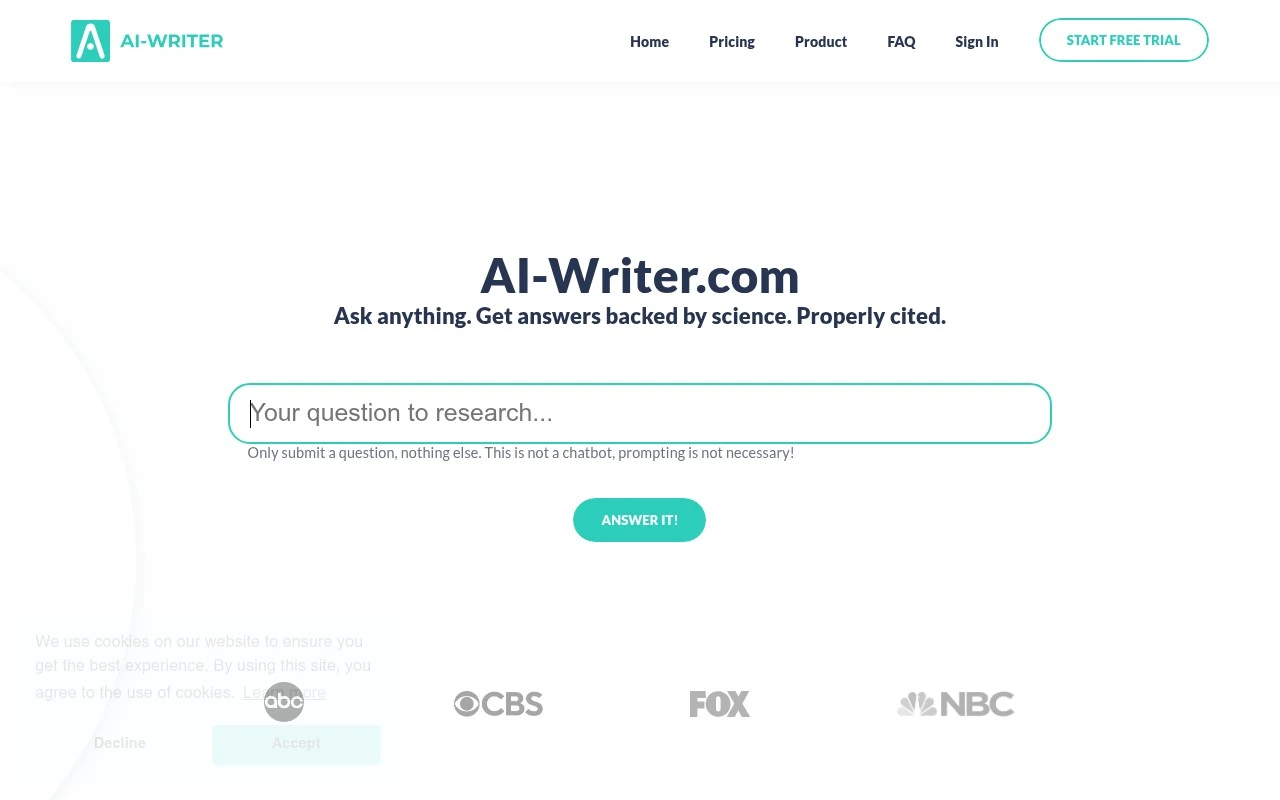
AI Writer is an academic and research-oriented AI writing tool for students, scholars, analysts, and research teams that need evidence-backed answers, summaries, citations, and structured report generation rather than generic marketing copy. AI Writer is best understood as a research assistant for turning scientific literature into traceable writing, with a stated corpus of more than 100 million open science papers behind its responses. For researchers, the main value is not simply that the platform can write, but that it tries to show where its writing comes from. Instead of producing unsupported prose, it is designed to connect generated answers with source paragraphs, source links, bibliographic details, citation formats, and BibTeX entries. That makes it useful in settings where a claim needs to be checked, reused, cited, or challenged. Traceability gives the tool a different character from broad AI writing software aimed at blogs, emails, ads, or general long form content creation. AI Writer is positioned for literature-grounded work, where the quality of an answer depends on whether the evidence can be inspected. This matters for academic writing, research briefs, review papers, grant preparation, policy analysis, and technical reports where citations are not decoration, but part of the argument. The Topic Explorer extends the platform from question answering into research planning. A user can start with a subject and explore important questions around it, which helps turn a broad topic into a more usable research map. This is especially helpful at the early stage of a project, when the challenge is not only writing paragraphs, but deciding which questions deserve attention. Review paper creation is another defining workflow. After selecting research questions, users can move toward a structured review paper rather than beginning with a blank document. In that sense, AI Writer supports report generation as a research process, from exploring a topic, to gathering evidence, to producing a cited draft that can be verified and revised. Where many AI tools optimise for speed and fluent surface-level text, this platform is more concerned with the relationship between generated writing and published evidence. The resulting output may still require expert review, especially for interpretation, methodology, and final academic judgement, but the source-aware design makes that review more practical. A reader assessing an AI Writer review should therefore look closely at citation quality, source relevance, and how well the generated structure reflects the actual literature. In practical use, AI Writer fits users who want to move faster through research-heavy writing without losing sight of provenance. It is not primarily a creative copywriting system or a brand voice generator. It is a specialised academic AI writing platform for people who need answers, summaries, and reports that remain connected to the scientific sources behind them.

Use cases

Best for

Report Generation

AI Writer generates research reports by answering questions from open science papers and attaching traceable citations with source paragraphs and BibTeX.

Long Form Content Creation

It drafts long form review papers by mapping questions in Topic Explorer, then compiling selected evidence into a structured outline with citations.

ANALYSIS

Strengths & limitations

Strengths
  • Best suited to academic and research writing because it grounds answers in scientific literature rather than generic web content.
  • Strong source-level traceability helps researchers verify generated claims through source paragraphs, links, bibliographic details, citation formats, and BibTeX entries.
  • Useful for literature-review workflows because Topic Explorer and review-paper drafting features help turn research questions into structured outputs.

Limitations
  • Less suitable for general marketing, sales, or creative copy because its workflow is oriented toward academic evidence synthesis.
  • Less suitable for teams that depend on proprietary, paywalled, or internal documents because its research base is centered on open scientific papers.
  • The paid model can be a barrier for students or occasional users who only need cited research assistance intermittently.

Evaluation

FYAI score breakdown

Our structured evaluation across five key criteria

7.6 / 10

Overall score

Based on 126 reviews

  • Ease of use8.2 / 10
  • Features7.4 / 10
  • Pricing7.7 / 10
  • Integrations7.1 / 10
  • Support7.6 / 10

What users say

Findings from public reviews, documentation and community sources.

  • Ease of use

    AI-Writer's website describes review-paper creation as happening "with a few clicks" and section organization through "simple drag & drop." AI-Writer's website includes testimonials saying the product makes writing and research "easy" and reduces work from hours to minutes.

  • Features

    AI-Writer's website says the product is built around "100M+ scientific papers" and supports verifiable citations, exact source paragraphs, bibliographic details, and BibTeX. AI-Writer's website also references Topic Explorer, AI Research, and full review-paper generation for academic and research writing workflows.

  • Pricing

    AI-Writer's pricing page lists Basic at $29 monthly or $24/month annually, Standard at $49 or $41/month annually, and Power at $375 or $312/month annually. AI-Writer's pricing page also lists a 7-day free trial that "does NOT have to be canceled."

  • Integrations

    AI-Writer's website says users can "download your research as a standalone HTML file or share it directly via a link." AI-Writer's website says citations include full bibliographic details plus a "ready-to-use BibTeX entry," making connectivity centered on research export and sharing outputs.

  • Support

    AI-Writer's website includes an FAQ covering research use, ChatGPT comparison, free-trial behavior, cancellation, usage rights, and affiliate questions. AI-Writer's website says subscriptions can be canceled in the dashboard or "by sending a formless email," and reports 4.4/5 across 126 G2 reviews.

Who is this for?

Best for researchers, students, and academic writers who need citation-backed drafts, AI-Writer's website says the product is built around "100M+ scientific papers" and provides verifiable citations, exact source paragraphs, bibliographic details, and BibTeX. Less suited to teams looking for broad writing-copy platform connectivity, AI-Writer's website describes sharing through a standalone HTML file, direct link, and BibTeX rather than CMS, document-editor, browser, or automation integrations.

PRODUCT PREVIEW

Feature highlights

Traceable citations

See exact source paragraphs, links, and BibTeX behind outputs.

Evidence summaries

Ask questions and get literature-backed summaries with references.

Topic Explorer

Map key questions and build a structured review from selections.

COMPARE

Discover curated alternatives worth comparing

Compare similar AI tools based on features, pricing and use cases

7.4/ 10Based on 5 reviews

Chapterly

Copy OptimizationBlog & Article Writing
Refines narrative, characters, and settings for authors
Best for:
Content creators
Pricing
Freemium

7.7/ 10Based on 5,772 reviews

Writesonic

Copy Optimization
Surfaces answer-engine visibility and citation gaps for GEO fixes
Best for:
Marketing teams
Pricing
Freemium

7.6/ 10Based on 266 reviews

Writehuman

AI Detection & Humanizing
Rewrites AI drafts, scans naturalness and detection signals
Best for:
Content creators
Pricing
Freemium

Turn complex research into clear, credible writing faster. Start with a question and leave with a draft you can trust and build on today.

FAQ

Frequently asked
questions

Everything you need to know about this AI tool,
its features, pricing, use cases, and limitations.

Who is AI Writer best suited for?
AI Writer is best suited for students, PhD candidates, academic researchers, educators, and industry researchers who need cited answers from scientific literature. It is most useful when the goal is to explore research questions, build topic outlines, or draft review-paper-style content with traceable sources.
Is AI Writer free or paid?
AI Writer is a paid tool, and buyers should expect plan-based access rather than an unlimited free writing assistant. Its paid usage is especially relevant for users who need literature-backed answers, citation traceability, and structured research writing support rather than casual general-purpose text generation.
How does AI Writer compare with other AI writing tools?
AI Writer differs from many general AI writing tools by focusing on scientific literature, cited answers, and source-level verification. It is a better fit for academic and research workflows than for broad marketing copy, casual blogging, or unsupported long-form content creation. The best choice depends on citation needs, budget, and review process.
How quickly can a team start using AI Writer?
AI Writer’s main limitation is that it is strongest for topics covered by scientific and open-literature sources, not every writing task. Its generated academic text still needs human review for accuracy, interpretation, citation quality, and institutional requirements. Paid plans may also include limits on questions or seats.
What privacy or compliance checks should buyers make before using AI Writer?
Buyers should review AI Writer’s data handling, privacy, and compliance terms before using it with sensitive research, unpublished manuscripts, student data, or proprietary information. Academic and enterprise users should confirm how prompts, uploaded content, generated drafts, citations, and account data are stored, processed, retained, and accessed.