Curated ToolThis tool is part of our curated AI directory. We only include tools that meet our standards for relevance, usability and real-world value.

Stacker

Builds internal web apps from Airtable, Sheets, and databases

App / No-code Builders
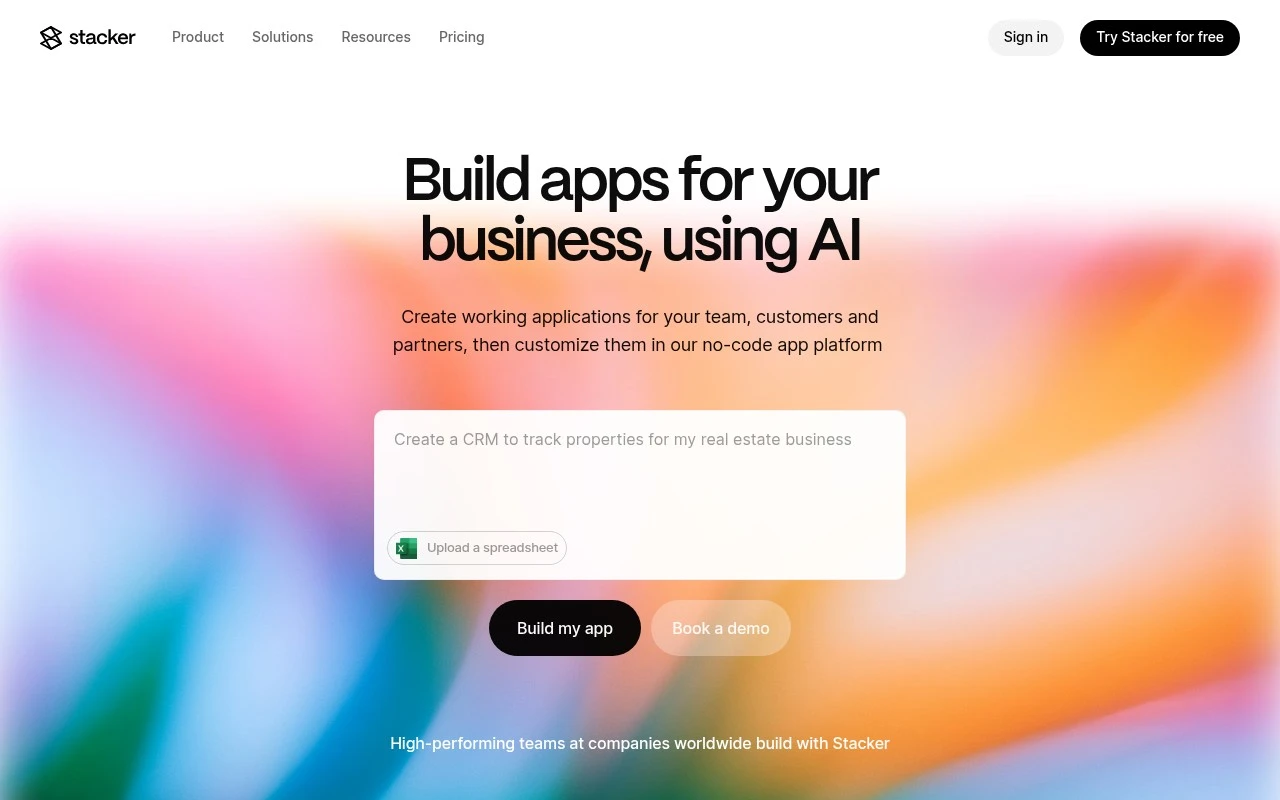
Stacker is described by its official site as an AI-native application platform for building internal tools, CRMs, and dashboards. The available source establishes its broad function as a custom business app-building platform, but does not provide detail on specific AI features, integrations, deployment options, or workflow capabilities.

FYAI Score

8.5 / 10

Based on 1.397 reviews

Pricing:

Paid

Best for:

Ops and RevOps teams building internal CRMs and dashboards

Score Breakdown

  • Ease of use8.6 / 10
  • Features7.6 / 10
  • Pricing8.7 / 10
  • Integrations9.0 / 10
  • Support9.0 / 10

PRODUCT PREVIEW

What this AI tool does

Stacker is an AI tool page for learning what the product does and how it fits into a workflow. It’s intended for readers who want a straightforward explanation rather than a sales pitch, with enough context to understand the tool’s purpose and typical ways it’s used. Because the intro and main use case aren’t specified, this description focuses on helping you evaluate whether stacker is relevant to your needs. You can use this page to understand the general problem it addresses, what inputs it works with, what kind of output it produces, and any practical considerations such as setup, integrations, and limitations. If you’re comparing AI tools, this overview is designed to support an informational search intent: it aims to clarify what to expect from the tool and what questions to ask before adopting it in a project or team setting.

Use cases

Best for

App Generation

Use Stacker to generate internal apps by configuring data sources, tables, forms, and workflows into a custom business tool.

Dashboard Generation

Generate dashboards in Stacker by connecting your data and arranging charts, tables, and filters into a shareable view.

ANALYSIS

Strengths & limitations

Strengths
  • Clearly focused on practical business application types: internal tools, CRMs, and dashboards
  • Positioned as AI-native, which suggests AI is central to the platform’s approach
  • Targets custom application building rather than a single fixed workflow
Limitations
  • The provided official text does not specify the exact AI capabilities
  • No source detail is available on integrations, data sources, permissions, or automation features
  • Pricing, implementation complexity, and technical requirements cannot be assessed from the provided content

Evaluation

FYAI score breakdown

Our structured evaluation across five key criteria

8.5 / 10

Overall score

Based on 1.397 reviews

  • Ease of use8.6 / 10
  • Features7.6 / 10
  • Pricing8.7 / 10
  • Integrations9.0 / 10
  • Support9.0 / 10

What users say

Findings from public reviews, documentation and community sources.

  • Ease of use

    Capterra describes Stacker’s interface as “intuitive and easy to use,” and G2 says users praise its “user-friendly design” for building no-code web apps.

  • Features

    Stacker’s pricing page lists “Unlimited customer portals,” “White-label customer portals,” “Custom domains,” and “Scheduled tasks & automations.”

  • Pricing

    Stacker’s pricing page offers a free start with “$100 in credits, no credit card required,” a Team plan at “$50/mo” for 250 credits, no per-seat charges, and all features included on every plan.

  • Integrations

    Zapier lists Stacker as connecting with “9000 other apps on Zapier,” and the integration listing states “2,000+ integrations.”

  • Support

    Software Advice quotes a user saying “Customer service has been a huge” part of the positive experience. Stacker’s pricing page lists “Dedicated onboarding” and “SLA & priority support” for Enterprise customers.

Who is this for?

Best for teams building customer portals, Stacker’s pricing page lists “Unlimited customer portals,” “White-label customer portals,” and no per-seat charges. Less suited to teams that need “Dedicated onboarding” and “SLA & priority support” outside Enterprise, Stacker’s pricing page lists those items for Enterprise customers.

PRODUCT PREVIEW

Feature highlights

Internal tool builder

Create custom apps for ops workflows, approvals, and handoffs.

Data-driven apps

Turn your existing data into searchable tables, forms, and views.

Dashboards & CRMs

Launch role-based dashboards and lightweight CRMs for teams.

COMPARE

Discover curated alternatives worth comparing

Compare similar AI tools based on features, pricing and use cases

8.8/ 10Based on 14.986 reviews

WordPress

Website BuildersE-commerce Builders
Builds WordPress sites using an AI website builder and AI tools
Best for:
Small business owners
Pricing
Freemium

8.6/ 10Based on 28.442 reviews

Wix AI

Website BuildersE-commerce Builders
Generates a Wix website draft from user answers for editing.
Best for:
Small business owners
Pricing
Freemium

7.7/ 10Based on 35 reviews

WeWeb

Hosting & DeploymentApp / No-code Builders
Generates web app pages, databases, and logic from prompts
Best for:
Startup founders
Pricing
Freemium

Build custom internal apps in days, not months. Start with your data and give your team tools that streamline work and keep everyone aligned with Stacker.

FAQ

Frequently asked
questions

Everything you need to know about this AI tool,
its features, pricing, use cases, and limitations.

What types of internal apps is Stacker a good fit for, and when should I pick something else?
Stacker is a strong fit for internal tools like CRMs, client portals, inventory trackers, approvals, and operations dashboards built on existing data sources. It works best when your workflows map cleanly to records, forms, and role-based access. If you need highly custom UI interactions, complex business logic, or consumer-scale performance, a more code-first framework or a more flexible builder may be a better match.
Does Stacker have a free plan, and what are the practical limits of lower-tier plans?
Stacker is typically positioned as a paid product, and any free access is usually limited to trials or constrained evaluation environments rather than an ongoing free tier. Lower tiers commonly limit advanced permissions, branding/customization, and the number of users or app features you can roll out broadly. If you’re comparing tools, confirm pricing based on your user count (internal users vs external portal users) and required integrations.
How does Stacker compare with Softr, Glide, Retool, or Bubble for building apps?
Compared with Softr or Glide, Stacker is often chosen for structured internal apps and portals with strong permissioning on top of existing databases, rather than mobile-first experiences. Versus Retool, Stacker is generally more approachable for non-technical teams but offers less flexibility for complex logic and custom components. Compared with Bubble, Stacker is faster for database-driven internal tools but is typically less customizable for fully bespoke front-end experiences.
How quickly can a team get a working app live in Stacker, and what onboarding effort should I expect?
Stacker can be limiting when you need deep UI customization, specialized interactions, or very complex conditional workflows beyond what the platform supports. Performance can become a concern with large datasets or heavy filtering, depending on your data source and app design. You’re also dependent on Stacker’s product roadmap for new capabilities and platform-level changes.
What should I consider about data storage, privacy, and compliance when using Stacker?
Stacker typically acts as a layer on top of your connected data source, so where your data lives (e.g., Airtable or your database) and how it’s secured matters as much as Stacker itself. Evaluate role-based access controls, auditability, and whether your required compliance (e.g., SOC 2, GDPR, HIPAA) is supported by both Stacker and the underlying data provider. For sensitive data, confirm encryption, SSO options, and how permissions are enforced across records and views.