Curated ToolThis tool is part of our curated AI directory. We only include tools that meet our standards for relevance, usability and real-world value.

Hostinger

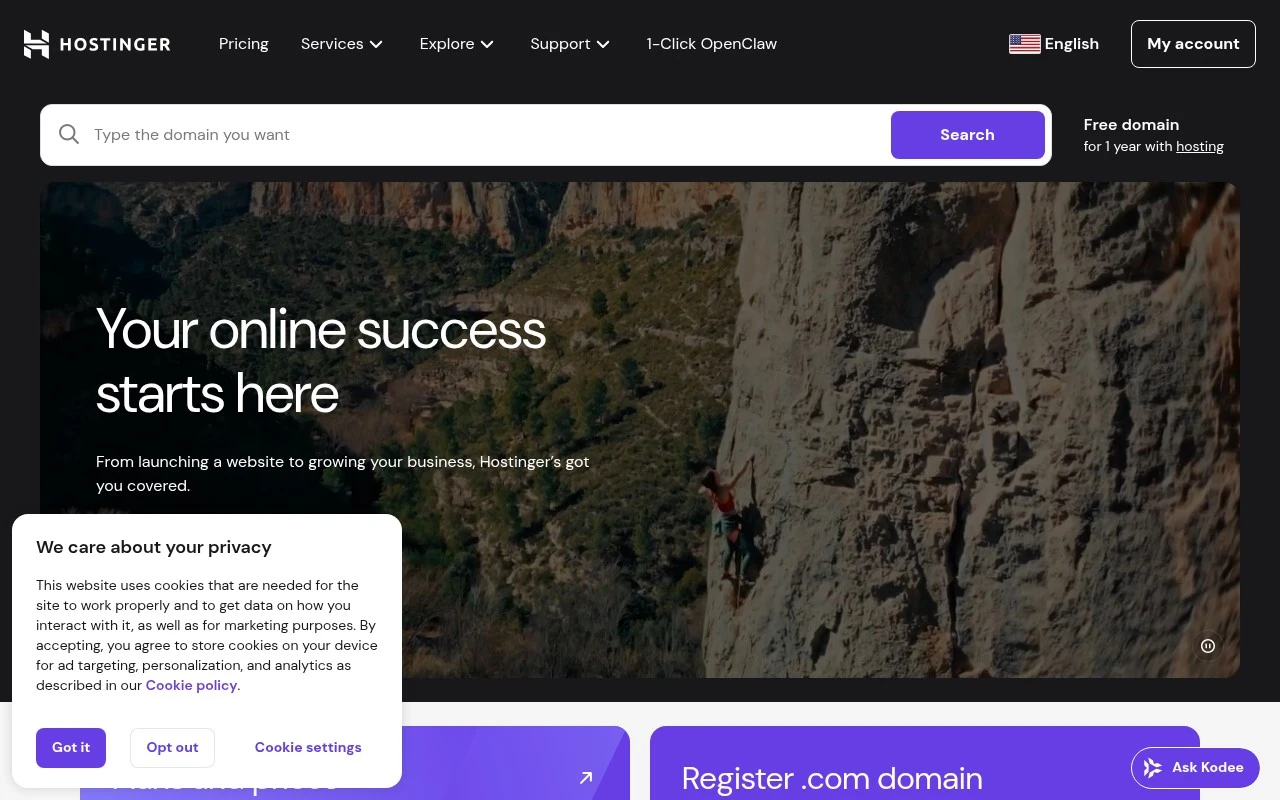
Hostinger is a web hosting platform that provides shared, cloud, and VPS hosting along with domain registration, business email, and website builder tools for creating and managing websites.
Website BuildersLanding Page Builders

FYAI Score

8.4 / 10

Based on 70,146 reviews

Pricing:

Paid

Best for:

Creators and small businesses launching websites and online stores

Score Breakdown

  • Ease of use8.6 / 10
  • Features8.3 / 10
  • Pricing8.5 / 10
  • Integrations7.5 / 10
  • Support9.2 / 10

PRODUCT PREVIEW

What this AI tool does

Hostinger is an all-in-one website hosting, site-building, and AI-assisted creation platform for individuals, small businesses, creators, and teams that want to bring an idea online from one account. It combines domain registration, managed WordPress hosting, drag-and-drop site creation, AI website generation, business email, and scalable infrastructure into a single web presence platform. For a user starting from a blank page, the core appeal is that the path from idea to published site is relatively direct. A business can register a domain, build landing page content, launch a portfolio, publish a service website, or start an online store without stitching together many separate products. The platform is designed to reduce the operational work that often sits around creating a website. Traditional website hosting remains a major part of the product. Shared hosting, WordPress hosting, cloud hosting, and VPS options give different types of users a place to run sites, applications, and larger web projects. Hostinger is for beginners who need guided setup as well as developers or growing businesses that need more control over performance, server resources, and deployment. AI-assisted creation is where the product has expanded beyond conventional hosting. Hostinger Horizons lets users describe a website or web app idea in natural language and turn that description into a generated project, making website generation and app generation part of the same broader workflow. Instead of treating AI as a separate add-on, the tool places it near the moment when someone is deciding what to build and how to publish it. Small businesses and solo operators are a natural fit because many web tasks live in one environment. Online store creation, appointment-style service pages, contact forms, portfolio sections, and basic marketing pages can be built without requiring a full development team. The drag-and-drop builder is especially useful for users who care more about launching clearly than about managing code. WordPress users get a more familiar route into the platform. Managed WordPress tools, templates, performance features, and hosting controls support people who prefer the WordPress ecosystem but still want simplified setup and maintenance. This makes the platform relevant for blogs, content sites, business websites, and agencies that build repeatable client projects. Email and marketing tools round out the web presence story. A business can add professional email accounts connected to its domain and, in some workflows, create email campaign activity around the site it has published. That matters because launching a site is rarely the end goal, as most users also need ways to communicate, capture leads, and present a credible brand. For larger or more technical projects, the infrastructure side gives Hostinger room to grow with the user. VPS and cloud plans support workloads that need more dedicated resources than entry-level website hosting can provide. Developers can use the platform as a hosting base for custom projects while non-technical team members use the site-building and AI tools for faster publishing. The character of the platform is practical rather than experimental. Its AI features are positioned around getting websites and web apps online, not simply generating isolated assets or mockups. The result is a tool that connects ideation, creation, publishing, and ongoing web operations in one commercial environment. Hostinger is best at helping people move from an online idea to a working web presence with fewer separate services to manage. It is not only a host, and it is not only a no-code builder. It is a combined website hosting and creation platform for users who want domain, site, AI generation, email, and scaling options to live close together.

Use cases

Best for

Website Hosting

Use Hostinger to host WordPress or custom sites on shared, cloud, or VPS plans and connect a registered domain.

Build Landing Page

Build a landing page with Hostinger’s drag and drop builder, then publish it to your domain with built in hosting.

Website Generation

Generate a website by describing it in Hostinger Horizons, then edit the AI created pages and publish online.

ANALYSIS

Strengths & limitations

Strengths
  • Best suited to individuals and small businesses that want one vendor for domains, hosting, site building, AI-assisted creation, email, and marketing assets because it reduces the number of separate tools needed to launch online.
  • Useful for non-technical creators because Hostinger Horizons and AI content tools can turn prompts into websites, web apps, copy, logos, and images with less manual setup.
  • Flexible for growing projects because users can start with drag-and-drop or WordPress options and move toward VPS or cloud hosting when they need more control or capacity.

Limitations
  • Less suitable for buyers who need a free tool because Hostinger is a paid platform and ongoing hosting or builder costs are part of using it.
  • Less suitable for teams that require maximum portability because sites and apps built through Hostinger’s builder or Horizons workflows can create dependence on Hostinger’s platform and hosting environment.
  • Less suitable for complex custom software projects because its AI-assisted site and app creation is geared toward launching online projects quickly rather than replacing a full bespoke development stack.

Evaluation

FYAI score breakdown

Our structured evaluation across five key criteria

8.4 / 10

Overall score

Based on 70,146 reviews

  • Ease of use8.6 / 10
  • Features8.3 / 10
  • Pricing8.5 / 10
  • Integrations7.5 / 10
  • Support9.2 / 10

What users say

Findings from public reviews, documentation and community sources.

  • Ease of use

    Hostinger says, “Describe what you want, and Horizons builds it. No technical skills needed,” and Hostinger also references a drag-and-drop website builder and a “simple dashboard” testimonial.

  • Features

    Hostinger’s pricing page lists “Drag-and-drop website builder,” “Integrated ecommerce,” “AI tools,” and “Vibe coding” credits as part of its website-building stack.

  • Pricing

    Hostinger’s pricing page lists Premium at “$2.99/mo” for 48 months with “Renews at $10.99/mo.” Hostinger’s pricing page also states “30-day money-back guarantee,” “Cancel anytime,” and “All plans are paid upfront.”

  • Integrations

    Hostinger’s Horizons integrations page describes connecting projects with “essential services like payments, user accounts, analytics, and more.” Hostinger support pages point users to in-builder integration settings.

  • Support

    Hostinger advertises “24/7 support” and “Priority 24/7 expert support.” Hostinger says Kodee chat/WhatsApp help can “help you choose the right plan, set things up, and start your online journey.”

Who is this for?

Best for users who want a hosted website/app builder with commerce and AI tools in one place, Hostinger’s pricing page lists “Drag-and-drop website builder,” “Integrated ecommerce,” “AI tools,” and “Vibe coding” credits. Less suited to buyers avoiding upfront commitments or renewal changes, Hostinger’s pricing page lists Premium at “$2.99/mo” for 48 months with “Renews at $10.99/mo,” and states “All plans are paid upfront.”

PRODUCT PREVIEW

Feature highlights

AI Website Builder

Describe your idea and generate a ready-to-edit website in minutes.

Domains + Email

Register a domain and add professional email for your brand.

VPS & Cloud Hosting

Scale from simple sites to bigger projects with managed hosting plans.

COMPARE

Discover curated alternatives worth comparing

Compare similar AI tools based on features, pricing and use cases

8.8/ 10Based on 14,986 reviews

WordPress

Website BuildersE-commerce Builders
Builds websites and helps create site content with AI tools
Best for:
Small business owners
Pricing
Freemium

8.6/ 10Based on 28,442 reviews

Wix AI

Website BuildersE-commerce Builders
Builds a website draft from answers for later customization
Best for:
Small business owners
Pricing
Freemium

7.7/ 10Based on 35 reviews

WeWeb

Hosting & DeploymentApp / No-code Builders
Builds web-app pages, databases, logic, and coded components
Best for:
Startup founders
Pricing
Freemium

Launch a fast, professional website with Hostinger and start growing online today. Join millions who build and scale their sites without the hassle.

FAQ

Frequently asked
questions

Everything you need to know about this AI tool,
its features, pricing, use cases, and limitations.

Who is Hostinger best for?
Hostinger is best for individuals, small businesses, creators, ecommerce owners, agencies, and developers that want hosting, domains, email, and site-building tools in one platform. It fits users launching websites, WordPress sites, landing pages, online stores, or web app projects who prefer a guided setup with AI-assisted creation and support.
Is Hostinger free or paid?
Hostinger is a paid platform, with plans built around hosting, website creation, domains, email, and related services. Buyers should compare the included websites, storage, mailboxes, backups, AI usage, and renewal terms because promotional introductory pricing can differ from the longer-term monthly cost.
What are the best Hostinger alternatives to consider?
The best Hostinger alternative depends on whether the priority is low-cost website hosting, WordPress management, landing page creation, online store setup, or app generation. Hostinger is strongest when buyers want multiple basics in one provider, while more specialised platforms may suit teams that need deeper design control, ecommerce features, developer workflows, or enterprise governance.
How quickly can I set up a website with Hostinger?
Hostinger’s main trade-offs are renewal pricing, plan limits, and uncertainty around the depth of some AI capabilities for complex builds. Lower-tier plans can cap websites, storage, mailboxes, and AI or vibe coding credits, so buyers should check whether the selected plan supports their expected traffic, content, email, and development needs.
What should I check about Hostinger privacy and compliance?
Teams using Hostinger should review its current privacy, security, data processing, backup, and compliance documentation before hosting sensitive or regulated data. Important checks include where data is stored, who can access admin accounts, how backups and migrations are handled, what security controls are included, and whether any required certifications or contractual terms are available.