Curated ToolThis tool is part of our curated AI directory. We only include tools that meet our standards for relevance, usability and real-world value.

Glide

Build custom apps and add AI steps for data and content tasks

App / No-code Builders
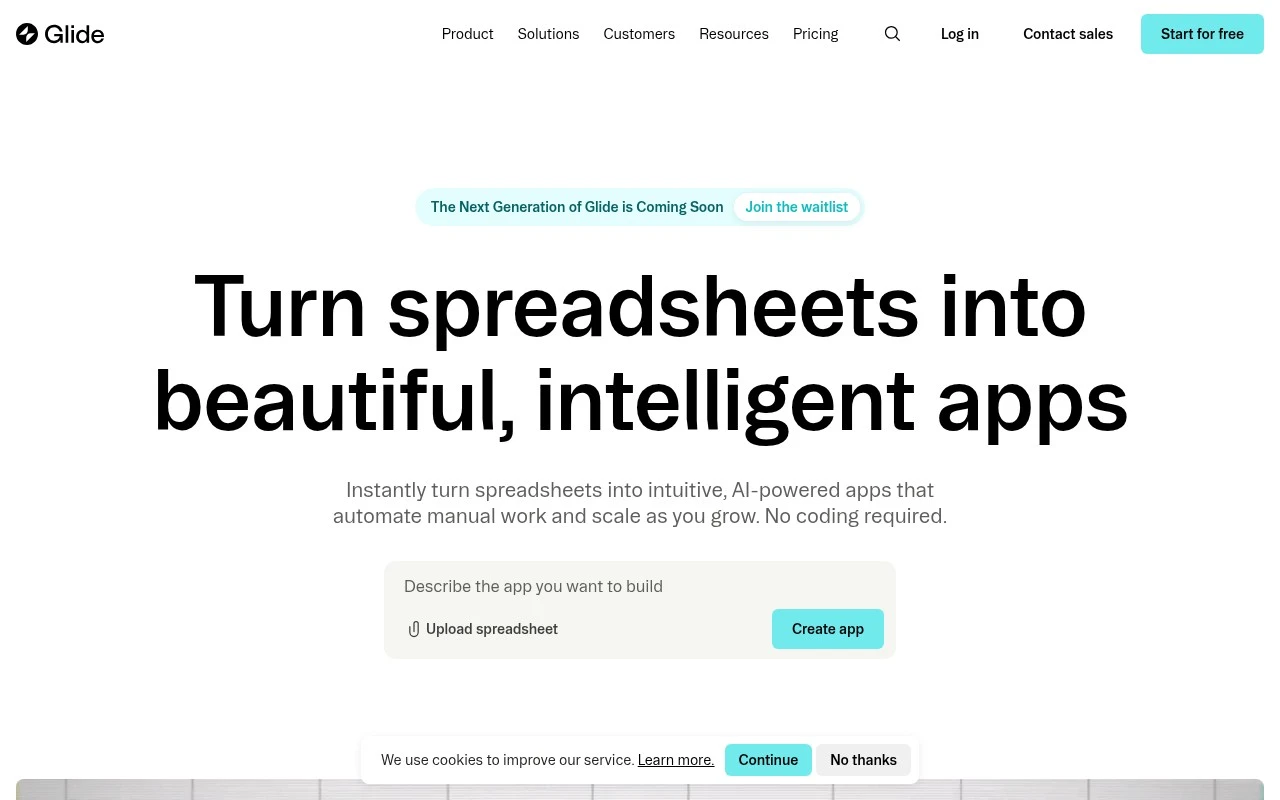
Glide lets businesses build no-code apps on top of their existing data. Users can import or sync spreadsheets and other business systems, design app interfaces with pre-built components, define access-controlled views, and automate processes with workflows and AI features. It is best suited to operational software and internal tools rather than consumer app development from scratch.

FYAI Score

8.7 / 10

Based on 9.682 reviews

Pricing:

Freemium

Best for:

Ops teams building internal tools from spreadsheets and business data

Score Breakdown

  • Ease of use9.2 / 10
  • Features8.8 / 10
  • Pricing7.7 / 10
  • Integrations9.1 / 10
  • Support8.8 / 10

PRODUCT PREVIEW

What this AI tool does

Glide is an AI tool designed to help people turn data and simple inputs into working apps with minimal manual coding. It’s typically used by teams and individuals who want to prototype internal tools, dashboards, or lightweight customer-facing apps without building everything from scratch. In practice, you connect your data source, define how information should be displayed, and let the tool assist with generating and refining the app’s structure and interface. This can be useful for quickly testing ideas, standardizing workflows, and sharing a functional app with others while keeping the build process approachable. Because it focuses on speed and accessibility, it’s often a fit for early-stage prototypes and operational tools where iteration matters. As needs become more complex, it can also serve as a starting point before moving to more customized development.

Use cases

Best for

App Generation

Build an internal app by connecting Glide to a spreadsheet or database and assembling screens with prebuilt components.

Workflow Automation

Automate approvals and notifications by triggering Glide workflows from data changes and writing results back to your tables.

Dashboard Generation

Generate role-based dashboards by turning synced tables into charts, lists, and summary metrics inside a Glide app.

ANALYSIS

Strengths & limitations

Strengths
  • Turns spreadsheet-style data and connected business sources into usable apps without requiring code.
  • Combines data management, app layout, workflows, integrations, permissions, and AI features in one platform.
  • Designed for practical operational use cases such as inventory, logistics, procurement, vendor management, warehouses, portals, dashboards, CRM, and field workflows.
Limitations
  • The product is primarily framed around business operations and internal apps, so it may not fit teams looking to build highly custom consumer software or complex coded products.
  • Design and functionality appear to rely on Glide’s no-code editors, components, layouts, and workflow model, which may limit customization compared with fully custom development.
  • More complex projects may require Glide Solutions, expert partners, or professional implementation support rather than a purely self-serve build.

Evaluation

FYAI score breakdown

Our structured evaluation across five key criteria

8.7 / 10

Overall score

Based on 9.682 reviews

  • Ease of use9.2 / 10
  • Features8.8 / 10
  • Pricing7.7 / 10
  • Integrations9.1 / 10
  • Support8.8 / 10

What users say

Findings from public reviews, documentation and community sources.

  • Ease of use

    G2 reports that users “consistently praise Glide for its ease of use and intuitive interface,” especially for people “without coding experience.” Glide’s own positioning says “From idea to app, in minutes” and “No coding required.”

  • Features

    Glide’s site lists spreadsheet-to-app generation, AI-powered apps and agents, real-time data sync, and workflows with “emails, webhooks, schedules,” conditions, loops, and AI enhancements.

  • Pricing

    Glide’s pricing page lists a Free plan and a Business plan starting at “$199 per month billed yearly,” with 30 included users, $5/additional user annually, 5,000 updates, and overage pricing of “2¢ / update.”

  • Integrations

    Glide’s pricing page lists data connections including Google Sheets, Airtable, BigQuery, and SQL Server, plus “100+ Data Sources,” “Call API,” and “Glide API.”

  • Support

    Glide’s pricing page says Free includes “Community Support,” Business includes “Glide Support” and “Express,” and Enterprise includes “Priority” plus an “Account Manager.” Glide’s site also surfaces Docs, Help Center, Glide University, certification, community, and events.

Who is this for?

Best for non-coders building internal business apps from data sources, Glide’s site lists spreadsheet-to-app generation, real-time data sync, and workflows with “emails, webhooks, schedules,” conditions, loops, and AI enhancements. Less suited to teams that need low-cost paid deployment with many updates, Glide’s Business plan starts at “$199 per month billed yearly,” includes 5,000 updates, and lists overage pricing of “2¢ / update.”

PRODUCT PREVIEW

Feature highlights

Data-powered apps

Build apps from Sheets, Airtable, and databases with live sync.

Role-based access

Create secure views and permissions so each user sees only their data.

Workflows + AI

Automate tasks and approvals with workflows and built-in AI actions.

COMPARE

Discover curated alternatives worth comparing

Compare similar AI tools based on features, pricing and use cases

8.8/ 10Based on 14.986 reviews

WordPress

Website BuildersE-commerce Builders
Builds WordPress sites using an AI website builder and AI tools
Best for:
Small business owners
Pricing
Freemium

8.6/ 10Based on 28.442 reviews

Wix AI

Website BuildersE-commerce Builders
Generates a Wix website draft from user answers for editing.
Best for:
Small business owners
Pricing
Freemium

7.7/ 10Based on 35 reviews

WeWeb

Hosting & DeploymentApp / No-code Builders
Generates web app pages, databases, and logic from prompts
Best for:
Startup founders
Pricing
Freemium

Turn your data into a polished app in days, not months. Join teams using Glide to streamline workflows and deliver better experiences—without writing code.

FAQ

Frequently asked
questions

Everything you need to know about this AI tool,
its features, pricing, use cases, and limitations.

What types of apps is Glide a good fit for, and when should I choose another builder?
Glide works best for internal tools and lightweight customer-facing apps like directories, inventory tracking, field checklists, and simple CRMs. It’s a strong option when your data already lives in spreadsheets or a supported database and you want fast iteration. Consider alternatives if you need highly custom UI, complex offline behavior, or heavy real-time workflows.
How do Glide’s free and paid plans differ in ways that matter during evaluation?
Glide’s free tier is useful for prototyping, but most production needs require paid plans for higher limits, more features, and team controls. Expect constraints around app usage, data rows/storage, and advanced capabilities like custom domains, role-based access, and integrations depending on the plan. If you’re comparing tools, map your expected users and data size to plan limits early to avoid rework.
How does Glide compare with Bubble, Adalo, or Softr for building apps without code?
Glide is typically faster for data-driven apps and internal tools, especially when you can model everything as tables and actions. Bubble offers deeper customization and complex logic at the cost of a steeper learning curve and more build time. Adalo and Softr can be competitive for simpler mobile apps or portal-style sites, but Glide often wins on speed-to-first-app and spreadsheet-to-app workflows.
How quickly can a team get a working app in Glide, and what onboarding effort should I expect?
Glide can feel limiting when you need bespoke UI, unusual navigation patterns, or highly specialized logic beyond what actions and components support. Performance can degrade with very large datasets or complex screens, so you may need to optimize data and views. You’re also working within Glide’s platform constraints, which can affect long-term portability.
What should I consider about data storage, privacy, and compliance when using Glide?
Glide apps can connect to data sources like Google Sheets and Glide Tables, so your compliance posture depends on where data is stored and who has access. Review how authentication, roles, and row-level access are configured to prevent unintended data exposure. If you have regulatory requirements (e.g., HIPAA/PCI), verify Glide’s current compliance commitments and whether your chosen data source and plan support the needed controls.