Curated ToolThis tool is part of our curated AI directory. We only include tools that meet our standards for relevance, usability and real-world value.

Draftbit

Draftbit is a visual builder for creating, previewing, and exporting React Native mobile apps, with tools for screens, components, and API integrations. It can support teams working across app and website generation workflows, but its core focus is low-code mobile app development.
Website BuildersApp / No-code Builders

FYAI Score

8.8 / 10

Based on 23 reviews

Pricing:

Freemium

Best for:

Product teams and developers building production apps with full code access

Score Breakdown

  • Ease of use8.4 / 10
  • Features8.8 / 10
  • Pricing9.2 / 10
  • Integrations8.4 / 10
  • Support9.1 / 10

PRODUCT PREVIEW

What this AI tool does

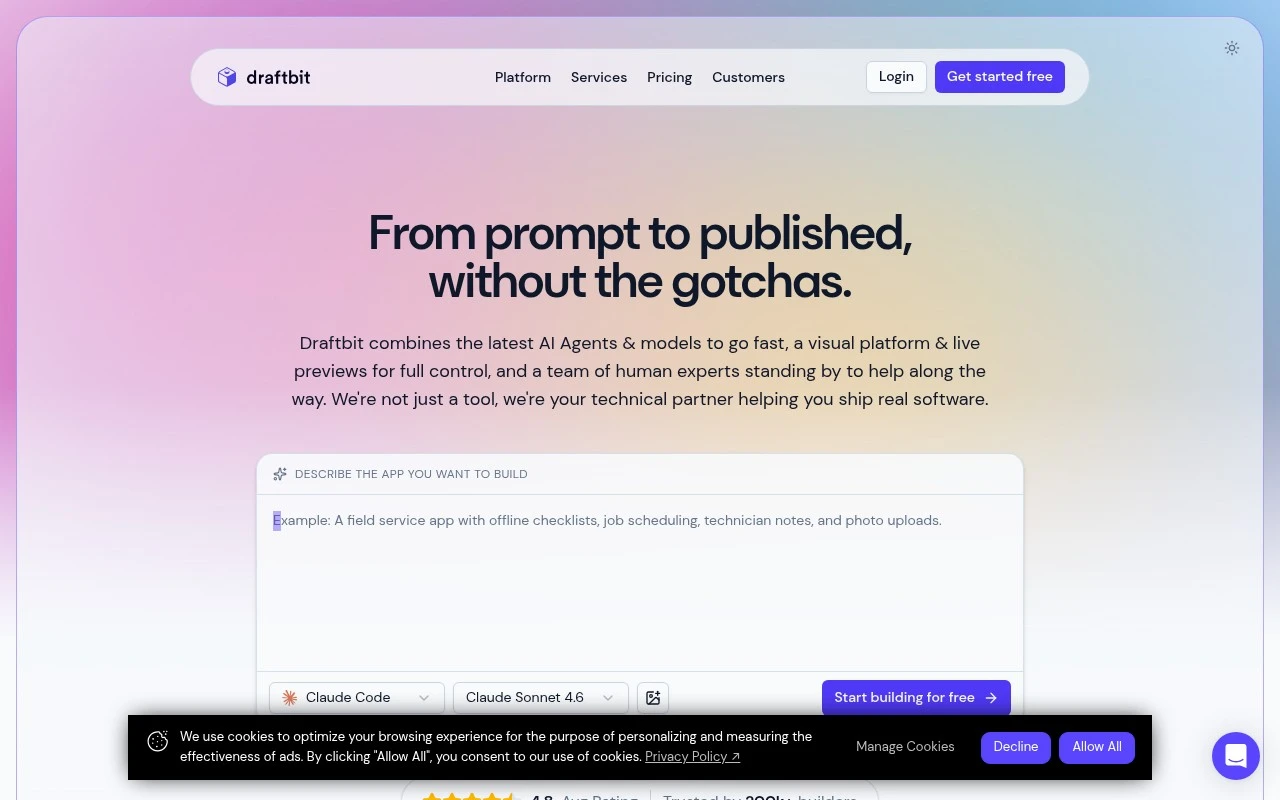
Draftbit is a hybrid AI, visual development, and expert-services platform for building real applications across web, iOS, and Android. Draftbit is for founders, product teams, designers, agencies, and developers who want faster app generation without giving up visual control, source-code access, or the option to work with human experts. Its strongest position is between no-code builders and traditional development, where a team can move from an idea to a working product while still owning the underlying code. App prototyping is often where the platform first makes sense. A user can begin with a prompt, generate an initial structure, then refine screens visually instead of starting from a blank codebase. That makes it useful for validating flows, exploring product concepts, or turning early requirements into something stakeholders can tap through on a device. Unlike closed no-code tools, the workflow is designed around real application development rather than just mockups. The visual editor helps teams adjust layouts and screens quickly, while code access gives technical users room to modify behavior when the visual layer is not enough. Draftbit can generate code as part of the building process, but it also supports the practical work that follows, including connecting APIs, integrating backends, managing versions, and preparing an app for release. For web and mobile teams, Draftbit treats website generation and mobile app creation as connected parts of the same product-building process. A project can target web, iOS, and Android, with previews that help teams see how changes behave on real devices. This makes the platform especially relevant for products that need more than a landing page, such as internal tools, marketplace apps, customer portals, SaaS companions, and mobile-first services. Version history, GitHub workflows, and source-code export are central to its identity. Many app builders promise speed, but Draftbit is best at combining AI-assisted creation with developer-friendly handoff and long-term ownership. That matters for teams that expect their prototype to become a production product, not just a demo that must later be rebuilt elsewhere. Human support is another part of the story. The platform includes optional expert services, so teams can use AI and visual editing for speed, then bring in specialists when architecture, integrations, design polish, or launch readiness require deeper help. This gives Draftbit a more flexible character than a pure self-serve builder, especially for nontechnical founders or small teams with limited engineering capacity. For teams comparing Draftbit alternatives, the main question is whether they want a closed no-code workflow or a builder that keeps code, integrations, and collaboration closer to conventional software development. A Draftbit review should focus less on whether it replaces engineers entirely and more on how well it shortens the distance between product idea, prototype, functional app, and maintainable source code. Draftbit pricing will matter by team size and support needs, but the broader value is the combination of AI agents, visual development, exportable code, versioning, and access to experts in one platform. Overall, Draftbit is best understood as a product-building environment for teams that want speed without a dead end. It helps users generate, shape, test, connect, and ship apps while preserving the ability to inspect and extend the code. That balance makes it particularly suitable for serious prototypes, MVPs, and production-oriented apps where flexibility and ownership matter as much as fast creation.

Use cases

Best for

App Generation

Draftbit generates iOS, Android, and web app screens from prompts, then lets you visually edit, preview, and publish or export source code.

Website Generation

Use Draftbit to build responsive web app pages with a visual editor, connect APIs, preview changes, and deploy or export the code.

Generate Code

Generate editable React Native code from visual screens, sync with GitHub, and customize components and API logic in code when needed.

ANALYSIS

Strengths & limitations

Strengths
  • Best suited to teams that want both visual building and code access because they can refine screens visually, edit source when needed, and avoid a closed no-code workflow.
  • Useful for founders and agencies building across web, iOS, and Android because one workspace can support multi-platform app creation, device previews, publishing, and source export.
  • Strong fit for teams that want AI assistance without giving up development control because AI agents, version history, GitHub-style workflows, integrations, and optional experts can support a more complete build process.

Limitations
  • Less suitable for users who want the simplest no-code builder because Draftbit’s code access, API connections, versioning, and publishing options add concepts that nontechnical teams may need time to learn.
  • Less ideal for teams that want a completely hands-off app builder because connecting backends, managing integrations, and preparing production releases can still require technical decisions.
  • The freemium model is best for evaluation and early experimentation because teams building serious apps should expect important capabilities, collaboration, or publishing needs to require a paid plan.

Evaluation

FYAI score breakdown

Our structured evaluation across five key criteria

8.8 / 10

Overall score

Based on 23 reviews

  • Ease of use8.4 / 10
  • Features8.8 / 10
  • Pricing9.2 / 10
  • Integrations8.4 / 10
  • Support9.1 / 10

What users say

Findings from public reviews, documentation and community sources.

  • Ease of use

    Software Advice user-review signals describe Draftbit as speeding up app development and being "relatively easy," and G2 snippets mention Draftbit's builder and templates as "very easy to use."

  • Features

    Draftbit's features page describes "cross-platform apps with AI assistance, visual editing, live preview, full code access, and publishing built in." Draftbit's features page also lists code export to GitHub or Zip, templates, simulators, and one-click publishing.

  • Pricing

    Draftbit's pricing page lists a Free plan, Standard at "$12 /month," Pro at "$24 /month," and Team at "$120 /month." Draftbit's pricing page includes notes on credits, publishing, code export, seats, and support tiers, and paid base plans list credits as add-ons.

  • Integrations

    Draftbit's pricing page advertises "100+ integrations & MCPs," and paid tiers include "Unlimited Integrations." Draftbit's pricing page says higher tiers add GitHub export plus custom MCP server integrations.

  • Support

    Draftbit's pricing page says Free includes community support, Standard adds email support, Pro adds "Priority Support & Training," and Team includes training sessions plus a dedicated account manager. Capterra review snippets describe a "great community forum" and helpful, receptive customer-facing team members.

Who is this for?

Best for teams that want a visual app builder while keeping source-code options, Draftbit's features page lists full code access and code export to GitHub or Zip. Less suited to teams that need all usage included in the base subscription, Draftbit's pricing page says paid base plans list credits as add-ons.

PRODUCT PREVIEW

Feature highlights

Prompt-to-app start

Kick off screens and flows from AI prompts, then refine as you go.

Visual screen builder

Edit UI visually, preview on devices, and iterate without rebuilds.

Exportable source code

Access and export code, use GitHub/version history, and ship anywhere.

COMPARE

Discover curated alternatives worth comparing

Compare similar AI tools based on features, pricing and use cases

8.8/ 10Based on 14,986 reviews

WordPress

Website BuildersE-commerce Builders
Builds websites and helps create site content with AI tools
Best for:
Small business owners
Pricing
Freemium

8.6/ 10Based on 28,442 reviews

Wix AI

Website BuildersE-commerce Builders
Builds a website draft from answers for later customization
Best for:
Small business owners
Pricing
Freemium

7.7/ 10Based on 35 reviews

WeWeb

Hosting & DeploymentApp / No-code Builders
Builds web-app pages, databases, logic, and coded components
Best for:
Startup founders
Pricing
Freemium

Turn your app idea into a real mobile product faster. Start building with Draftbit today and ship a polished iOS and Android app your team can own and iterate on.

FAQ

Frequently asked
questions

Everything you need to know about this AI tool,
its features, pricing, use cases, and limitations.

Who is Draftbit best suited for?
Draftbit is best suited for founders, product teams, agencies, developers, and business builders creating web, iOS, or Android apps. It fits teams that want more control than a basic no-code builder, with visual editing, AI-assisted changes, code access, integrations, and publishing workflows in one workspace.
Does Draftbit have a free plan, and what should I expect to pay for?
Draftbit uses a freemium pricing model, so users can start with a free option and may need a paid plan for expanded capabilities. Buyers should check Draftbit’s current pricing page for limits around projects, AI usage, source export, publishing, collaboration, integrations, and expert services before committing.
How does Draftbit compare with other app builders?
Draftbit stands out from simpler app builders by combining visual app design with AI agents, code editing, source export, version history, integrations, and publishing. The right alternative depends on whether a team prioritizes speed, design control, backend flexibility, developer handoff, pricing, or fully managed no-code simplicity.
How quickly can a team get started with Draftbit?
Draftbit is focused on building apps and software, not general content creation or broad AI assistance. Teams should expect some technical involvement for complex backends, custom integrations, debugging AI-generated changes, deployment decisions, and advanced code requirements. Paid expert help may be useful for projects that exceed typical visual-builder workflows.
What should I consider about data privacy and compliance when using Draftbit?
Teams using Draftbit should review how prompts, project details, code, API credentials, and backend data may be handled across the platform and connected AI providers. For regulated or sensitive use cases, confirm current privacy terms, data retention practices, third-party model usage, access controls, and compliance requirements directly with Draftbit before production use.