Curated ToolThis tool is part of our curated AI directory. We only include tools that meet our standards for relevance, usability and real-world value.

Moz

Moz is an SEO software platform that helps marketers research keywords, track search rankings, audit websites, and analyze backlinks. It provides data and workflows for improving organic search visibility.
Content & On-pageBacklinks & Off-page

FYAI Score

8.7 / 10

Based on 1,102 reviews

Pricing:

Free trial

Best for:

SEO teams and agencies improving rankings and reporting performance

Score Breakdown

  • Ease of use9.0 / 10
  • Features8.9 / 10
  • Pricing8.2 / 10
  • Integrations8.6 / 10
  • Support8.9 / 10

PRODUCT PREVIEW

What this AI tool does

Moz is an SEO software suite for marketers, agencies, and in-house teams that need keyword research, competitor analysis, backlink analysis, rank tracking, local SEO management, and search visibility data in one ecosystem. Its products are organized around practical SEO workflows, from understanding what people search for to monitoring how pages, domains, and local business profiles perform over time. At the center of the platform is Moz Pro, the core product for organic search work. It helps users investigate keywords, compare domains, analyze links, crawl websites, and track rankings so that SEO decisions are based on measurable search data rather than isolated reports. For teams that manage ongoing optimization, Moz Pro connects research, technical SEO analysis, and performance monitoring in a single workspace. For SEO teams, Moz is best at turning complex search signals into accessible metrics and repeatable workflows. Domain Authority, Page Authority, Spam Score, and related link metrics have become familiar reference points for backlink analysis, competitive research, and SEO client reporting. The platform’s strength is not only that it gathers data, but that it translates that data into formats marketers can use when prioritizing content, links, and technical fixes. STAT extends the Moz ecosystem for organizations that need large-scale daily SERP analysis and rank tracking. It is designed for enterprises, agencies, and search teams monitoring thousands or millions of keywords across locations, devices, and search result types. Where a smaller team may need visibility into priority terms, STAT supports deeper tracking for brands with broad portfolios, regional markets, or complex reporting requirements. Local SEO is handled through Moz Local, which focuses on business listings, review management, local reputation, and location-level reporting. This part of the platform is useful for businesses that depend on accurate directory information and consistent local presence across the web. It helps teams manage how locations appear in search and map experiences, while also giving them a structure for monitoring customer feedback and local performance. Developers and data teams can use the Moz API to bring proprietary SEO metrics and link intelligence into custom tools, dashboards, and internal systems. Moz provides API access to data such as Domain Authority, Page Authority, Brand Authority, Spam Score, and link indexes, which allows teams to enrich their own reporting or automate parts of their SEO analysis. This makes the platform relevant beyond its user interface, especially for companies that build SEO data into larger marketing operations. AI search visibility tracking adds a newer layer to the product story as search behavior expands beyond traditional blue links. Moz helps teams look at visibility across evolving search experiences, including AI-driven results, so they can understand whether their brands and content are being surfaced in new discovery environments. This fits naturally with its broader role as a visibility platform rather than only a keyword tracker. The broader value of Moz is its balance between depth and usability. It serves beginners who need clear direction, agencies that need structured reporting, and advanced teams that want dependable metrics for content gap analysis, on page optimization, technical audits, and competitor research. Moz is positioned as a long-standing SEO platform for organizations that want search intelligence they can explain, monitor, and act on across organic, local, and data-driven workflows.

Use cases

Best for

Backlink Analysis

Moz analyzes inbound links and anchor text, showing Domain Authority, Spam Score, and linking domains for a URL or site.

Keyword Research

Moz Pro surfaces keyword suggestions with volume, difficulty, and SERP analysis so you can compare ranking opportunities.

Local SEO

Moz Local syncs business listings, monitors reviews, and reports local visibility across key directories for each location.

ANALYSIS

Strengths & limitations

Strengths
  • Strong fit for SEO teams that want keyword research, link analysis, rank tracking, site crawling, and competitive research in one established toolkit.
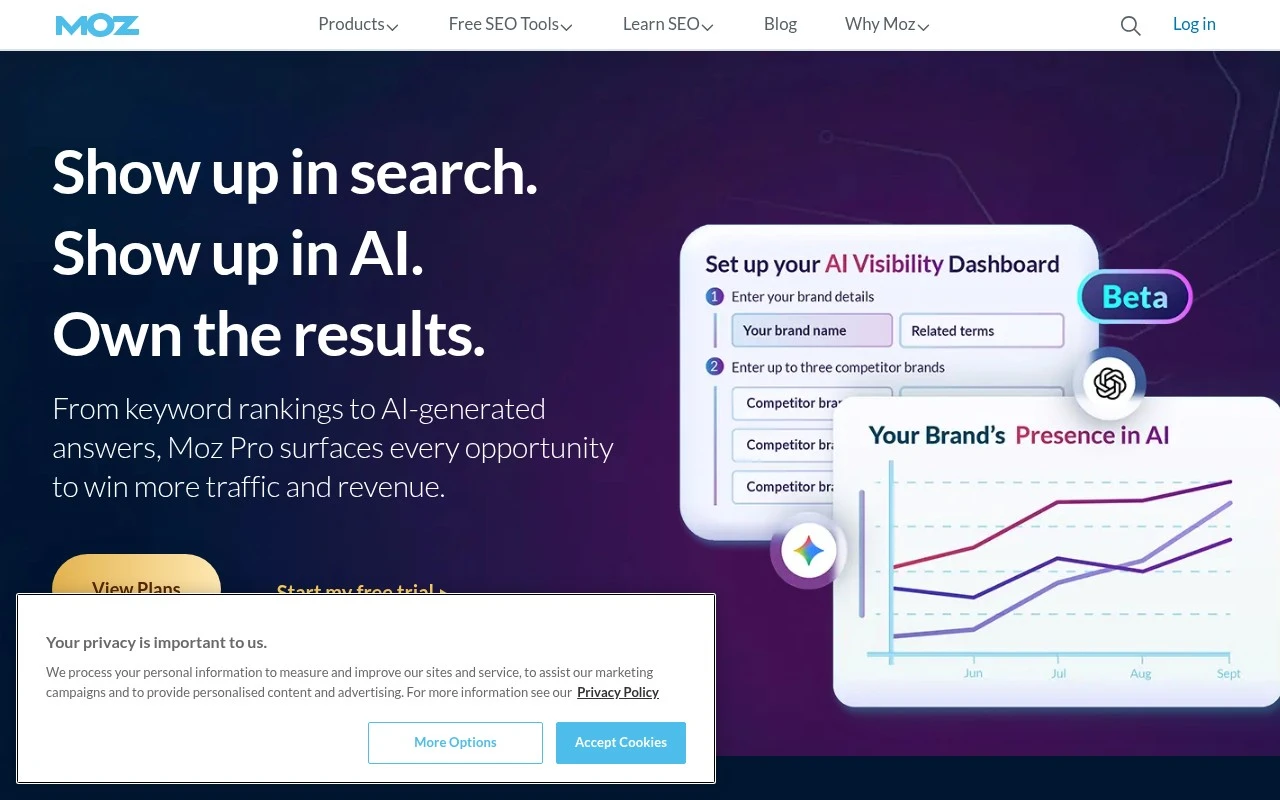
  • Useful for teams tracking AI search visibility because Moz benchmarks brand presence in Google AI Mode, ChatGPT, and Gemini alongside traditional SERP data.
  • Well suited to agencies, local brands, and enterprises because Moz Pro, STAT, Moz Local, and the Moz API cover campaign SEO, large-scale rank tracking, listings management, and custom data access.

Limitations
  • Less suitable for buyers that want one unified product for every SEO need because Moz separates core SEO, enterprise rank tracking, local listings, and API access across different products.
  • Less suitable for teams seeking a permanently free SEO workflow because Moz is structured around paid products after the free trial.
  • Less suitable for users without SEO expertise because interpreting metrics such as Domain Authority, Spam Score, rank movement, and AI visibility benchmarks still requires search strategy knowledge.

Evaluation

FYAI score breakdown

Our structured evaluation across five key criteria

8.7 / 10

Overall score

Based on 1,102 reviews

  • Ease of use9.0 / 10
  • Features8.9 / 10
  • Pricing8.2 / 10
  • Integrations8.6 / 10
  • Support8.9 / 10

What users say

Findings from public reviews, documentation and community sources.

  • Ease of use

    G2’s 608-review Moz Pro product page rates Moz Pro 4.3/5 and says Moz Pro has “one of the most intuitive interfaces in the SEO space,” making Moz Pro “easy to navigate even for beginners.”

  • Features

    Moz’s homepage positions Moz Pro as an “all-in-one SEO and AI search toolkit” with keyword research, link research, rank tracking across “170+ search engines,” and AI visibility.

  • Pricing

    Moz’s pricing page publishes Standard at “$99 USD / mo,” Medium at “$179 USD / mo,” Large at “$299 USD / mo,” and a “starter solution” at “$49/month.” Moz’s pricing page also lists annual savings and a free trial on Medium.

  • Integrations

    Moz’s Moz API page describes Moz API as giving users power to “create custom SEO tools, dashboards, and integrations.” Moz’s app gallery references “many apps that use the Moz API data.”

  • Support

    Moz’s pricing page states every Moz Pro plan includes a “1-on-1 walkthrough,” “24-hour online support,” and “Moz Q&A forum.” Moz’s pricing plan comparison lists “24/7 Support.”

Who is this for?

Best for SEO teams that need keyword research, link research, rank tracking across “170+ search engines,” and AI visibility in one toolkit, Moz’s homepage positions Moz Pro as an “all-in-one SEO and AI search toolkit.” Less suited to teams that do not want API-based workflows. Moz describes Moz API as the way to “create custom SEO tools, dashboards, and integrations.”

PRODUCT PREVIEW

Feature highlights

Rank & SERP tracking

Track rankings daily at scale and monitor SERP changes over time.

Moz API metrics

Use DA, PA, Spam Score, and link data in your own dashboards.

Daily Rank Monitoring

Track search performance daily with scalable reporting across markets.

COMPARE

Discover curated alternatives worth comparing

Compare similar AI tools based on features, pricing and use cases

8.8/ 10Based on 846 reviews

Yoast SEO

Content & On-pageTechnical & Audit
Optimizes SEO titles, descriptions, and product content
Best for:
SEO teams
Pricing
Freemium

8.1/ 10Based on 1,124 reviews

Yext

SEO MonitoringAI Search / GEO
Publishes verified business data, tracks AI and search discovery
Best for:
SEO teams
Pricing
Paid

7.7/ 10Based on 5,772 reviews

Writesonic

Copy Optimization
Surfaces answer-engine visibility and citation gaps for GEO fixes
Best for:
Marketing teams
Pricing
Freemium

Join thousands of marketers using Moz to grow organic traffic and rank with confidence. Turn SEO data into clear next steps and measurable wins.

FAQ

Frequently asked
questions

Everything you need to know about this AI tool,
its features, pricing, use cases, and limitations.

Who is Moz best suited for?
Moz is best suited for SEO teams, agencies, digital marketers, local businesses, multi-location brands, and enterprises that need to measure and improve search visibility. It fits workflows around keyword research, competitor and backlink analysis, rank tracking, technical SEO audits, local listings, reviews, and visibility in AI-generated answer surfaces.
Can I use Moz for free, or is the free trial only for testing?
Moz offers a free trial for evaluation rather than positioning itself as a fully free ongoing SEO suite. Buyers should use the trial to test core workflows such as keyword research, rank tracking, site audits, backlink analysis, and reporting, then confirm current plan limits on moz.com before committing.
What should I compare Moz against when looking at similar SEO tools?
Moz should be compared with SEO platforms that cover keyword research, rank tracking, backlink analysis, technical audits, competitor analysis, local SEO, and reporting. The right alternative depends on whether your priority is all-in-one SEO coverage, large-scale SERP tracking, local listing management, API access, or AI search visibility tracking.
How much setup work does Moz usually require?
Moz is focused on SEO, local search, SERP data, and search visibility rather than broader marketing functions such as paid advertising, email, or CRM. Some larger workflows may involve separate Moz offerings, such as STAT for rank tracking, Moz Local for listings, or API access for data integration.
What privacy and compliance questions should buyers ask before using Moz?
Buyers should review Moz’s current privacy, security, data processing, and compliance documentation before connecting business or client data. Important checks include how keywords, domains, backlinks, locations, reviews, API data, users, and reports are handled, especially for agencies, enterprises, and multi-location brands managing sensitive client information.