Curated ToolThis tool is part of our curated AI directory. We only include tools that meet our standards for relevance, usability and real-world value.

Superhuman

Superhuman is an email client for Gmail and Outlook that helps teams manage inboxes with keyboard shortcuts, split inboxes, reminders, read statuses, and AI-assisted writing and summarization.
Task & Project ManagementEmail Assistant

FYAI Score

8.6 / 10

Based on 15,748 reviews

Pricing:

Paid only

Best for:

Leaders and operators who live in email and need faster execution

Score Breakdown

  • Ease of use8.7 / 10
  • Features9.0 / 10
  • Pricing7.4 / 10
  • Integrations9.1 / 10
  • Support8.9 / 10

PRODUCT PREVIEW

What this AI tool does

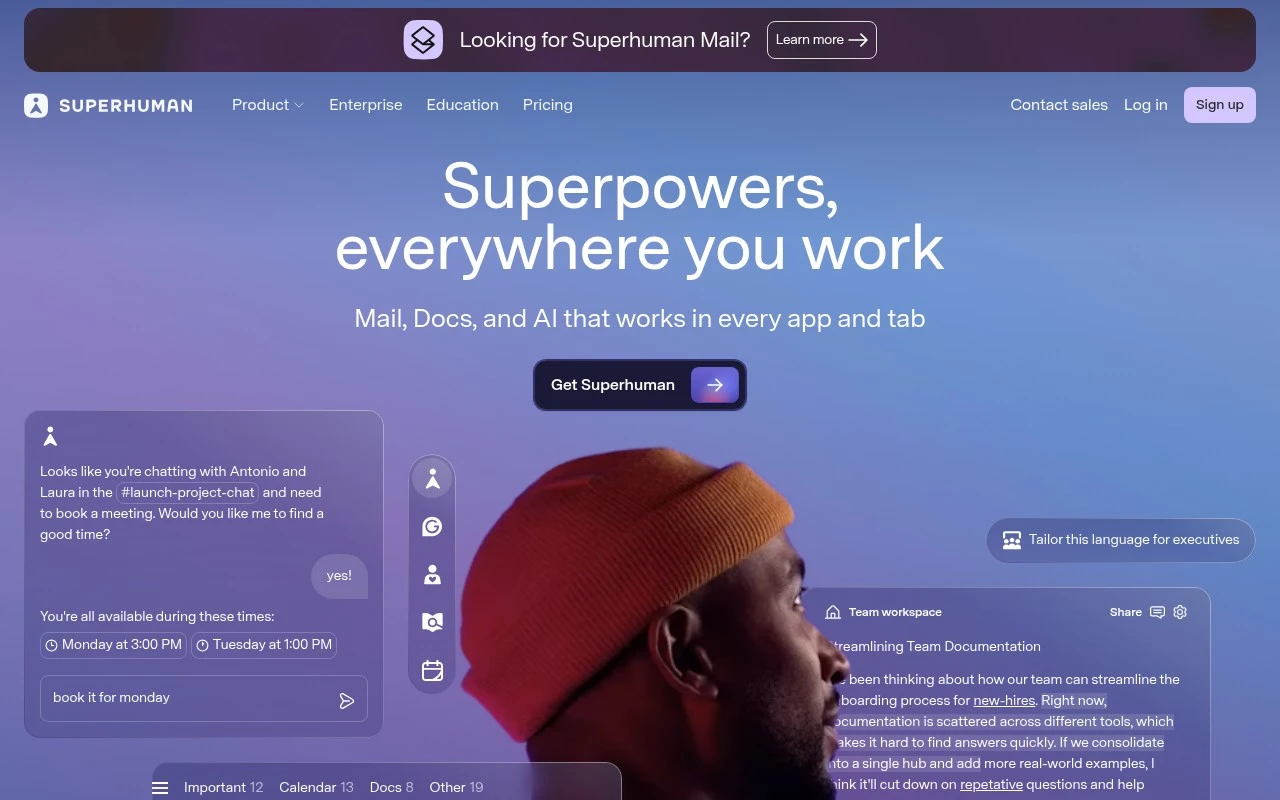
Superhuman is an AI productivity suite for work across email, writing, documents, team workflows, and everyday business apps. It brings together Superhuman Mail, Grammarly, Coda, and Go into a broader system for communication, collaboration, and task execution. Superhuman is best at helping knowledge workers move faster through inbox triage, email writing, document creation, and workflow automation without constantly switching context. For busy professionals, the platform is designed around the reality that work is scattered across many tools. Messages live in Gmail, files sit in Drive, projects move through Jira, conversations happen in Slack, and customer information may be stored in Salesforce. Superhuman gives those fragmented work streams a more unified AI layer, so users can find information, draft responses, and act on tasks with less manual effort. At the center of the experience is Superhuman Mail, an email app built for speed, focus, and high-volume communication. It is aimed at people who treat the inbox as a command center, including executives, founders, sales teams, operators, recruiters, and client-facing professionals. The value is not only faster email, but a more intentional way to triage, prioritize, and respond before the inbox becomes a bottleneck. Writing support comes through Grammarly, which extends the suite beyond sending and sorting messages. The AI writing assistant helps users improve tone, clarity, correctness, and concision across professional communication. In practice, that means someone can rewrite content, polish a proposal, adapt a message for a different audience, or turn rough notes into cleaner business writing. Team knowledge and project coordination are represented by Coda, the all-in-one workspace in the suite. Coda gives teams a flexible place to build docs, tables, trackers, lightweight apps, and collaborative systems without relying only on static documents or spreadsheets. For project management, planning, operating rhythms, and internal knowledge bases, it helps teams turn information into structured work. A more agentic layer appears through Go, the proactive AI assistant designed to work across connected apps. Rather than waiting inside a single editor or chat window, it can use context from tools such as Gmail, Drive, Jira, Slack, Salesforce, and other workplace systems. This positions the platform as more than a writing tool, since it can assist with actions that depend on information spread across the modern work stack. The larger product story is about reducing the distance between knowing what needs to happen and actually getting it done. Email, documents, tasks, meetings, and app data are usually handled as separate workflows, which creates friction and repetition. By combining communication, writing, workspace creation, and app-aware assistance, the platform aims to make everyday work feel more continuous. Superhuman is built for individuals and teams that value speed, polish, and operational focus in their daily tools. Superhuman is strongest for professionals who live in their inbox, write constantly, coordinate across teams, and need AI help that understands more than one app at a time. Its character is less about replacing a single productivity app and more about creating an intelligent work layer across the tools people already depend on.

Use cases

Best for

Inbox Triage

Superhuman Mail helps you triage by using AI to summarize threads and draft quick replies from your inbox context.

Project Management

Use Coda in Superhuman to manage projects by turning docs into tables, tasks, and workflows that sync with your team.

Email Writing

Use Grammarly in Superhuman to rewrite emails with tone, clarity, and grammar suggestions as you type.

ANALYSIS

Strengths & limitations

Strengths
  • Best suited to email-heavy knowledge workers because Superhuman Mail and AI assistance can help draft replies, manage follow-ups, and schedule meetings from conversations.
  • Strong fit for teams that write across many work contexts because Grammarly-powered assistance can refine emails, documents, and everyday business communication.
  • Useful for operators and executives with work spread across multiple apps because Go can draw on connected tools such as Gmail, Drive, Jira, Slack, and Salesforce to surface context and take action.

Limitations
  • Less suitable for teams seeking a free productivity tool because Superhuman is paid-only.
  • Less suitable for organizations that do not want to connect core business apps because much of the cross-app assistance depends on access to tools such as email, drives, chat, and CRM systems.
  • Potentially heavier than a single-purpose email or writing tool because the suite spans mail, writing, workspace, automation, and proactive assistance across multiple apps.

Evaluation

FYAI score breakdown

Our structured evaluation across five key criteria

8.6 / 10

Overall score

Based on 15,748 reviews

  • Ease of use8.7 / 10
  • Features9.0 / 10
  • Pricing7.4 / 10
  • Integrations9.1 / 10
  • Support8.9 / 10

What users say

Findings from public reviews, documentation and community sources.

  • Ease of use

    G2 shows Superhuman at “4.7 stars” from “15748 verified reviews,” and Superhuman’s own positioning says users can “Fly through your inbox twice as fast” and “save 4 hours every single week.”

  • Features

    The Superhuman pricing page lists AI features including “Instant Reply,” “Auto Summarize,” “Ask AI,” and “Voice and Tone Match.” The Superhuman pricing page also references team collaboration, sales CRM features, admin controls, and security options.

  • Pricing

    The Superhuman pricing page lays out tiered plans, “Starter,” “Business,” and “Enterprise”, with feature differences across AI, collaboration, security, and support. A Reddit discussion asks whether “AUD $45/month for an email client” can be justified.

  • Integrations

    Superhuman Docs states “800+ integrations” with “two-way sync” and names “Jira, Salesforce, or Asana.” Superhuman Docs also says MCP connections can link to “ChatGPT, Claude, and Cursor,” and the Superhuman pricing page names Zoom, Google Meet, Microsoft Teams, HubSpot, Salesforce, and Pipedrive.

  • Support

    The Superhuman pricing page lists “Technical Support” via “Email” and “Email & Video Call.” The Superhuman pricing page also lists “Productivity Coaching,” webinars, account management, and “Dedicated Customer Success” on higher tiers.

Who is this for?

Best for email-heavy users and teams that want AI-assisted inbox workflows, the Superhuman pricing page lists “Instant Reply,” “Auto Summarize,” “Ask AI,” “Split Inbox,” “Snooze,” and “Send Later.” Less suited to buyers trying to minimize email-client spend, a Reddit discussion asks whether “AUD $45/month for an email client” can be justified, so budget-conscious users may need to validate the cost against expected time savings.

PRODUCT PREVIEW

Feature highlights

Fast AI email

Blaze through triage with shortcuts, reminders, and AI-assisted replies.

AI writing polish

Rewrite, clarify, and fix tone instantly for confident, crisp messages.

Works across apps

Connect tools like Gmail, Drive, Slack, Jira, and Salesforce for action.

COMPARE

Discover curated alternatives worth comparing

Compare similar AI tools based on features, pricing and use cases

7.8/ 10Based on 31 reviews

Wudpecker

Meeting NotesSummarization
Turns recordings into notes, summaries, action items, and Q&A
Best for:
Knowledge workers
Pricing
Freemium

9.0/ 10Based on 1,589 reviews

Toggl Track

Time & Habit Tracking
Tracks time, automates activity capture, and reports team data
Best for:
Operations teams
Pricing
Freemium

8.5/ 10Based on 2,648 reviews

Todoist

Task & Project Management
Captures tasks, organizes schedules, and clarifies action plans
Best for:
Knowledge workers
Pricing
Freemium

Take control of your inbox and get hours back each week. See why high-performing teams choose Superhuman to stay responsive without the stress.

FAQ

Frequently asked
questions

Everything you need to know about this AI tool,
its features, pricing, use cases, and limitations.

Who is Superhuman best suited for?
Superhuman is best suited for knowledge workers, executives, operators, and teams that spend a large part of the day in email, writing, documents, scheduling, and connected business apps. It is a stronger fit for broad productivity workflows than for buyers who only need a narrow email client or standalone writing tool.
Is Superhuman free or paid?
Superhuman is a paid productivity suite, so teams should expect to evaluate it as a commercial tool rather than a free inbox or writing assistant. Buyers should check superhuman.com for current plan details, product packaging, seat requirements, and any limits that vary across Mail, Grammarly, Coda, and Go.
What are the best alternatives to Superhuman?
The best alternative to Superhuman depends on whether the priority is inbox triage, email writing, project management, workflow automation, team documentation, or cross-app assistance. Some tools focus deeply on one of those areas, while Superhuman is positioned as a broader suite across email, writing, docs, scheduling, and connected workflows.
How hard is it to set up Superhuman for a team?
Superhuman’s main trade-off is breadth: it covers email, writing, documents, scheduling, and connected workflows, which may be more than some teams need. Its value also depends on whether users are willing to adopt multiple Superhuman products and whether those products fit the company’s existing tools and workflows.
What should teams check about Superhuman privacy and compliance?
Teams evaluating Superhuman should review how it handles email, documents, workspace content, connected app data, and AI-assisted context. Buyers should confirm current security controls, admin settings, data retention terms, compliance certifications, and third-party app permissions directly with Superhuman before deploying it for sensitive business workflows.