Curated ToolThis tool is part of our curated AI directory. We only include tools that meet our standards for relevance, usability and real-world value.

Sunsama

Plans daily work by organizing tasks and calendars across tools

Task & Project ManagementTime & Habit Tracking

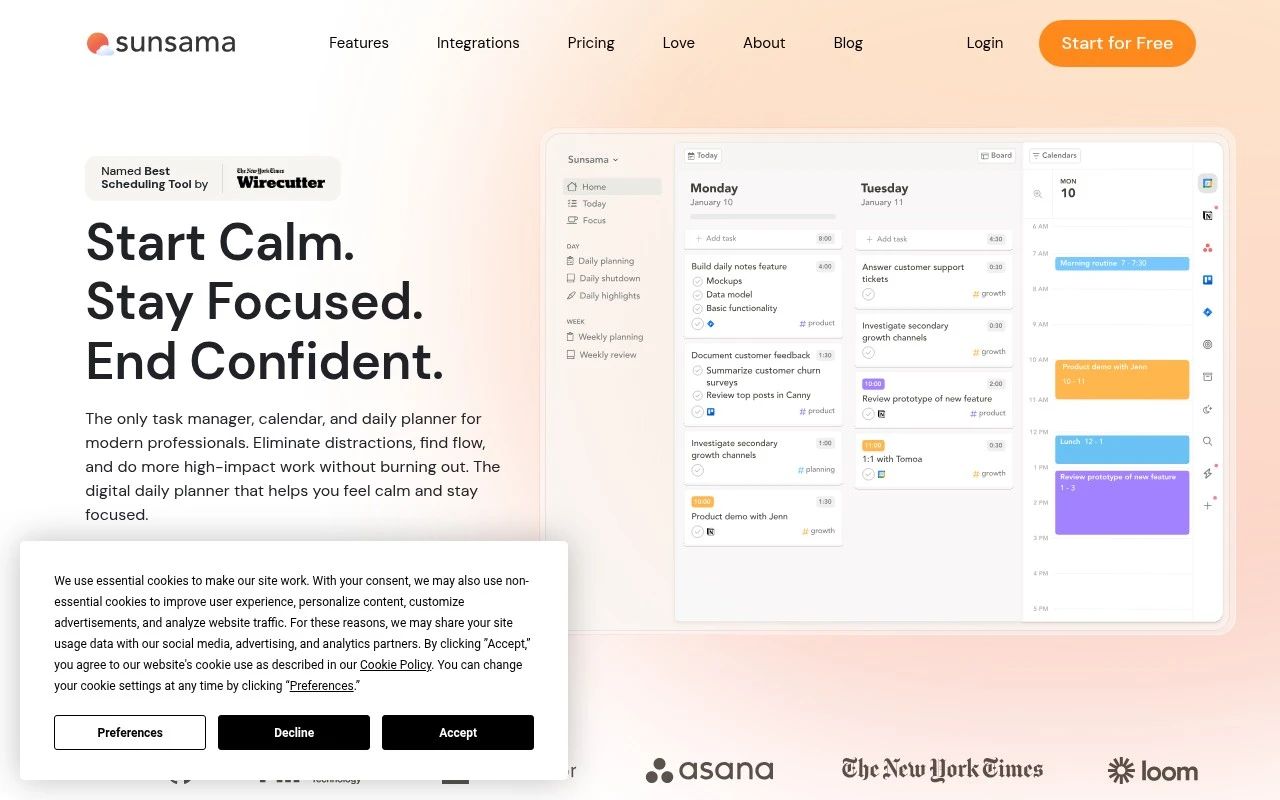
Sunsama is a daily planning app for professionals who want to organize tasks and meetings into a focused, realistic workday. It brings together calendars, project management tools, task apps, email, and messaging sources so users can decide what fits today, timebox work on their schedule, and review progress at the end of the day. Its distinguishing focus is not broad project management, but guided daily planning, focus protection, and work-life balance.

FYAI Score

8.2 / 10

Based on 27 reviews

Pricing:

Paid

Best for:

Busy knowledge workers balancing tasks, meetings, and deep work

Score Breakdown

  • Ease of use8.6 / 10
  • Features7.6 / 10
  • Pricing7.6 / 10
  • Integrations8.8 / 10
  • Support8.9 / 10

PRODUCT PREVIEW

What this AI tool does

Sunsama is a digital daily planning tool designed to help you organize tasks and time in one place. It focuses on turning a list of work items into a realistic day plan by encouraging you to choose priorities and map them onto your schedule. The tool is typically used by people who want a structured routine for managing personal and professional tasks, especially when work comes from multiple sources. It can support a consistent planning workflow by helping you review what’s on your plate, decide what to do today, and keep track of progress as the day unfolds. For someone researching sunsama, it’s best understood as a planning layer that sits between your task lists and your calendar. It aims to make day-to-day execution clearer by keeping your plan visible and easy to adjust when priorities change.

Use cases

Best for

Schedule Planning

Sunsama pulls tasks and meetings into one view so you can timebox them on your calendar for a realistic day plan.

Task Management

Import tasks from connected apps, choose what to do today, and keep a single prioritized daily task list.

Time Tracking

Track time by scheduling tasks as calendar blocks and reviewing planned versus completed work during the daily shutdown.

ANALYSIS

Strengths & limitations

Strengths
  • Combines tasks and calendar events in one daily planning view with timeboxing.
  • Integrates with many common work tools, including calendar, project management, task, email, messaging, and Zapier workflows.
  • Includes planning rituals, Pomodoro/focus features, workload awareness, analytics, and daily shutdown support.
Limitations
  • The official site does not describe Sunsama as an AI-native tool or list specific AI features.
  • It is centered on individual daily planning rather than replacing full project management systems.
  • Its value depends on adopting a structured daily planning workflow and connecting the tools where work already lives.

Evaluation

FYAI score breakdown

Our structured evaluation across five key criteria

8.2 / 10

Overall score

Based on 27 reviews

  • Ease of use8.6 / 10
  • Features7.6 / 10
  • Pricing7.6 / 10
  • Integrations8.8 / 10
  • Support8.9 / 10

What users say

Findings from public reviews, documentation and community sources.

  • Ease of use

    Sunsama says users can “Start each day with clarity,” “Plan your day with intention,” and use a “14-day free trial” with “No credit card required.” Reddit sentiment in r/Sunsama highlights the “minimalist interface” and “daily review flow” as core strengths.

  • Features

    Sunsama's site describes the product as combining “task manager, calendar, and daily planner” functionality with timeboxing, Pomodoro timers, analytics, and bi-directional calendar sync.

  • Pricing

    Sunsama's pricing page lists a “14-day free trial,” “Unlimited access to all features,” and a Pro plan at “$17 per month, billed yearly” or “$22 per month, billed monthly.” Sunsama's pricing page states the absence of a free-forever plan.

  • Integrations

    Sunsama's site lists native connectivity across calendar, project, task, email, and messaging tools, including Asana, GitHub, Gmail, and Slack. Sunsama's site also states Zapier connects Sunsama to “9k+ apps.”

  • Support

    Sunsama's site lists “User Manual & Guides,” a status page, vulnerability disclosure, and email support at “[email protected].” Sunsama's site also references a Slack community where users can “connect with the Sunsama team.”

Who is this for?

Best for professionals who want a daily planning workflow around tasks and calendar work, Sunsama combines “task manager, calendar, and daily planner” functionality with timeboxing and bi-directional calendar sync. Less suited to users who need a free-forever productivity app, Sunsama's pricing page lists a Pro plan at “$17 per month, billed yearly” or “$22 per month, billed monthly,” and the stated absence of a free-forever plan means continued use requires a paid subscription after the “14-day free trial.”

PRODUCT PREVIEW

Feature highlights

Unified daily plan

Pull tasks from your tools into one place to choose what fits today.

Timebox your day

Drag tasks onto your calendar to build a focused, realistic schedule.

Daily review ritual

Reflect, track progress, and roll over priorities for tomorrow.

COMPARE

Discover curated alternatives worth comparing

Compare similar AI tools based on features, pricing and use cases

7.8/ 10Based on 31 reviews

Wudpecker

Meeting NotesSummarization
Turns meeting recordings into notes, summaries, and action items
Best for:
Knowledge workers
Pricing
Freemium

9.0/ 10Based on 1.589 reviews

Toggl Track

Time & Habit Tracking
Tracks time with automatic activity detection and reporting.
Best for:
Operations teams
Pricing
Freemium

8.5/ 10Based on 2.648 reviews

Todoist

Task & Project Management
Organize, schedule, and share tasks with AI-assisted planning
Best for:
Knowledge workers
Pricing
Freemium

Plan your day with intention and finish work on time. See why teams choose Sunsama to stay focused, aligned, and consistently ship what matters.

FAQ

Frequently asked
questions

Everything you need to know about this AI tool,
its features, pricing, use cases, and limitations.

What types of teams and workflows is Sunsama a good fit for?
Sunsama works best for individuals or small teams that want a structured daily planning routine and a single place to pull tasks from tools like email, calendars, and task apps. It’s a strong fit for knowledge work where prioritization and time-blocking matter more than complex project tracking. If you need heavy-duty dependencies, resource planning, or portfolio views, a dedicated project management tool may fit better.
Does Sunsama have a free plan, and what are the limitations of paid access?
Sunsama is typically offered as a paid subscription, often with a free trial rather than a permanent free tier. The paid plan is mainly about continued access to the full daily planning workflow and integrations after the trial ends. For larger teams, per-seat pricing can become a deciding factor compared with tools that include broader PM features at similar cost.
How does Sunsama compare with tools like Todoist, Asana, or Motion?
Compared with Todoist, Sunsama is more opinionated about daily planning and time-blocking, while Todoist is lighter and faster for pure task capture. Versus Asana, Sunsama is less robust for project governance (workflows, reporting, cross-team visibility) but can be simpler for day-to-day execution. Compared with Motion, Sunsama is generally more manual and flexible, whereas Motion emphasizes automated scheduling.
How quickly can a team get set up in Sunsama, and what onboarding effort should you expect?
Sunsama is centered on daily execution, so it may feel limited if you need advanced project features like complex dependencies, custom workflows, or detailed reporting. It can also introduce process overhead for people who prefer a lightweight, always-on task list rather than a daily planning session. If your organization is cost-sensitive, the subscription model may be a drawback at scale.
What should we consider about data handling, privacy, and compliance when using Sunsama?
If you connect Sunsama to Google/Microsoft calendars and task tools, you’re granting access to potentially sensitive meeting and task metadata, so review what scopes and permissions are required. For regulated environments, confirm whether Sunsama offers the specific compliance, retention, and admin controls you need (e.g., SSO, audit logs, data residency) before standardizing on it. It’s also worth checking how data is stored, how exports/deletion requests work, and what third-party subprocessors are involved.