Curated ToolThis tool is part of our curated AI directory. We only include tools that meet our standards for relevance, usability and real-world value.

Spark Email

Drafts, summarizes, and translates emails; assists with inbox tasks

Email Assistant
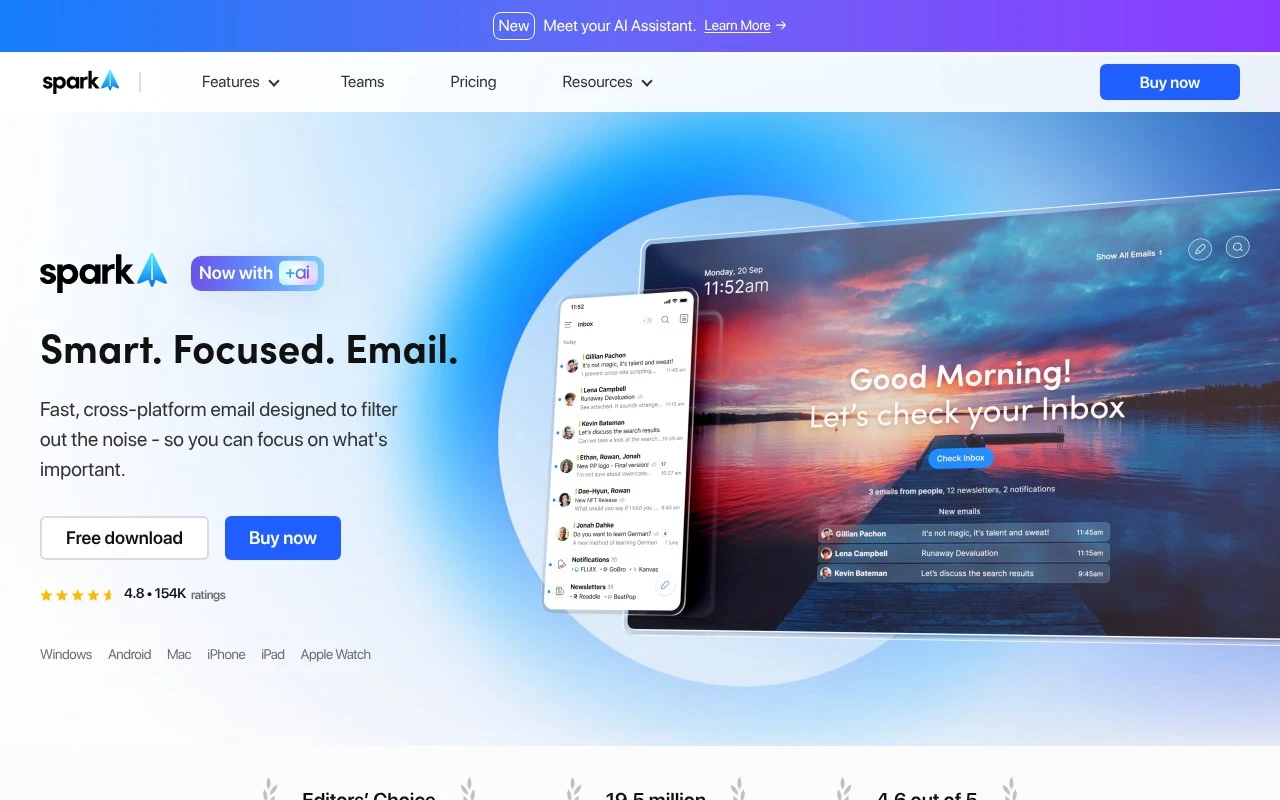
Spark Email is a cross-platform email app focused on making inbox management less distracting. It brings multiple email accounts into one client and adds workflow tools for prioritizing important contacts, filtering newsletters and notifications, setting messages aside, scheduling sends, reminders, and team-based email collaboration. Its newer AI features support email writing, inbox search and assistance, summaries, and translation.

FYAI Score

8.1 / 10

Based on 28 reviews

Pricing:

Freemium

Best for:

Busy professionals managing multiple email accounts and priorities

Score Breakdown

  • Ease of use7.8 / 10
  • Features8.1 / 10
  • Pricing8.5 / 10
  • Integrations7.8 / 10
  • Support8.4 / 10

PRODUCT PREVIEW

What this AI tool does

Spark Email is an AI tool designed to help people draft and refine email messages with less manual effort. It can take a short prompt or rough notes and turn them into a clearer email, adjusting wording and structure to better match common professional communication. This tool is useful when you need to respond quickly, improve tone, or make a message easier to understand before sending. It can support everyday tasks like writing outreach, follow-ups, scheduling requests, or internal updates, while leaving the final review and decision-making to the user.

Use cases

Best for

Inbox Triage

Triage your inbox by grouping newsletters and notifications, pinning priority senders, and snoozing emails for later follow up.

Email Writing

Use Spark Email AI to draft and rewrite replies, adjust tone, and translate messages directly in the compose window.

Email Summarization

Summarize long email threads with Spark Email AI so you can review key points and next steps without reading every message.

ANALYSIS

Strengths & limitations

Strengths
  • Strong focus-management features for separating important messages from newsletters, notifications, and unwanted senders.
  • Works across major desktop and mobile platforms and supports common email account types including Google, Outlook, Exchange, iCloud, Yahoo, and IMAP.
  • Includes team email workflows such as real-time drafting, private comments, delegation, progress tracking, and deadlines.
Limitations
  • It is an email client rather than a replacement email provider, so users still need existing email accounts.
  • The official page gives limited detail on which AI features are included in free versus paid plans.
  • Security and privacy claims are stated broadly on the page, but detailed compliance, retention, and enterprise control information is not included in the provided source.

Evaluation

FYAI score breakdown

Our structured evaluation across five key criteria

8.1 / 10

Overall score

Based on 28 reviews

  • Ease of use7.8 / 10
  • Features8.1 / 10
  • Pricing8.5 / 10
  • Integrations7.8 / 10
  • Support8.4 / 10

What users say

Findings from public reviews, documentation and community sources.

  • Ease of use

    A Reddit user in r/SparkMail described Spark as “better organized, cleaner” and “easier to manage multiple business emails.”

  • Features

    Spark’s pricing page lists Smart Inbox, Gatekeeper, AI writing/summaries/translation, meeting notes, shared drafts, assignments, and shared inboxes. Spark’s pricing page marks Workflows, Auto-Drafts, and Auto-Labels as “SOON.”

  • Pricing

    Spark’s pricing page lists a Free plan, Plus at $10/month per user or $8.25/month annually, Pro at $20/month per user or $16.58/month annually, and Enterprise via sales, plus a seven-day trial for Plus and Pro. Spark’s pricing page says the Free plan includes unlimited email accounts, Smart Inbox, smart notifications, calendar, and cross-device sync.

  • Integrations

    Spark’s pricing page names Reminders, Todoist, Notion, HubSpot, Zoom, Google Meet, Microsoft Teams, and calendar providers including Gmail and Outlook. Spark’s integrations page references Asana, Evernote, and Dropbox.

  • Support

    Spark’s pricing page says plans include Self-Service Support, paid Priority Support for faster responses, and Enterprise options such as a Dedicated Customer Success Manager and 1:1 Productivity Coaching.

Who is this for?

Best for people managing multiple business email accounts, a Reddit user described Spark as “easier to manage multiple business emails,” and Spark’s Free plan includes unlimited email accounts, Smart Inbox, calendar, and cross-device sync. Less suited to teams that need currently available workflow automation, Spark’s pricing page marks Workflows, Auto-Drafts, and Auto-Labels as “SOON.”

PRODUCT PREVIEW

Feature highlights

Smart Inbox Priority

Highlights important people and threads so you act on what matters.

Schedule & Remind

Send later, set follow-up reminders, and snooze messages until ready.

AI Writing & Summaries

Draft replies, summarize threads, and translate emails in seconds.

COMPARE

Discover curated alternatives worth comparing

Compare similar AI tools based on features, pricing and use cases

7.8/ 10Based on 31 reviews

Wudpecker

Meeting NotesSummarization
Turns meeting recordings into notes, summaries, and action items
Best for:
Knowledge workers
Pricing
Freemium

9.0/ 10Based on 1.589 reviews

Toggl Track

Time & Habit Tracking
Tracks time with automatic activity detection and reporting.
Best for:
Operations teams
Pricing
Freemium

8.5/ 10Based on 2.648 reviews

Todoist

Task & Project Management
Organize, schedule, and share tasks with AI-assisted planning
Best for:
Knowledge workers
Pricing
Freemium

See why teams choose Spark Email to stay on top of every conversation. Start collaborating faster and responding with confidence today.

FAQ

Frequently asked
questions

Everything you need to know about this AI tool,
its features, pricing, use cases, and limitations.

Who is Spark Email a good fit for, and when should I pick something else?
Spark Email fits small to mid-sized teams that need shared inbox workflows, internal notes, and lightweight collaboration around customer or partner email. It’s also a solid choice for individuals who want smart sorting and a streamlined inbox across devices. If you need strict enterprise controls, complex compliance requirements, or deep admin policy management, a more enterprise-focused email suite may be a better match.
What do I get on Spark Email’s free plan vs paid, and what are the common limitations?
The free tier is usually enough to evaluate the core inbox experience and basic productivity features, but team collaboration features tend to be limited or gated. Paid plans are typically where shared inbox capabilities and advanced team workflows become practical at scale. If your decision hinges on collaboration, confirm which features (shared inboxes, roles/permissions, team analytics) are included in the plan you’re considering.
How does Spark Email compare with Outlook, Gmail, or Superhuman for team email?
Compared with Outlook or Gmail clients, Spark Email is more focused on collaborative handling of email (shared inbox-style workflows) rather than being tightly tied to a broader enterprise admin ecosystem. Versus Superhuman, Spark Email generally emphasizes team coordination and inbox organization over speed-centric power-user shortcuts. If your priority is centralized IT governance and policy enforcement, Outlook/Gmail ecosystems often win; if it’s team triage and shared ownership, Spark Email is often easier to adopt.
How fast can a team set up Spark Email, and what onboarding effort should I expect?
Spark Email can involve a learning curve if your team hasn’t used shared inbox collaboration, and inconsistent habits can reduce the benefit. It may not match enterprise-grade solutions on advanced admin controls, auditing, or highly specialized workflows. Pricing can also become a factor for smaller teams if premium collaboration features are required for everyone.
What should I know about Spark Email data handling, privacy, and compliance before adopting it?
Spark Email functions as an email client, so it connects to your existing mail provider and may process certain data to deliver features like smart sorting and cross-device sync. For regulated environments, review Spark’s published security documentation, data storage practices, and any available enterprise agreements before rollout. If you need specific certifications, retention controls, or region-specific data residency, verify those requirements explicitly rather than assuming they’re included.