Curated ToolThis tool is part of our curated AI directory. We only include tools that meet our standards for relevance, usability and real-world value.

Sonix

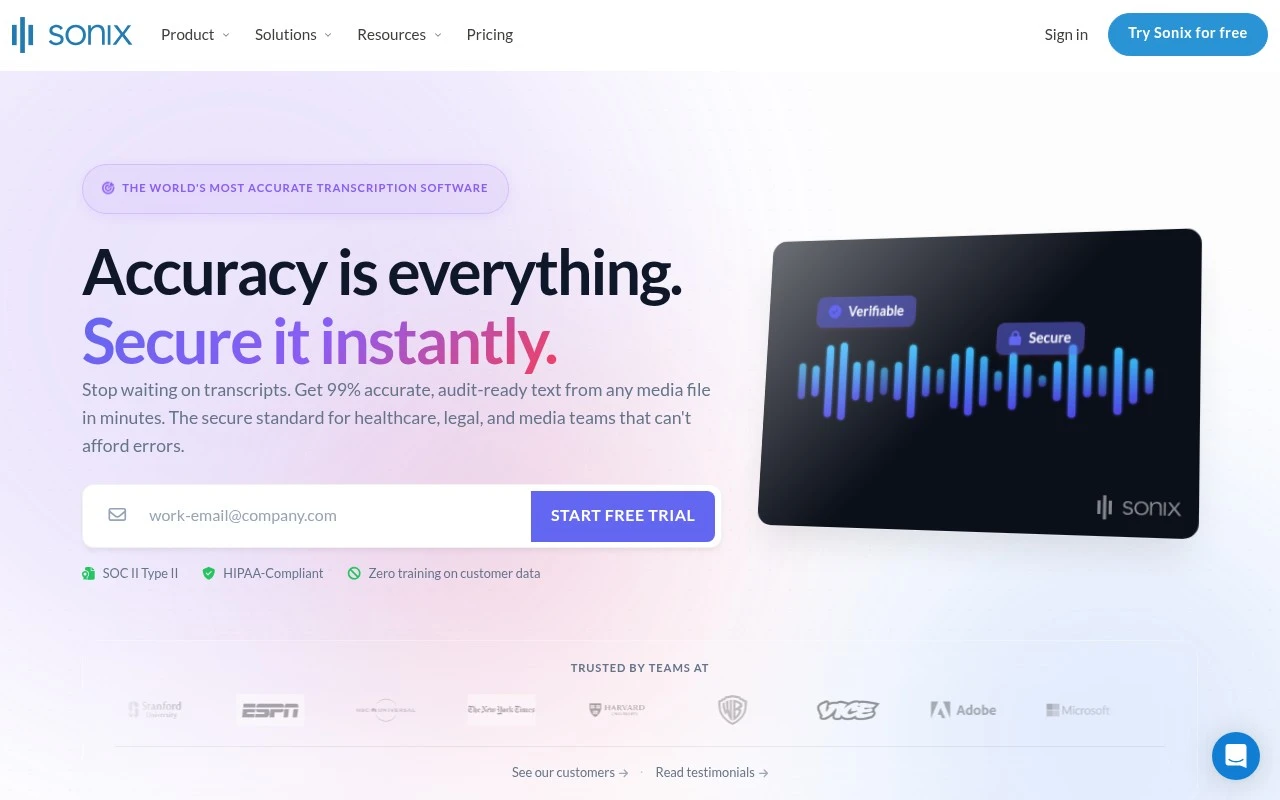
Sonix is an AI transcription platform used to transcribe audio and video files into searchable, editable text. It also supports subtitle creation and transcript translation for media workflows.
Meeting NotesSummarization

FYAI Score

9.1 / 10

Based on 1,122 reviews

Pricing:

Usage-based

Best for:

Podcasters, journalists, and video teams turning recordings into text

Score Breakdown

  • Ease of use9.2 / 10
  • Features9.0 / 10
  • Pricing8.9 / 10
  • Integrations9.0 / 10
  • Support9.2 / 10

PRODUCT PREVIEW

What this AI tool does

Sonix is an AI transcription platform for people and teams that need to transcribe audio and video into accurate text, subtitles, translations, and reusable transcript intelligence. It takes recordings from meetings, interviews, podcasts, lectures, webinars, and video projects, then turns them into searchable transcripts that can be edited, organized, exported, and shared. Sonix is best at turning raw recordings into searchable, shareable, and analyzable transcripts without forcing users to build a complex media workflow around transcription. For creators, researchers, journalists, educators, and business teams, the platform acts as a bridge between spoken content and written assets. A podcast episode can become a transcript, an interview can become quotes and notes, and a video can gain captions or translated subtitles. The value is not only in transcription speed, but in making audio and video easier to repurpose. In meeting-heavy workflows, Sonix helps convert calls and recorded discussions into meeting notes, summaries, and follow-up material. Speaker identification and timestamps make long conversations easier to navigate, while transcript organization helps teams keep recordings connected to projects, clients, or topics. This makes it useful for both individual productivity and shared knowledge management. Accuracy and usability are central to the product experience. The editor is designed around the transcript itself, so users can review text alongside the original media, correct wording, search for key moments, and export in formats that suit their workflow. AI summaries, audio summarization, video summarization, and sentiment analysis add another layer by helping users understand the content rather than simply store it. For multilingual publishing, the platform extends transcription into translation and subtitle production. Teams can use it for video translation, add subtitles to media, and prepare content for audiences who speak different languages or need accessibility support. This makes Sonix especially relevant for content teams that publish across websites, social platforms, learning systems, and video channels. Enterprise and regulated use cases are also part of the positioning. Sonix includes security and administration features such as encryption, permissions, SSO, API access, SOC 2 alignment, and healthcare-oriented workflows connected to HIPAA requirements. That gives larger organizations more confidence when transcripts may contain sensitive conversations, customer data, research material, or internal records. Integrations help the tool fit into existing stacks rather than sit apart from them. Connections with Zoom, Microsoft Teams, Zapier, and Adobe Premiere support workflows where recordings are captured in one place, processed in another, and then used for editing, publishing, archiving, or analysis. For media teams, the Adobe Premiere connection is particularly useful because transcripts and subtitles can move closer to the editing process. Compared with simple speech-to-text utilities, Sonix is more of a transcript workspace than a one-step converter. Its strength is in the full lifecycle of spoken content, from upload and automated transcription to editing, translation, summarization, sharing, and structured insight. That makes it a practical option for users who need more than a plain text file at the end of a recording. When evaluating Sonix pricing or comparing Sonix alternatives, the key question is how much value comes from the surrounding workflow. A casual user may care most about quick transcription, while a team may place more weight on collaboration, integrations, compliance, subtitles, and analytics. Sonix is a strong fit when audio and video are not just files to be converted, but important knowledge sources that need to be searched, understood, reused, and distributed.

Use cases

Best for

Transcribe Audio

Sonix converts uploaded audio or video into a timestamped transcript with speaker labels and an editor for cleanup and export.

Video Translation

Sonix translates video transcripts and generates subtitles in other languages for download or embedding in your video workflow.

Sentiment Analysis

Sonix runs sentiment analysis on transcripts to label tone and highlight positive or negative sections for review.

ANALYSIS

Strengths & limitations

Strengths
  • Best suited to teams that need transcripts, subtitles, and translations in one workflow because it combines speaker identification, timestamps, captions, and multilingual transcript outputs.
  • Useful for research, media, legal, and enterprise teams because transcript organization, search, summaries, action items, and sentiment analysis help turn recordings into structured knowledge.
  • Strong fit for organizations with governance requirements because it supports security and administration features such as encryption, SSO, permissions, API access, SOC 2, and HIPAA-related workflows.

Limitations
  • Less predictable for high-volume recording teams because usage-based pricing means costs grow with the amount of audio and video processed.
  • Less suitable for workflows that require certified human transcription by default because Sonix is primarily an AI transcription platform and important outputs still need review.
  • Less suitable for teams that only need occasional simple dictation because its transcript management, integrations, analytics, and enterprise controls can be more workflow than they need.

Evaluation

FYAI score breakdown

Our structured evaluation across five key criteria

9.1 / 10

Overall score

Based on 1,122 reviews

  • Ease of use9.2 / 10
  • Features9.0 / 10
  • Pricing8.9 / 10
  • Integrations9.0 / 10
  • Support9.2 / 10

What users say

Findings from public reviews, documentation and community sources.

  • Ease of use

    G2 says users “consistently praise the software for its accuracy and ease of use,” and a Sonix customer quote calls Sonix “accurate, intuitive, friendly and simple to use.”

  • Features

    Sonix says it provides “99% accuracy across 54+ languages,” speaker diarization, translation, and AI summaries/chapters/sentiment. Sonix also references medical/legal workflows, SOC 2/HIPAA, SSO, granular permissions, and API access.

  • Pricing

    The Sonix pricing page lists “Pay As You Go” at “$10/hr,” subscriptions from “$25/mo” to “$80/mo,” and 30 free minutes. The Sonix pricing page also states add-ons such as extra seats and additional hours at “$10/hr,” with translation and some usage charged separately.

  • Integrations

    The Sonix integrations page lists “Zoom, Microsoft Teams, Dropbox, Google Drive, Zapier, and 30+ other apps.” The Sonix pricing page includes “API access,” “Automate with Zapier,” and “Webhook events,” and Zapier lists Sonix as connecting with “9000 other apps.”

  • Support

    The Sonix pricing page lists support from Pay As You Go with “Self-serve Help center & docs” to Enterprise with a dedicated account manager. The Sonix pricing page states Core includes “Email 48-hour response,” Advanced adds “Email + chat 12-hour response,” and Pro has “Priority email + chat 4-hour response.”

Who is this for?

Best for teams that need multilingual transcription workflows, Sonix says it provides “99% accuracy across 54+ languages,” plus translation and AI summaries/chapters/sentiment. Best for teams that need workflow automation, the Sonix pricing page includes “API access,” “Automate with Zapier,” and “Webhook events.” Less suited to users who want all usage included in one flat price, the Sonix pricing page lists additional hours at “$10/hr,” with translation and some usage charged separately.

PRODUCT PREVIEW

Feature highlights

AI Transcription

Fast, accurate transcripts with speaker labels and timestamps.

Subtitles & Translate

Create captions and translations for global audiences.

Enterprise Security

SOC 2, encryption, SSO, permissions, and API access.

COMPARE

Discover curated alternatives worth comparing

Compare similar AI tools based on features, pricing and use cases

7.4/ 10Based on 30 reviews

Zencastr

Podcast Editing
Edits recordings like text, transcribes, and cuts social clips
Best for:
Audio & podcast creators
Pricing
Freemium

7.8/ 10Based on 31 reviews

Wudpecker

Meeting NotesSummarization
Turns recordings into notes, summaries, action items, and Q&A
Best for:
Knowledge workers
Pricing
Freemium

8.5/ 10Based on 16 reviews

Wondercraft

Short-form VideoVideo Editing
Creates editable videos and audio from text, prompts, media
Best for:
Video creators
Pricing
Freemium

Turn interviews, meetings, and videos into polished text in minutes. See why teams rely on Sonix to move faster from recording to ready-to-share content.

FAQ

Frequently asked
questions

Everything you need to know about this AI tool,
its features, pricing, use cases, and limitations.

Who is Sonix best suited for?
Sonix is best suited for teams that need searchable, speaker-labeled transcripts from recorded audio or video. Common users include journalists, researchers, filmmakers, educators, legal teams, healthcare organizations, and enterprises that work with interviews, meetings, lectures, legal proceedings, clinical conversations, or media footage.
Is Sonix free, and how does its pricing work?
Sonix uses usage-based pricing, so costs are tied to how much audio or video you process. This can work well for occasional transcription, but high-volume teams should estimate monthly hours carefully. Buyers should check sonix.ai for current trial terms, included features, and any enterprise pricing options.
How does Sonix compare with other transcription tools?
Sonix stands out when you need transcription, translation, subtitles, and transcript analysis in one workflow. Similar tools may focus mainly on converting speech to text, while Sonix also supports summaries, chapters, sentiment analysis, action items, and multi-transcript search. The best choice depends on volume, budget, language needs, and review requirements.
How quickly can a team start using Sonix?
The main limitation of Sonix is that it relies primarily on automated AI transcription, so sensitive or publication-critical transcripts may still need human review. Teams with very simple one-off needs may not require its broader analysis and collaboration features. High-volume users should also evaluate usage-based costs before committing.
How does Sonix handle privacy and compliance for sensitive transcripts?
Sonix includes enterprise-oriented controls such as SOC 2, HIPAA-oriented workflows, SSO, permissions, encryption, and API access. These features make it relevant for regulated or security-conscious teams, but buyers handling sensitive legal, healthcare, or enterprise data should still validate current contractual terms, retention settings, and compliance fit before deployment.