Curated ToolThis tool is part of our curated AI directory. We only include tools that meet our standards for relevance, usability and real-world value.
Synthflow
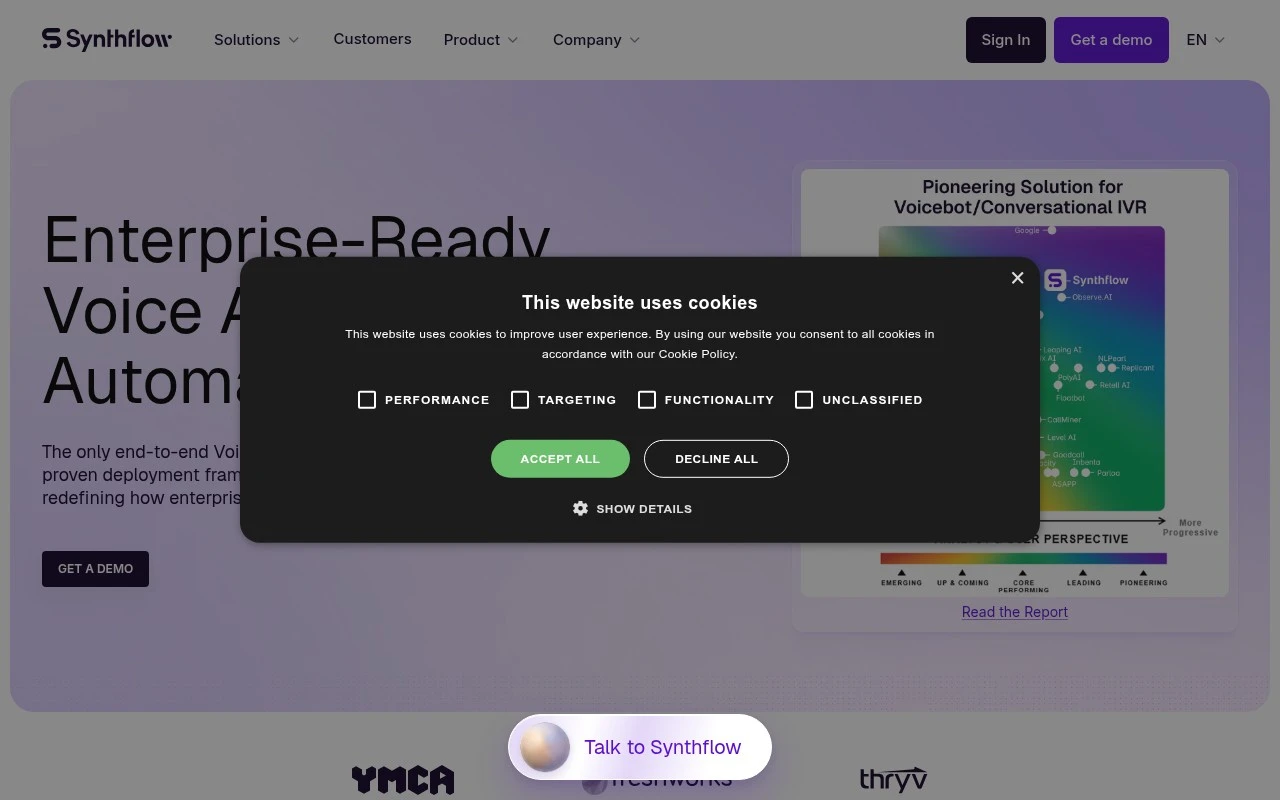
Synthflow is a no-code platform for building AI voice agents that handle phone calls, qualify leads, book appointments, and update connected CRM or workflow systems.
Voice & Audio

FYAI Score
8.2 / 10
Based on 215 reviews
Pricing:
Paid only
Best for:
Contact centers automating high-volume customer calls
Score Breakdown
- Ease of use7.4 / 10
- Features8.5 / 10
- Pricing7.4 / 10
- Integrations9.3 / 10
- Support9.0 / 10
 | Strengths |
-
 Strong fit for enterprise call automation because it combines flow design, testing, deployment, telephony, and monitoring in one platform.
-
Useful for teams with existing phone infrastructure because it supports SIP-based connectivity and integrations with systems such as Cisco, Avaya, Genesys, and RingCentral.
-
Well aligned with regulated or high-volume operations because it emphasizes compliance, auditability, uptime, regional hosting, and real-time call monitoring.
 | Limitations |
-
 Less suitable for small teams that only need a simple chatbot or lightweight call answering because the product is built around enterprise voice operations and deployment workflows.
-
Less suitable for broad non-voice automation because its clearest strength is customer conversation handling over phone and related messaging channels.
-
Requires operational setup around call flows, telephony, APIs, testing, and compliance, so it is not a hands-off tool for teams without technical or contact center resources.
 | 8.5/ 10Based on 23 reviews |
Cartesia
AI Voiceover
Adds AI speech, streaming transcription, and voice agents
Best for: | Software developers |
Pricing | Freemium |
 | 9.2/ 10Based on 2,638 reviews |
Retell AI
Voice & Audio
Automates phone calls, routes issues, and logs outcomes
Best for: | Operations teams |
Pricing | Usage-based |
 | 8.1/ 10Based on 119 reviews |
Fish Audio
AI VoiceoverVideo Dubbing & Translation
Creates expressive speech, clones voices, and transcribes audio
Best for: | Audio & podcast creators |
Pricing | Freemium |