Fish Audio
Curated ToolThis tool is part of our curated AI directory. We only include tools that meet our standards for relevance, usability and real-world value.

Fish Audio

Fish Audio is an AI voice platform for text-to-speech and voice cloning, allowing users to clone voice samples and generate speech in different styles and languages.
AI VoiceoverVideo Dubbing & Translation

FYAI Score

8.1 / 10

Based on 119 reviews

Pricing:

Freemium

Best for:

Creators producing narration, character voices, and audiobooks

Score Breakdown

  • Ease of use8.4 / 10
  • Features8.2 / 10
  • Pricing8.2 / 10
  • Integrations7.7 / 10
  • Support7.6 / 10

PRODUCT PREVIEW

What this AI tool does

Fish Audio
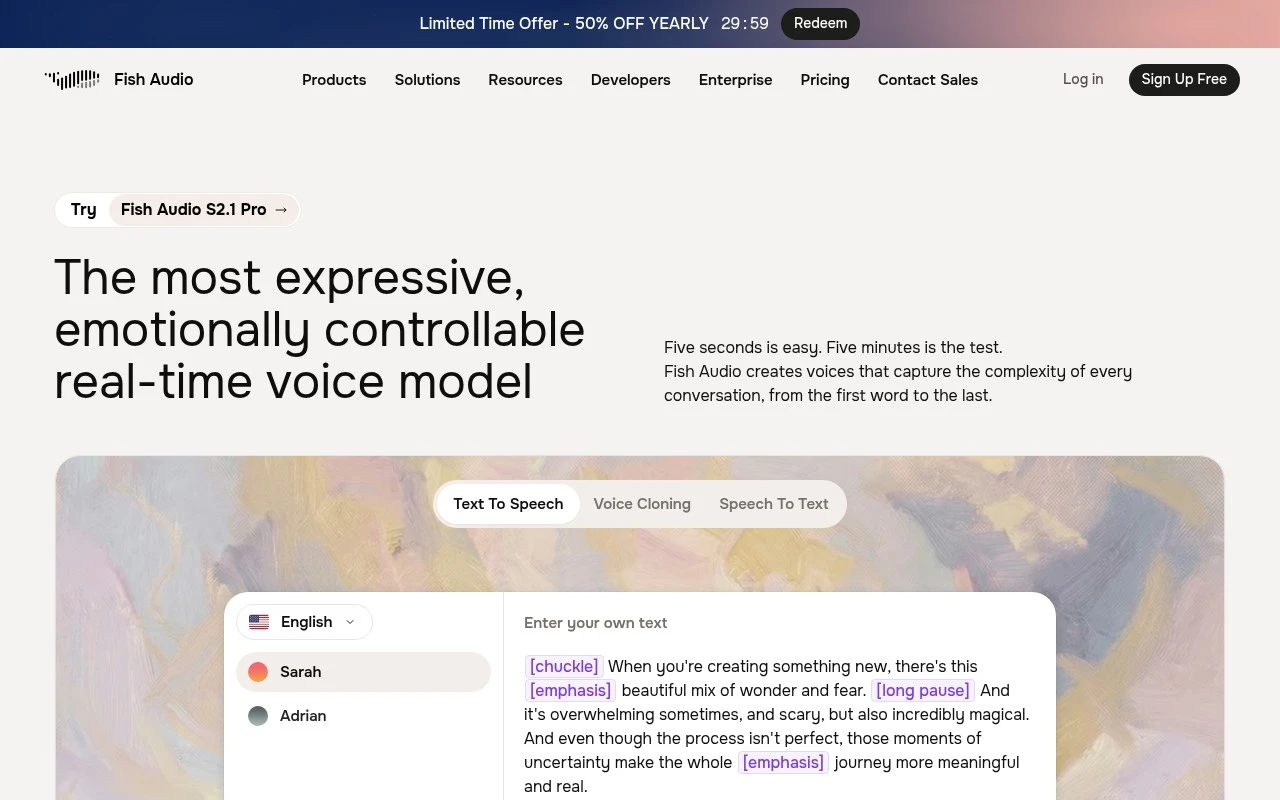
Fish Audio is an AI voice platform for text to speech, voice cloning, speech transcription, and voice-agent workflows, built for creators and teams that need expressive synthetic voices rather than flat narration. Fish Audio is best suited to people producing lifelike voiceovers, character dialogue, audiobooks, support bots, interactive agents, and speech features inside their own products. At its core, the platform turns written text into spoken audio with a focus on emotional range and vocal control. Instead of treating text to speech as a simple read-aloud function, it lets users guide delivery with emotion tags, special vocal cues, pacing choices, and multilingual voice options that make generated speech feel more performed than assembled. For creators, the appeal is speed without giving up too much character. A video producer can generate voiceover for a tutorial, a game designer can prototype character lines, and an audiobook team can test narration styles before recording or publishing. The large library of user-uploaded voices also makes it easier to explore different tones, ages, accents, and personalities without starting from scratch. Voice cloning is another major part of the story. Fish Audio gives users tools to clone voice samples into reusable AI voices, which can support consistent narration, localized versions of content, or recurring characters across episodes and campaigns. This makes the platform especially relevant when a project needs a recognizable voice identity, but also needs the flexibility to generate new lines on demand. Multilingual production is built into the platform’s positioning rather than treated as an afterthought. Teams working across regions can use multilingual voice generation to adapt scripts, support audiences in different languages, or create localized audio while keeping a consistent vocal style. For global creators, educators, and product teams, that can reduce the friction of producing speech for multiple markets. Developers and product teams can use the web tools for production work or connect through APIs when voice needs to become part of an application. Real-time generation and voice-agent capabilities make the platform useful beyond static audio files, especially for conversational interfaces, support automation, roleplay experiences, and interactive assistants. In that sense, it sits between a creator tool and an infrastructure layer for AI speech. Compared with many Fish Audio alternatives, the platform is most clearly defined by its emphasis on expressive control, user-generated voice variety, and production-ready speech workflows. It is not only for making quick narration from a script, although it can do that. Its stronger use case is when the voice itself matters, including emotion, identity, timing, and the ability to fit a specific creative or product context. Fish Audio is therefore best understood as a flexible AI voice studio and API platform for anyone who needs to generate realistic speech at scale. It brings together text to speech, the ability to clone voice samples, multilingual voice creation, transcription, and voice-agent support in one environment. For teams building media, games, education products, customer experiences, or AI-powered apps, it offers a practical way to make synthetic speech sound more human, controlled, and reusable.

Use cases

Best for

Text to Speech

Fish Audio converts typed text into expressive multilingual speech with emotion tags, vocal tags, and real time generation.

Clone Voice

It clones a voice from audio samples so the same speaker can be used for narration, characters, or app speech.

Generate Voiceover

It generates voiceovers from scripts using selectable voices, emotion controls, and API or web playback output.

ANALYSIS

Strengths & limitations

Strengths
  • Strong fit for expressive narration because Fish Audio supports emotion and special vocal tags such as whispering, laughing, sighing, and pauses.
  • Useful for creators who need voice variety because the platform advertises a library of more than 2,000,000 voices alongside custom voice cloning.
  • Well suited to product teams because it offers APIs for text-to-speech, speech-to-text, voice cloning, multilingual speech, and voice agents.

Limitations
  • Less suitable for teams looking for a full video, podcast, or music production suite because Fish Audio focuses on speech generation, cloning, transcription, and voice agents.
  • Voice cloning workflows require consent and likeness governance because the product is designed to create synthetic versions of voices from short recordings.
  • Large-scale API and real-time voice-agent deployments need technical setup because production use involves latency, streaming, and application integration decisions.

Evaluation

FYAI score breakdown

Our structured evaluation across five key criteria

8.1 / 10

Overall score

Based on 119 reviews

  • Ease of use8.4 / 10
  • Features8.2 / 10
  • Pricing8.2 / 10
  • Integrations7.7 / 10
  • Support7.6 / 10

What users say

Findings from public reviews, documentation and community sources.

  • Ease of use

    G2 lists 119 reviews and a 4.5/5 rating for Fish Audio. The surfaced G2 review text describes Fish Audio as "smooth, fast, high-quality, affordable, and easy to use," while Fish Audio includes advanced controls such as emotion tags and voice cloning.

  • Features

    Fish Audio’s own page lists voice cloning, real-time streaming APIs, emotion tags, and "2,000,000+ voices."

  • Pricing

    The Fish Audio pricing SERP snippet shows public subscription tiers including Free, Plus, Pro, and Max, with a Max tier at "$749/mo" discounted from "$999." Fish Audio developer docs describe API pricing as pay-as-you-go with "no subscription fees or monthly minimums."

  • Integrations

    Fish Audio’s page describes "Powerful Voice-AI APIs" for real-time streaming, instant voice cloning, text to speech, speech to text, and voice agents.

  • Support

    Fish Audio’s site includes Resources, Developers, Enterprise, and Contact Sales. Reddit users describe Fish Audio "Tech Support" as being through Discord.

Who is this for?

Best for developers and teams building voice-audio products, with Fish Audio’s page describing "Powerful Voice-AI APIs" for real-time streaming, instant voice cloning, text to speech, speech to text, and voice agents. Fish Audio developer docs describe API pricing as pay-as-you-go with "no subscription fees or monthly minimums," which can fit variable usage patterns. Less suited to teams that need a broad app marketplace and non-Discord support, because Fish Audio’s page emphasizes APIs and Reddit users describe "Tech Support" as being through Discord.

PRODUCT PREVIEW

Feature highlights

Clone voice

Create custom AI voices for narration, characters, and branded audio.

Expressive text to speech

Turn scripts into natural speech with emotion and vocal style controls.

Multilingual voice

Generate multilingual voice audio for global content, apps, and agents.

COMPARE

Discover curated alternatives worth comparing

Compare similar AI tools based on features, pricing and use cases

8.5/ 10Based on 23 reviews

Cartesia

AI Voiceover
Adds AI speech, streaming transcription, and voice agents
Best for:
Software developers
Pricing
Freemium

8.2/ 10Based on 215 reviews

Synthflow

Voice & Audio
Automates phone calls, follows logic, and connects systems
Best for:
Customer support teams
Pricing
Paid only

9.2/ 10Based on 2,638 reviews

Retell AI

Voice & Audio
Automates phone calls, routes issues, and logs outcomes
Best for:
Operations teams
Pricing
Usage-based

Fish Audio

Start creating lifelike voices today and turn scripts into polished audio your audience actually wants to hear.

FAQ

Frequently asked
questions

Everything you need to know about this AI tool,
its features, pricing, use cases, and limitations.

Who is Fish Audio best suited for?
Fish Audio is best suited for creators, production teams, developers, and businesses that need AI-generated speech, voice cloning, transcription, or voice APIs. It fits use cases such as video voiceovers, audiobooks, game characters, brand voices, chatbots, customer support agents, and multilingual voice-enabled applications.
Is Fish Audio free to use, and when would I need a paid plan?
Fish Audio uses a freemium pricing model, so users can start with free access and move to paid usage as their needs grow. Paid plans are typically more relevant for higher-volume generation, production workflows, API usage, voice cloning projects, or business applications that require more consistent capacity.
How does Fish Audio compare with other AI voice tools?
Fish Audio stands out most for expressive speech generation, voice cloning, a large voice library, and developer APIs for speech workflows. Compared with broader creative suites, it is more focused on voice and audio generation than full video, podcast, or music production, so the best choice depends on the workflow.
How quickly can a team get started with Fish Audio?
Teams can usually start quickly for basic text-to-speech voiceovers by entering a script and selecting or creating a voice. Voice cloning, API integration, real-time voice agents, and multilingual production workflows require more planning, including testing output quality, latency, streaming behavior, and application integration.
What are the main limitations of Fish Audio?
Fish Audio is not a full media production suite, so teams needing video editing, podcast production, or music creation may need additional tools. Voice cloning also introduces consent and likeness governance requirements, while large-scale API or real-time deployments need technical decisions around reliability, latency, and workflow design.
What privacy and compliance issues should teams consider with Fish Audio?
Teams using Fish Audio should confirm consent, rights, and governance before cloning or generating voices that resemble real people. Buyers should also review how audio, transcripts, prompts, generated outputs, and API data are handled, including retention, access controls, security practices, and any compliance requirements relevant to their industry.