Curated ToolThis tool is part of our curated AI directory. We only include tools that meet our standards for relevance, usability and real-world value.

Shortwave

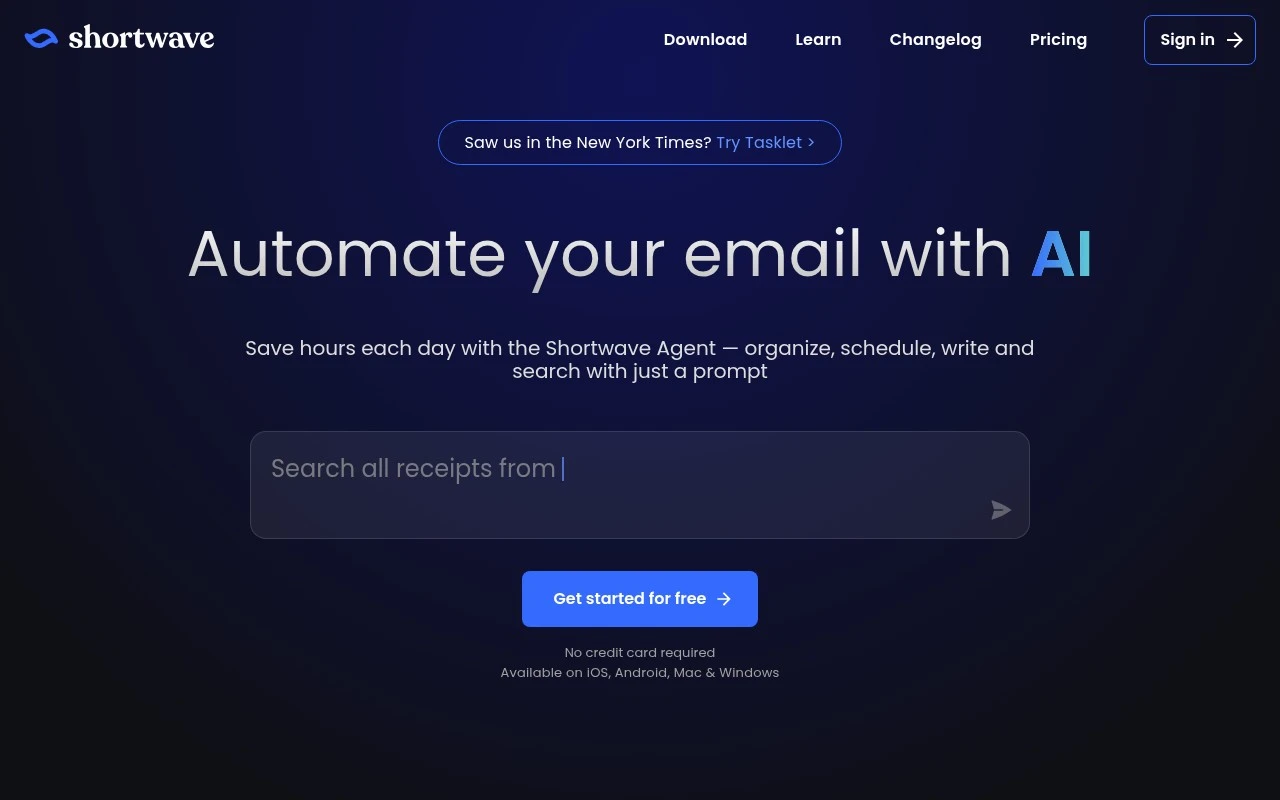
Shortwave is an AI-powered email client for Gmail that helps users manage their inbox with conversation summaries, natural-language search, and AI-assisted email writing.
Email AssistantScheduling & Calendar

FYAI Score

8.4 / 10

Based on 68 reviews

Pricing:

Freemium

Best for:

Busy professionals and teams who live in email all day

Score Breakdown

  • Ease of use8.6 / 10
  • Features9.0 / 10
  • Pricing7.2 / 10
  • Integrations8.5 / 10
  • Support8.7 / 10

PRODUCT PREVIEW

What this AI tool does

Shortwave is an AI email client and inbox automation tool for professionals and teams that need faster inbox triage, clearer email writing, and a more structured way to turn messages into work. It sits in the space between a modern email app, an AI assistant, and a lightweight workflow system, with the goal of making the inbox less reactive and more actionable. For busy professionals, the core value is that email becomes something the system helps organize rather than something users must constantly sort by hand. Messages can be grouped into bundles, separated into split inboxes, turned into todos, snoozed for later, and managed with keyboard shortcuts. That gives it the feel of a full productivity client rather than a thin AI wrapper on top of email. AI-assisted email summarization is one of the clearest ways the platform reduces inbox load. Long threads can be compressed into the key points, decisions, and next steps, which is especially useful for people who return to a conversation after several days or join a thread late. Natural-language search adds to this by letting users ask for messages, files, or details in ordinary language instead of relying on exact keywords. The writing experience is designed for everyday business communication rather than generic content generation. Email writing support can help draft replies, refine tone, shorten messages, or create a response that fits the context of a thread. Because the assistant works inside the email client, it can draw on surrounding conversation history and reduce the friction between understanding a message and answering it. Custom plain-English filters are a major part of the automation story. Instead of building rules through rigid menus, users can describe how certain messages should be handled, such as routing newsletters, highlighting customer issues, or separating finance-related mail. This makes inbox triage more accessible to people who want automation but do not want to maintain complex rule sets. Scheduling and follow-through are also part of the product’s character. The tool supports snoozing, reminders, todos, and schedule planning workflows that help turn email into a manageable queue of commitments. Read tracking, link tracking, and shared threads add practical visibility for users who coordinate with clients, candidates, vendors, or internal teams. Team collaboration is where Shortwave moves beyond personal inbox cleanup. Shortwave is built for individuals and teams that want shared context around email, including collaborative threads and workflows that make communication easier to track across a group. This is useful in roles where the inbox is not private administration but a shared operating surface for sales, support, recruiting, operations, or leadership. Compared with many Shortwave alternatives, the distinction is the combination of a polished email productivity interface with an AI assistant that can act on messages and connect to workplace tools. Some tools focus mainly on email writing, others on summarization or search, but Shortwave’s broader positioning is about managing the full lifecycle of email, from arrival and triage to reply, delegation, follow-up, and automation. Automation is also connected to the company’s wider product direction through Tasklet, its sister product for deeper trigger-based workflows. That matters because the Shortwave story is not only about helping users read and respond faster, but also about turning recurring email-driven processes into systems that can run with less manual intervention. For buyers evaluating Shortwave pricing or reading a Shortwave review, the key question is whether email is a central work hub or just a communication channel. Shortwave is most compelling for people who live in their inbox and want AI to help organize, summarize, search, write, and coordinate work without losing the familiar structure of an email client.

Use cases

Best for

Inbox Triage

Use Shortwave AI triage, bundles, and split inboxes to summarize threads and surface priority emails for action.

Email Writing

Draft and refine replies with AI writing assistance that rewrites tone, expands bullets, and suggests responses from context.

Schedule Planning

Plan meetings by extracting availability from email threads and generating scheduling-ready replies with proposed times.

ANALYSIS

Strengths & limitations

Strengths
  • Best suited to Gmail-heavy professionals because it combines AI triage, summaries, writing help, natural-language search, and scheduling support inside a full email client.
  • Strong fit for high-volume inboxes because bundles, split inboxes, todos, snoozing, filters, and keyboard shortcuts turn email into a structured workflow rather than a message list.
  • Useful for collaborative teams because shared threads, team workflows, and connections to workplace tools let people act on email context together.

Limitations
  • Less suitable for teams standardized outside Gmail because its strongest fit is Gmail-based inbox workflows.
  • The freemium model means heavier AI-assisted email use and team adoption require upgraded access, so costs can grow as more users rely on it.
  • Teams that need broad trigger-based workflow automation in the same product may need to use Shortwave alongside Tasklet, which adds another tool to configure and govern.

Evaluation

FYAI score breakdown

Our structured evaluation across five key criteria

8.4 / 10

Overall score

Based on 68 reviews

  • Ease of use8.6 / 10
  • Features9.0 / 10
  • Pricing7.2 / 10
  • Integrations8.5 / 10
  • Support8.7 / 10

What users say

Findings from public reviews, documentation and community sources.

  • Ease of use

    G2’s review signal says users “consistently praise Shortwave for its user-friendly interface and effective email organization,” and Product Hunt sentiment says Shortwave makes heavy Gmail inboxes “faster and easier to process.”

  • Features

    Shortwave lists features across AI email automation, AI search, AI filters, personalized writing, scheduling, todos, read statuses, link tracking, keyboard shortcuts, and team collaboration.

  • Pricing

    Shortwave’s pricing page lists Business at $30 per seat/month, Premier at $45 per seat/month, and Max at $120 per seat/month, plus a 14-day free trial. G2 notes user concern around high pricing for Shortwave.

  • Integrations

    Shortwave says its AI can connect to Slack, Calendar, Notion, Asana, HubSpot, and more. Shortwave also mentions Tasklet connectivity to 3,000+ apps for workflow automation.

  • Support

    A Reddit user describing Shortwave says “the developer pushes updates frequently and is very responsive both by email or reddit.”

Who is this for?

Best for users managing heavy Gmail inboxes, Product Hunt sentiment says Shortwave makes heavy Gmail inboxes “faster and easier to process.” Best for teams that want email tied into workflows, Shortwave says its AI can connect to Slack, Calendar, Notion, Asana, HubSpot, and more, and mentions Tasklet connectivity to 3,000+ apps. Less suited to teams prioritizing low per-seat cost, Shortwave’s pricing page lists Business at $30 per seat/month, Premier at $45 per seat/month, and Max at $120 per seat/month.

PRODUCT PREVIEW

Feature highlights

AI inbox triage

Auto-summarize threads and surface what needs action first.

Plain-English rules

Create custom filters and split inboxes using natural language.

Shared team threads

Collaborate on email with assignments, notes, and visibility.

COMPARE

Discover curated alternatives worth comparing

Compare similar AI tools based on features, pricing and use cases

7.8/ 10Based on 31 reviews

Wudpecker

Meeting NotesSummarization
Turns recordings into notes, summaries, action items, and Q&A
Best for:
Knowledge workers
Pricing
Freemium

9.0/ 10Based on 1,589 reviews

Toggl Track

Time & Habit Tracking
Tracks time, automates activity capture, and reports team data
Best for:
Operations teams
Pricing
Freemium

8.5/ 10Based on 2,648 reviews

Todoist

Task & Project Management
Captures tasks, organizes schedules, and clarifies action plans
Best for:
Knowledge workers
Pricing
Freemium

Join teams who stay on top of email without the chaos. Start triaging faster, responding with confidence, and keeping priorities clear with Shortwave today.

FAQ

Frequently asked
questions

Everything you need to know about this AI tool,
its features, pricing, use cases, and limitations.

Who is Shortwave best suited for?
Shortwave is best suited for professionals and teams that handle a high volume of email and want AI support inside the inbox. It is especially relevant for Gmail users who need help with inbox triage, summaries, drafting, search, scheduling, todos, and shared team workflows around email.
Does Shortwave have a free plan, and what should I expect from paid plans?
Shortwave uses a freemium pricing model, so users can start with a free option and upgrade for broader capabilities. Teams evaluating Shortwave should compare plan limits around AI usage, collaboration features, history access, integrations, and administrative controls on shortwave.com before committing.
How does Shortwave compare with other AI email assistants?
Shortwave differs from many AI email assistants by combining writing help with a full inbox experience. It supports summarization, drafting, contextual autocomplete, search across emails and attachments, scheduling, triage, shared threads, comments, assignments, labels, and integrations, so it fits users who want email management, not only message generation.
How much setup does Shortwave require before it becomes useful?
Shortwave’s main trade-offs are its apparent focus on Gmail, the level of inbox access required, and the need to configure workflows thoughtfully. Some broader workflow automation appears associated with the related Tasklet product, so buyers should confirm which automation capabilities are native to Shortwave itself.
What privacy and compliance issues should teams consider with Shortwave?
Teams should treat Shortwave as a tool that may process sensitive email content, attachments, contacts, and scheduling data. Before adoption, buyers should review Shortwave’s current security documentation, data retention practices, permission model, access controls, compliance posture, and suitability for regulated communications or confidential client work.