Curated ToolThis tool is part of our curated AI directory. We only include tools that meet our standards for relevance, usability and real-world value.

Clickup

AI assistant for tasks and docs: search, summarize, draft, automate

Knowledge SearchTime & Habit Tracking
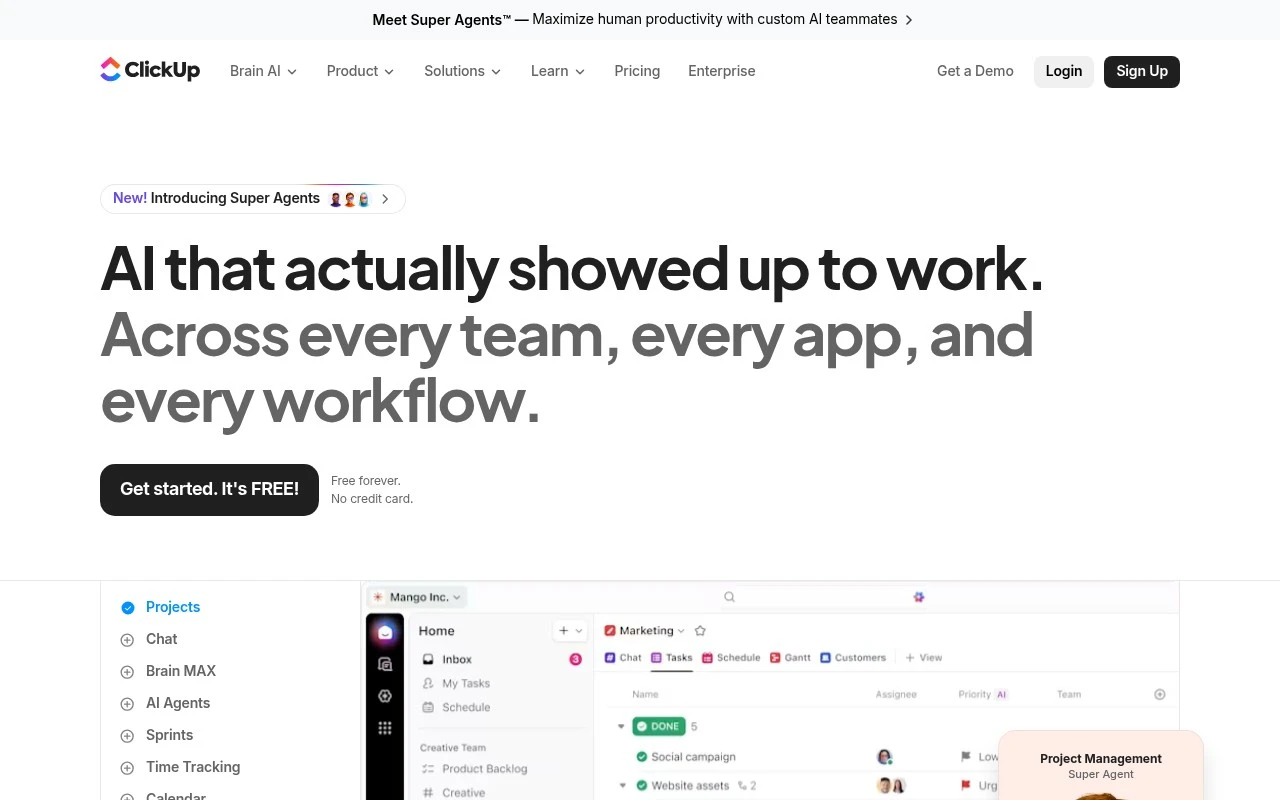
Clickup is a work management and productivity platform positioned as software to replace many separate workplace apps. It brings together project management, collaboration, documentation, scheduling, reporting, time tracking, automations, and AI features. Its newer AI layer, ClickUp Brain and Super Agents, is presented as using workspace context from tasks, docs, conversations, and connected apps to answer questions, suggest actions, and execute workflows.

FYAI Score

8.3 / 10

Based on 12.977 reviews

Pricing:

Freemium

Best for:

Cross-functional teams managing projects, docs, and workflows in one hub

Score Breakdown

  • Ease of use7.1 / 10
  • Features9.2 / 10
  • Pricing8.1 / 10
  • Integrations9.0 / 10
  • Support8.1 / 10

PRODUCT PREVIEW

What this AI tool does

Clickup is a work management tool designed to help teams and individuals organize projects, tasks, and day-to-day work in one place. It’s commonly used to plan work, track progress, and keep information connected so people can see what needs to happen next. In practice, it supports different ways of structuring work depending on your workflow, whether you prefer simple task lists or more detailed project planning. Many teams use it to coordinate responsibilities, manage deadlines, and reduce back-and-forth by keeping updates and related materials tied to the work itself. If you’re comparing options or trying to understand how clickup fits into a project management setup, it’s helpful to consider how it handles collaboration, reporting, and integrations with other tools you already use. The best fit usually depends on team size, the complexity of your projects, and how much structure you want around planning and execution.

Use cases

Best for

Project Management

Plan projects in Clickup with lists, boards, Gantt views, dependencies, and status reporting across tasks and milestones.

Task Management

Create tasks with assignees, priorities, due dates, checklists, and recurring rules, then track progress in views and inboxes.

Time Tracking

Track time per task with timers and manual entries, then review timesheets and reports for projects, people, and tags.

ANALYSIS

Strengths & limitations

Strengths
  • Combines many work tools in one system, including tasks, docs, chat, calendars, whiteboards, dashboards, sprints, time tracking, and automations.
  • Designed around shared work context, so project data, documentation, conversations, and reporting can live in the same workspace.
  • AI features are tied to workspace context and include agents, deep search, writing assistance, Q&A, and workflow support.
Limitations
  • The broad feature set may be more complex than needed for individuals or teams that only need a simple task list.
  • Getting full value depends on teams moving enough of their work context into ClickUp or connecting relevant external apps.
  • Organizations already standardized on separate best-of-breed tools may face migration, configuration, and adoption work.

Evaluation

FYAI score breakdown

Our structured evaluation across five key criteria

8.3 / 10

Overall score

Based on 12.977 reviews

  • Ease of use7.1 / 10
  • Features9.2 / 10
  • Pricing8.1 / 10
  • Integrations9.0 / 10
  • Support8.1 / 10

What users say

Findings from public reviews, documentation and community sources.

  • Ease of use

    ClickUp positions itself as "All Apps, AI, Projects, Chat + 20 more," while a Reddit complaint describes ClickUp as a "bloated mess."

  • Features

    ClickUp's homepage lists projects, chat, AI, time tracking, docs, and whiteboards, and ClickUp claims "100+ products to replace fragmented software."

  • Pricing

    ClickUp's pricing page lists a "Free Forever" plan, Unlimited at "$7 per user/month, billed yearly," Business at "$12 per user/month," and AI plans at "$9" and "$28" per user/month. ClickUp's pricing page also references paid add-ons and workspace-wide upgrades.

  • Integrations

    ClickUp's pricing page includes "Unlimited Integrations," named integrations including "Slack, Hubspot, Google Drive," "Webhooks & Automation Integrations," "API," and "Enterprise API."

  • Support

    ClickUp's pricing page includes "24/7 Support," and Enterprise adds "Live Onboarding Training," "Customer Success Manager," and managed-services access. A Reddit complaint about ClickUp describes "poor communication."

Who is this for?

Best for teams trying to consolidate work in one workspace. ClickUp lists projects, chat, AI, time tracking, docs, whiteboards, and claims "100+ products to replace fragmented software." Less suited to users who want a low-overhead productivity app. ClickUp positions itself as "All Apps, AI, Projects, Chat + 20 more," and a Reddit complaint describes it as a "bloated mess," which points to setup and navigation overhead.

PRODUCT PREVIEW

Feature highlights

Tasks + Docs in sync

Plan, write, and execute with docs tied directly to tasks and goals.

ClickUp Brain

Ask questions and get answers using context from your workspace.

Automations & Agents

Automate handoffs and let agents run repeatable workflows for you.

COMPARE

Discover curated alternatives worth comparing

Compare similar AI tools based on features, pricing and use cases

7.8/ 10Based on 31 reviews

Wudpecker

Meeting NotesSummarization
Turns meeting recordings into notes, summaries, and action items
Best for:
Knowledge workers
Pricing
Freemium

9.0/ 10Based on 1.589 reviews

Toggl Track

Time & Habit Tracking
Tracks time with automatic activity detection and reporting.
Best for:
Operations teams
Pricing
Freemium

8.5/ 10Based on 2.648 reviews

Todoist

Task & Project Management
Organize, schedule, and share tasks with AI-assisted planning
Best for:
Knowledge workers
Pricing
Freemium

Bring projects, people, and priorities into one place. Start moving work forward faster with Clickup today.

FAQ

Frequently asked
questions

Everything you need to know about this AI tool,
its features, pricing, use cases, and limitations.

What types of teams and workflows is Clickup a good fit for?
Clickup works best for teams that need flexible project management across tasks, docs, goals, and dashboards in one place (e.g., product, marketing, agencies, and ops). It’s a strong option if you want to standardize workflows across multiple teams while still allowing customization per space or project. If you only need a lightweight to-do list or a simple kanban board, a simpler tool may be faster to run day to day.
How does Clickup’s Free plan compare to its paid plans, and what are the common limits?
Clickup’s Free plan is usually enough to trial basic task management and collaboration, but teams often hit limits around advanced views, automation, and admin controls. Paid tiers generally add more automation capacity, reporting/dashboards depth, permissions, and integrations at scale. If you expect to rely on automations or need tighter governance, plan on a paid tier early.
When would you choose Clickup over Asana, Trello, or Jira?
Choose Clickup over Trello if you need more than kanban—such as multiple views, docs, goals, and richer reporting in one workspace. Compared with Asana, Clickup tends to offer more customization and “all-in-one” breadth, but can feel heavier to configure. Against Jira, Clickup is often easier for cross-functional teams, while Jira may be stronger for software teams that need deep issue tracking and development workflows.
How quickly can a team get set up in Clickup, and what onboarding effort should you expect?
Clickup’s flexibility can create complexity: too many statuses, fields, and views can confuse users and slow adoption. Some teams also report performance lag in large workspaces or during heavy usage, which matters if you rely on real-time updates. If your priority is a minimal interface with strict, opinionated workflows, a simpler tool may reduce overhead.
What should I consider about Clickup’s data handling, privacy, and compliance before adopting it?
Before committing, confirm Clickup’s security and compliance posture matches your requirements (e.g., SSO/SAML availability, audit logs, data retention, and any needed certifications). Check where data is stored, how exports and backups work, and what admin controls exist for permissions and external sharing. If you operate in a regulated environment, review Clickup’s DPA and security documentation and validate whether your plan includes the controls you need.