Curated ToolThis tool is part of our curated AI directory. We only include tools that meet our standards for relevance, usability and real-world value.

Akiflow

AI scheduling assistant for tasks, events, reminders, and briefings

Task & Project ManagementScheduling & Calendar
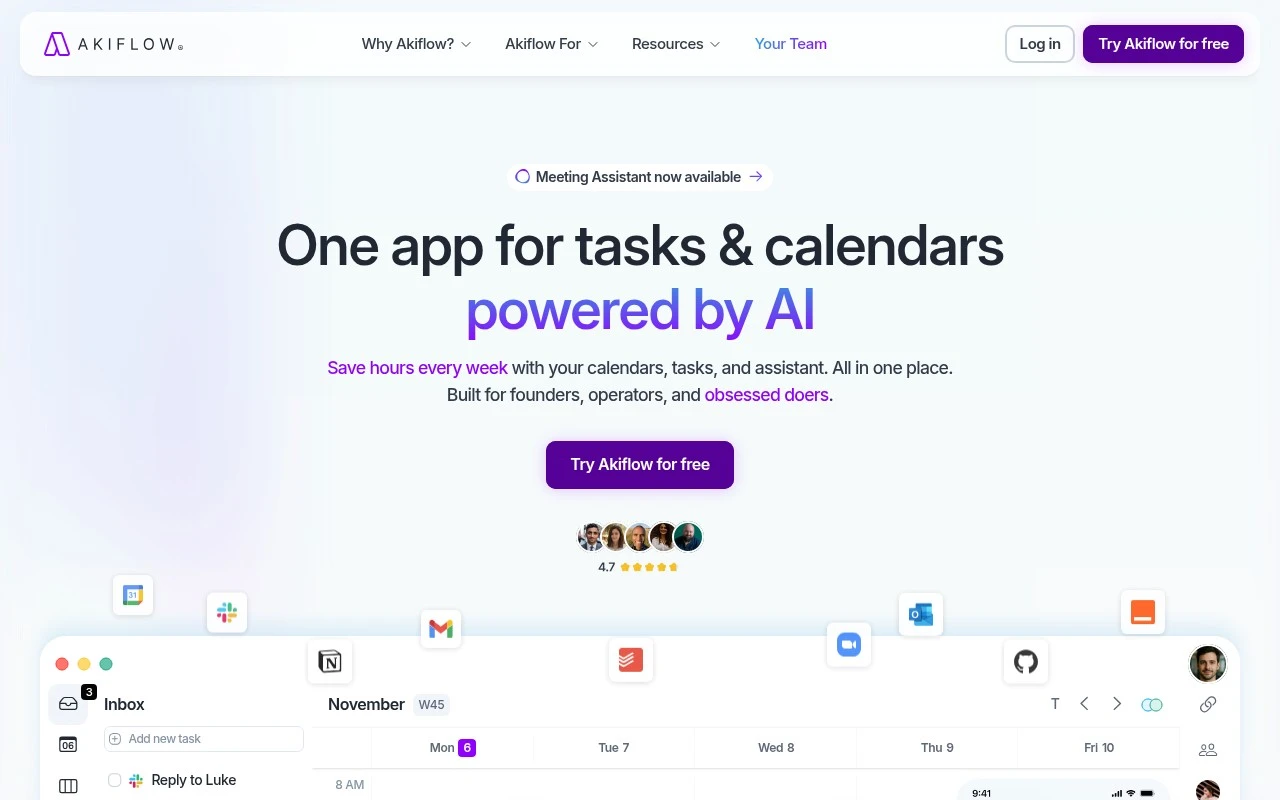
Akiflow is a time-blocking digital planner and calendar for centralizing tasks and schedules. It brings together a calendar, task manager, universal inbox, integrations, and an AI sidekick called Aki so users can capture work from multiple tools, turn tasks into scheduled blocks, and manage daily planning from one place.

FYAI Score

8.2 / 10

Based on 212 reviews

Pricing:

Paid only

Best for:

Busy knowledge workers who time-block tasks to protect focus

Score Breakdown

  • Ease of use9.2 / 10
  • Features8.2 / 10
  • Pricing7.3 / 10
  • Integrations8.3 / 10
  • Support7.4 / 10

PRODUCT PREVIEW

What this AI tool does

Akiflow is a productivity tool designed to help people manage tasks and daily work in one place. It focuses on turning incoming items—such as notes, messages, or reminders—into actionable tasks so they are easier to track and complete. In practice, it’s used to plan your day, prioritize what matters, and keep a clear view of what’s next without constantly switching between apps. If you’re looking for an informational overview, it can be understood as a task management and workflow organization app aimed at reducing scattered to-dos and making follow-through more consistent.

Use cases

Best for

Schedule Planning

Plan your day by dragging tasks into time blocks on Akiflow’s calendar and adjusting blocks as priorities change.

Task Management

Manage tasks in one place by capturing items into a universal inbox, organizing them, and turning them into scheduled work blocks.

Calendar Automation

Automate calendar updates by syncing events and tasks via integrations so scheduled blocks stay aligned with your meetings.

ANALYSIS

Strengths & limitations

Strengths
  • Combines calendar, tasks, inbox, and planning workflows instead of treating task lists and schedules separately.
  • Supports capture from multiple contexts, including mobile apps, voice mode, AI chat, command shortcuts, email, Slack, native integrations, Zapier, and IFTTT.
  • Includes AI-assisted planning features such as auto-scheduling, prioritization nudges, daily briefings, reminders, and natural-language schedule actions.
Limitations
  • The product is aimed at structured time-blocking workflows, so it may be more than needed for users who only want a simple to-do list or basic calendar.
  • Its value depends on connecting calendars, task sources, and integrations; users with fewer external tools may benefit less from the universal inbox model.
  • The site presents some assistant capabilities as emerging or coming soon, so not every AI interaction shown may be fully mature or available to all users.

Evaluation

FYAI score breakdown

Our structured evaluation across five key criteria

8.2 / 10

Overall score

Based on 212 reviews

  • Ease of use9.2 / 10
  • Features8.2 / 10
  • Pricing7.3 / 10
  • Integrations8.3 / 10
  • Support7.4 / 10

What users say

Findings from public reviews, documentation and community sources.

  • Ease of use

    G2 says users “consistently praise Akiflow for its ease of use and intuitive design,” and SoftwareAdvice highlights Akiflow as “Crazily easy to use” with “great use of keyboard shortcuts.”

  • Features

    Akiflow's own page describes an “All-in-One Productivity Suite” combining “Calendar, tasks, inbox, and AI,” and lists time-blocking, AI nudges, quick capture, and offline mode.

  • Pricing

    Akiflow's public pricing page lists Pro Monthly at “$34 per month” and Pro Yearly at “$19 per month, billed yearly,” with a “7 days free trial” and “Cancel anytime.”

  • Integrations

    Akiflow advertises “10+ Native Integrations + Thousands via Zapier and IFTTT” and “2-way sync your favorite tools.” Akiflow's pricing page references email-to-task capture, Slack message saving, and Google/Outlook calendar integrations.

  • Support

    Akiflow says Pro includes a “Free 1:1 Onboarding call,” while a Reddit post says, “Their support is terrible until you call them out on Reddit or other social media platforms.”

Who is this for?

Best for people who want tasks and calendars in one workflow, Akiflow's page describes an “All-in-One Productivity Suite” combining “Calendar, tasks, inbox, and AI,” with time-blocking and daily/weekly planning. Less suited to price-sensitive users, the pricing page lists Pro Monthly at “$34 per month” and Pro Yearly at “$19 per month, billed yearly,” so Akiflow becomes a recurring paid commitment after the “7 days free trial.”

PRODUCT PREVIEW

Feature highlights

Time-block planning

Drag tasks onto your calendar to build a realistic daily plan.

Universal inbox

Capture tasks from multiple tools in one place for quick triage.

Aki AI sidekick

Get help prioritizing and turning messy inputs into clear next steps.

COMPARE

Discover curated alternatives worth comparing

Compare similar AI tools based on features, pricing and use cases

7.8/ 10Based on 31 reviews

Wudpecker

Meeting NotesSummarization
Turns meeting recordings into notes, summaries, and action items
Best for:
Knowledge workers
Pricing
Freemium

9.0/ 10Based on 1.589 reviews

Toggl Track

Time & Habit Tracking
Tracks time with automatic activity detection and reporting.
Best for:
Operations teams
Pricing
Freemium

8.5/ 10Based on 2.648 reviews

Todoist

Task & Project Management
Organize, schedule, and share tasks with AI-assisted planning
Best for:
Knowledge workers
Pricing
Freemium

Take control of your week with a plan you’ll actually follow. Start time blocking in Akiflow and finish more of what matters—without the chaos.

FAQ

Frequently asked
questions

Everything you need to know about this AI tool,
its features, pricing, use cases, and limitations.

Who is Akiflow a good fit for, and when is it overkill?
Akiflow fits people who plan their day around a calendar and want tasks, meetings, and a universal inbox unified into a time-blocking workflow. It’s especially useful for knowledge workers juggling multiple projects who benefit from daily planning and automatic scheduling suggestions. If you mainly need a lightweight checklist or don’t want to time-block, it can feel like more structure than necessary.
Does Akiflow have a free plan, and what are the practical limitations?
Akiflow is primarily a paid product; if a trial is available, it’s usually time-limited rather than a full free tier. The main limitation of not paying is that you won’t get sustained access to the full planning workflow (calendar/task sync and automation features) that makes it valuable. Check current pricing on akiflow.com because plan details can change.
How does Akiflow compare with Motion, Sunsama, and Todoist + Google Calendar?
Compared with Motion, Akiflow tends to keep you more in control of planning rather than fully auto-scheduling everything. Versus Sunsama, Akiflow is often chosen for faster capture and a more integrated “universal inbox” plus assistant-driven actions. Against Todoist + Google Calendar, Akiflow can reduce tool switching by combining tasks, calendar, and planning in one place, but it requires committing to its workflow.
How long does it take to set up Akiflow, and what’s the onboarding effort?
Akiflow works best when you adopt its structured planning routine; if you prefer a flexible, low-maintenance system, it may feel rigid. You’ll get the most value only after consolidating calendars and tasks, which can be disruptive if your team or clients rely on other tools. Also, integration coverage can require verification because not every native integration is always clearly listed in one place.
What should I consider about data handling, privacy, and compliance with Akiflow?
Akiflow needs access to your calendars and task sources to provide scheduling actions and briefings, so you should review what permissions it requests and what data is synced. If you’re in a regulated environment, confirm whether Akiflow offers the compliance and contractual terms you need (e.g., DPA, retention controls, admin features) before adopting it. For AI assistant features, check how prompts and connected data are processed and whether you can limit what’s shared.