Curated ToolThis tool is part of our curated AI directory. We only include tools that meet our standards for relevance, usability and real-world value.

Affinity Designer

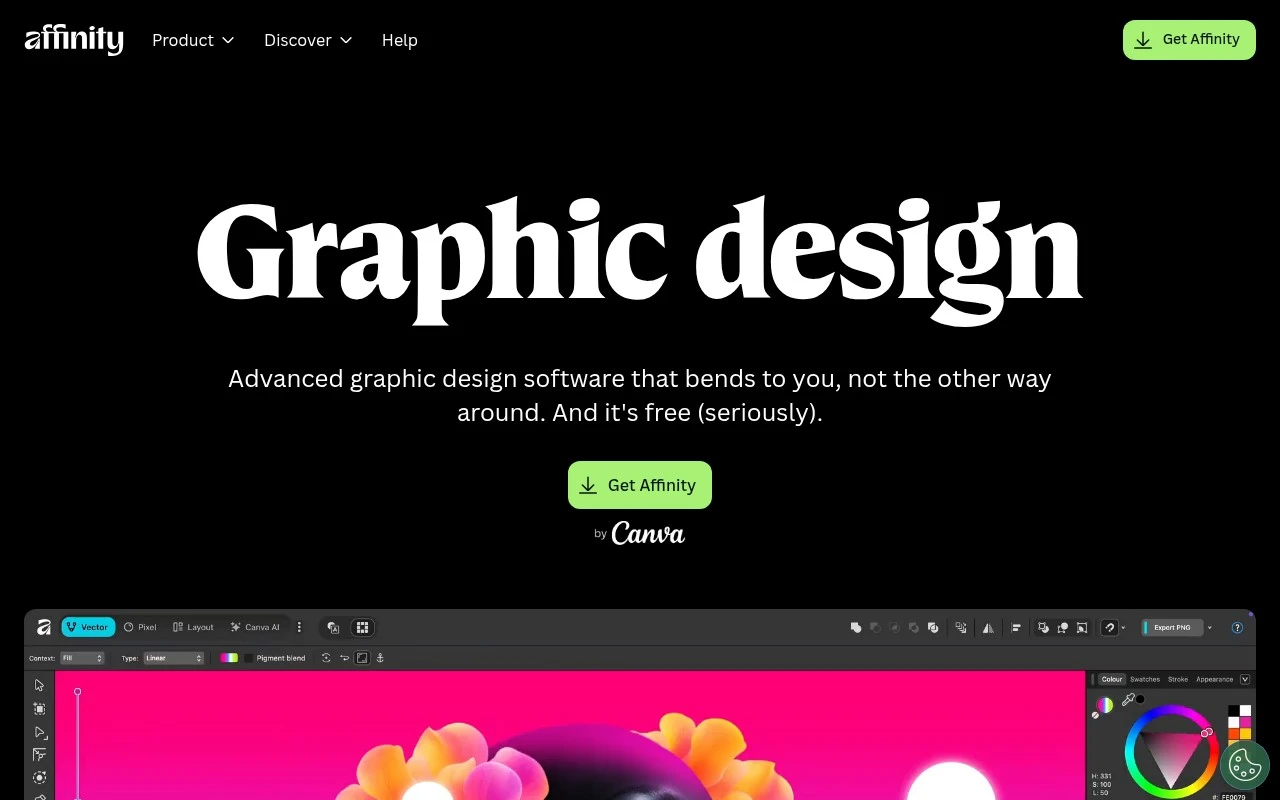
Affinity Designer is a vector graphics editor for creating illustrations, icons, logos, UI assets, and other scalable designs. It combines vector drawing tools with pixel-based editing features for detailed design work.
Logo & Brand AssetsGraphic Design

FYAI Score

8.5 / 10

Based on 454 reviews

Pricing:

Freemium

Best for:

Illustrators and graphic designers creating vector artwork for print and digital

Score Breakdown

  • Ease of use8.3 / 10
  • Features8.6 / 10
  • Pricing9.4 / 10
  • Integrations8.2 / 10
  • Support7.8 / 10

PRODUCT PREVIEW

What this AI tool does

Affinity Designer is Affinity’s professional vector graphic design application for creating crisp, scalable artwork across digital, print, and product design. It gives designers a focused workspace for drawing, shaping, refining, and exporting visual assets with precision, while still allowing raster textures and painterly details when a project needs more organic character. For illustrators, graphic designers, web designers, game developers, and brand teams, Affinity Designer is built to support both expressive artwork and production-ready design systems. A user might start by sketching an icon set, create a logo, develop UI screens, prepare merch graphics, or assemble design templates, then keep moving within the same environment instead of switching between unrelated tools. At the centre of the tool is vector control. Curves, nodes, shapes, strokes, fills, gradients, and typography can be adjusted with the kind of accuracy expected from a professional design application, making it well suited to logos, icons, interface elements, badges, packaging graphics, and other artwork that must stay sharp at any size. Real-time previews help the creative process feel direct, because edits appear immediately rather than being hidden behind render steps or repeated exports. A distinctive part of the experience is the way clean vectors and textured raster work can live together. Designers can build polished geometric forms, then add brush detail, shading, noise, or hand-drawn texture without losing the overall structure of the composition. This makes the platform useful not only for corporate brand assets, but also for editorial illustration, game art, posters, concept graphics, and more characterful visual systems. Non-destructive editing gives projects room to evolve. Effects, adjustments, layers, masks, constraints, and reusable elements can be refined as a brief changes, so the same file can move from exploration to final artwork without forcing designers to flatten decisions too early. That matters in professional workflows where stakeholders may ask for alternate colours, different formats, updated copy, or new versions of the same concept. For interface and web work, the application supports the practical rhythm of creating mockups, icons, app assets, buttons, layouts, and export-ready graphics. Its precision tools help maintain alignment and consistency, while its artboards and export options make it easier to prepare multiple sizes or variants from one project. The result is a design environment that can handle both the visual thinking stage and the asset delivery stage. Print-focused creatives can also use the tool for posters, stationery, marketing materials, packaging concepts, and templates that need controlled layout, reliable type handling, and high-resolution output. Typography controls, colour handling, grid options, and scalable artwork make it suitable for projects where visual polish and technical preparation need to meet. It is not only about drawing attractive shapes, but about preparing work that can survive real production requirements. Rather than positioning itself as a simple illustration app, Affinity Designer presents itself as a complete creative workspace for professional vector-based design. Affinity Designer is best at giving creatives a fast, precise, and visually flexible way to create brand assets, illustrations, UI graphics, mockups, merchandise artwork, game visuals, and print-ready designs. Its character is practical and craft-oriented, combining the discipline of vector design with enough texture, flexibility, and export control to support a wide range of modern creative work.

Use cases

Best for

Vector Graphic Design

Build scalable vector artwork using curve and node editing, shape tools, advanced fills, and real time preview.

Create Logo

Use Affinity Designer to draw and refine logo marks with precise curves, typography controls, and export presets for SVG and PNG.

Design Templates

Create reusable design templates with artboards, layers, symbols, and styles, then export assets for web or print.

ANALYSIS

Strengths & limitations

Strengths
  • Best suited to professional vector artwork because curve editing, node control, shape building, gradients, typography, and export tools support precise scalable designs.
  • Useful for mixed vector and raster illustration because raster brush textures and non-destructive editing let creatives add painterly detail without leaving the design workspace.
  • Helpful for AI-assisted ideation because Canva premium Generate Vector creates editable node-based graphics that can be recolored, reshaped, and refined in the design workflow.

Limitations
  • Less suitable for teams seeking a mainly AI-first design platform because its core workflow is still manual vector and graphic design rather than prompt-led automation.
  • Less suitable if AI vector generation must be built into the standalone app because Generate Vector depends on Canva premium plans.
  • Less suitable as an all-in-one creative suite because it focuses on vector and graphic design rather than dedicated photo retouching, video editing, or long-document publishing.

Evaluation

FYAI score breakdown

Our structured evaluation across five key criteria

8.5 / 10

Overall score

Based on 454 reviews

  • Ease of use8.3 / 10
  • Features8.6 / 10
  • Pricing9.4 / 10
  • Integrations8.2 / 10
  • Support7.8 / 10

What users say

Findings from public reviews, documentation and community sources.

  • Ease of use

    Affinity’s own page says “Every adjustment happens in real-time” and says users can “customize your workspace to adapt to your style of working.” A Reddit user describes Affinity Designer as “significantly smoother, faster,” while the supplied notes describe Affinity Designer as a full-featured vector app with some learning curve.

  • Features

    Affinity’s Designer page lists curve and node editing, Shape Builder, Image Trace, and vector/raster/layout work in one space. Affinity’s Designer page also lists non-destructive editing, text-on-path, character/paragraph styles, and raster brushes.

  • Pricing

    Affinity’s pricing page states “One powerful app. No cost” and “Fully-featured toolsets.” Affinity’s Designer page says the graphic design studio is “free,” while paid value-adds are tied to Canva premium AI features.

  • Integrations

    Affinity’s integration page says Affinity connects with “professional apps you already rely on like DaVinci Resolve, Capture One and Claude.” The integration evidence also mentions Canva integrations and an optional Design API.

  • Support

    G2 lists Affinity Designer at 4.5/5 from 452 reviews.

Who is this for?

Best for designers who want a free professional design app for mixed vector and raster work, Affinity’s pricing page states “One powerful app. No cost,” and the Designer page lists vector/raster/layout work in one space. Less suited to users who need a full marketplace-style ecosystem, Affinity’s integration evidence names connections such as DaVinci Resolve, Capture One and Claude, plus Canva integrations and an optional Design API, rather than a marketplace-style integration catalog.

PRODUCT PREVIEW

Feature highlights

Precision vector tools

Curve and node editing for clean icons, logos, and illustrations.

Non-destructive edits

Adjust shapes, strokes, and effects anytime with live previews.

Fills, gradients, type

Advanced color, gradients, and typography for polished layouts.

COMPARE

Discover curated alternatives worth comparing

Compare similar AI tools based on features, pricing and use cases

7.2/ 10Based on 2,027 reviews

Pixa

AI Image Generator
Edits and creates pixel-art images in a visual canvas editor
Best for:
Designers
Pricing
Freemium

8.2/ 10Based on 193 reviews

Uizard

UI/UX Design
Converts prompts, screenshots, and sketches into UI prototypes
Best for:
Product teams
Pricing
Freemium

8.2/ 10Based on 56,265 reviews

Topaz Labs

Image UpscalerPhoto Editing
Enhances photos and videos with upscaling, denoising, sharpening
Best for:
Designers
Pricing
Paid only

Create crisp logos, icons, and illustrations faster with a smooth, precise workflow. Start designing with Affinity Designer today and ship work you’re proud to share.

FAQ

Frequently asked
questions

Everything you need to know about this AI tool,
its features, pricing, use cases, and limitations.

Is Affinity Designer a good fit for logo design, icons, and brand assets?
Affinity Designer is a strong fit for professional vector graphic design, especially logos, icons, illustrations, UI assets, mockups, and print-ready brand materials. It gives designers precise control over curves, nodes, shapes, typography, fills, artboards, snapping, alignment, symbols, and reusable components, making it better suited to production design than simple template editing.
Is Affinity Designer free, and what do you need to pay for?
Affinity Designer uses a freemium model, with some capabilities available at no cost and premium access needed for certain features. Its AI-assisted Generate Vector feature is tied to eligible Canva premium plans, so users who want prompt-based editable vector generation should check the current Canva and Affinity plan details before choosing a workflow.
How does Affinity Designer compare with other vector design tools?
Affinity Designer competes well with other vector design tools when the priority is precise editing of scalable artwork rather than quick template-based content creation. It is designed for users who need editable curves, artboards, export controls, UI assets, logos, and illustrations, while simpler tools may be easier for casual social graphics.
How hard is it to set up and learn Affinity Designer?
The main trade-off with Affinity Designer is that its depth can be more than casual users need for simple graphics. AI vector generation is connected to Canva premium plans rather than the free base workflow, and the product is positioned around installed desktop design software rather than a fully browser-based design experience.
What should teams check about privacy and compliance before using Affinity Designer?
Teams should review Affinity Designer and Canva account terms, data handling practices, and current compliance documentation before using it with sensitive client or brand assets. This is especially important when using AI-assisted Generate Vector, because prompt-based workflows may involve cloud-connected services and account-level controls that procurement or legal teams need to assess.