Curated ToolThis tool is part of our curated AI directory. We only include tools that meet our standards for relevance, usability and real-world value.

Cline

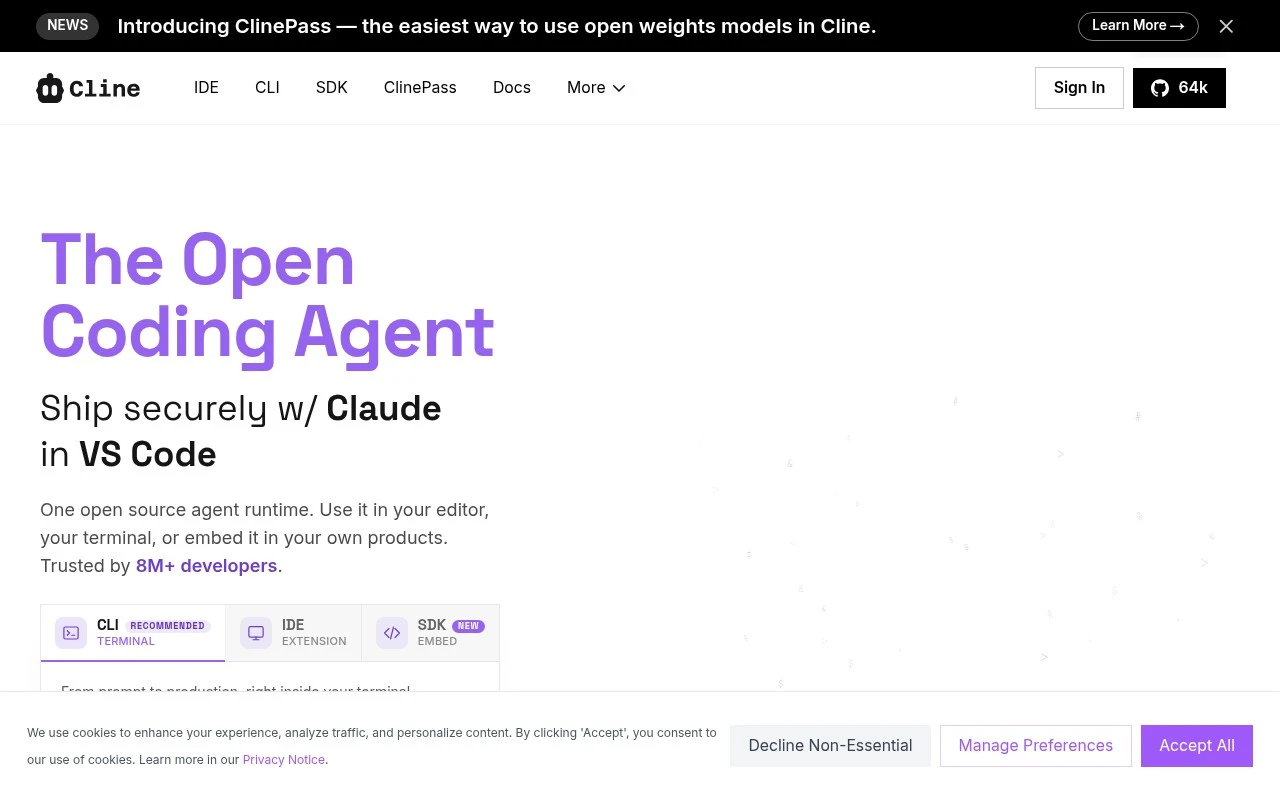
Cline is an open-source AI coding agent for Visual Studio Code that can plan and implement code changes, edit files, run terminal commands, and interact with browser workflows under user approval.
Code Generation & CompletionDebugging

FYAI Score

8.9 / 10

Based on 6 reviews

Pricing:

Free

Best for:

VS Code developers who want an agent to plan, code, and run tasks

Score Breakdown

  • Ease of use8.3 / 10
  • Features9.1 / 10
  • Pricing9.3 / 10
  • Integrations9.2 / 10
  • Support9.0 / 10

PRODUCT PREVIEW

What this AI tool does

Cline is an open-source AI coding agent for developers who want an assistant that can understand a real project, plan changes, edit code, run commands, and iterate inside their development workflow. Cline is strongest as a hands-on engineering agent for VS Code, the terminal, and SDK-based automation, where it can move from discussion to implementation while keeping the user in control. For developers working in existing repositories, the central idea is not just to generate code from a prompt. The tool reads context, follows project instructions, proposes an implementation strategy, and then applies changes across files when approved. That makes it useful for code refactoring, feature work, bug fixing, and test generation in codebases where small edits often depend on broader architectural context. Plan and Act modes give Cline its distinctive rhythm. In Plan mode, users can align with the agent before anything changes, refining the approach, constraints, and intended outcome. In Act mode, the agent can edit files, run bash commands, observe terminal output, and continue the loop until the task is complete or needs human input. Control is a major part of the experience. Cline can ask for review before taking actions, or use auto-approval settings for teams and individuals who want faster execution on trusted operations. This makes it suitable both for cautious exploratory work and for repeatable engineering flows where the boundaries are already well understood. Inside VS Code, the agent behaves like a coding partner that can see and modify the workspace rather than a detached chatbot. It can help debug code by running commands, reading errors, adjusting files, and reacting to the results. In the terminal and through the SDK, the same agentic approach can extend into scripts, internal tools, and devops automation. Repository rules help Cline adapt to the way a project is actually built. Teams can define conventions, preferred patterns, safety constraints, and workflow expectations so the agent does not treat every codebase the same. This is especially important for larger projects, where consistency and maintainability matter as much as producing a working patch. Connectivity is another important part of the platform story. Cline can connect to MCP servers and plugins, which lets it reach beyond local files into external tools, data sources, documentation, and custom systems. For organizations building internal AI-assisted workflows, that extensibility can turn the agent from a code editor companion into part of a broader engineering platform. Model choice is deliberately flexible. Cline works with multiple model providers, including Claude, GPT, Gemini, local models, and OpenAI-compatible endpoints. This allows individual developers and teams to balance capability, cost, privacy, latency, and deployment preferences without being locked into a single AI backend. The open-source nature of Cline also shapes its character. Developers can inspect how it works, contribute to it, customize behavior, and integrate it into their own environments. That transparency is valuable for users who want more than a hosted assistant and need confidence in how an agent is acting on their code. Overall, Cline is built for software teams and independent developers who want AI assistance that can participate in the full coding loop, from planning to implementation to verification. Its appeal comes from combining agentic execution with human oversight, making it practical for everyday engineering tasks such as generating code, refactoring modules, debugging failures, writing tests, and automating development workflows.

Use cases

Best for

Generate Code

Generate new functions and files in VS Code by having Cline plan changes, edit the project, and run terminal commands to validate.

Code Refactoring

Refactor code by having Cline propose a plan, apply multi-file edits, and run tests or linters via bash with review or auto-approval.

Debug Code

Debug code by letting Cline run your app or tests in the terminal, read error output, and patch files iteratively until failures stop.

ANALYSIS

Strengths & limitations

Strengths
  • Best suited to developers who want an open-source coding agent because it can inspect projects, edit files, run commands, and automate implementation workflows without a paid tool subscription.
  • Flexible for teams with different AI stacks because it supports multiple model providers, local models, and OpenAI-compatible endpoints.
  • Useful for controlled code changes because Plan and Act modes let teams agree on an approach before execution and choose between review-based or auto-approved actions.

Limitations
  • Less suitable for nontechnical users because Cline is built around code editors, terminals, SDK usage, repository rules, and command execution rather than no-code app building.
  • Teams with strict security or compliance controls need governance around its file editing and bash execution capabilities because the agent can make project changes and run commands in development environments.
  • Free access to Cline does not eliminate model-related setup or usage costs because teams still need to connect and manage their chosen AI model providers or local model infrastructure.

Evaluation

FYAI score breakdown

Our structured evaluation across five key criteria

8.9 / 10

Overall score

Based on 6 reviews

  • Ease of use8.3 / 10
  • Features9.1 / 10
  • Pricing9.3 / 10
  • Integrations9.2 / 10
  • Support9.0 / 10

What users say

Findings from public reviews, documentation and community sources.

  • Ease of use

    Cline.bot says Cline supports “Install once, run anywhere,” editor and terminal use, “Approve every step,” and “one-click undo.” Product Hunt describes a “smooth VS Code workflow.”

  • Features

    Cline’s documentation lists coordinated multi-file edits, terminal command execution, Plan/Act modes, and MCP/plugins. Cline’s documentation also lists multi-agent schedules, CLI, IDE extensions, Kanban, and an SDK.

  • Pricing

    Cline’s pricing page says the open-source version is “free for individual developers,” with “no subscriptions or seat fees,” usage-based AI inference, and BYO API keys. Cline’s pricing page says Enterprise is custom-priced.

  • Integrations

    Cline.bot lists model providers including OpenAI, Anthropic, Google, AWS Bedrock, GCP Vertex, Groq and others, plus “any OpenAI-compatible API.” Cline.bot also lists MCP, Slack/Discord/Telegram/Linear, GitHub Actions/GitLab pipelines, and an SDK.

  • Support

    Cline’s pricing page lists a full documentation hub, free-tier “Community Support,” and Enterprise “SLA & Dedicated Support.” Cline’s official Reddit community is positioned for users to “ask questions.”

Who is this for?

Best for individual developers or teams that want a coding agent across editor and terminal workflows, Cline.bot lists coordinated multi-file edits, terminal command execution, Plan/Act modes, and human-in-the-loop controls like “Approve every step” and “one-click undo.” Less suited to organizations that require published Enterprise pricing before evaluation, Cline’s pricing page says Enterprise is custom-priced.

PRODUCT PREVIEW

Feature highlights

Plan & Act workflow

Align on a strategy first, then execute changes with confidence.

Edits & runs commands

Modify files, run bash, and adapt to terminal output in-loop.

MCP & SDK extensions

Connect MCP servers/plugins and integrate Cline via SDK.

COMPARE

Discover curated alternatives worth comparing

Compare similar AI tools based on features, pricing and use cases

8.3/ 10Based on 68 reviews

Gemini Code Assist

Code Generation & CompletionTesting & Refactoring
Completes code, edits codebases, and answers dev questions
Best for:
Software developers
Pricing
Freemium

9.1/ 10Based on 46 reviews

GitHub Copilot

Code Generation & CompletionTesting & Refactoring
Suggests code, reviews changes, and automates repo tasks
Best for:
Software developers
Pricing
Freemium

8.0/ 10FYAI score

Amazon CodeWhisperer

Code Generation & CompletionDebugging
Completes code, fixes bugs, and automates software tasks
Best for:
Software developers
Pricing
Freemium

Reduce no-shows and keep patients informed with less staff effort. Start using Cline to deliver smoother scheduling and a better patient experience today.

FAQ

Frequently asked
questions

Everything you need to know about this AI tool,
its features, pricing, use cases, and limitations.

Who is Cline best suited for?
Cline is best suited for developers and technical teams that want an AI coding agent to understand codebases, plan changes, edit files, and run commands. It fits teams working in VS Code, terminal workflows, CI pipelines, or embedded SDK contexts, especially when multi-file changes and automation matter.
Is Cline free, and what should I know about costs?
Cline is available as a free, open-source AI coding agent, but model usage may still create separate costs depending on the provider or endpoint you choose. Teams should evaluate model pricing, latency, and usage limits because Cline can work with different model providers, local models, and OpenAI-compatible endpoints.
How does Cline compare with other AI coding tools?
Cline differs from many AI coding tools by focusing on agentic workflows, including planning, editing, terminal execution, test runs, and automation across editor, CI, and SDK environments. The best alternative depends on whether you need lightweight code suggestions, deeper codebase automation, local model support, or tighter team governance.
How much setup effort does Cline require?
Cline’s main trade-offs are that it requires technical comfort, careful permission management, and model selection decisions. Because it can edit project files and execute terminal commands, users need to review proposed changes and approvals. Output quality, speed, and cost can also vary by model provider or local setup.
What privacy and compliance issues should teams consider with Cline?
Teams should review how Cline is configured to access code, run commands, and send prompts or code context to chosen model providers. Privacy and compliance depend heavily on deployment choices, provider policies, local model use, repository permissions, and internal approval workflows, especially for regulated or sensitive codebases.