Kiro
Curated ToolThis tool is part of our curated AI directory. We only include tools that meet our standards for relevance, usability and real-world value.

Kiro

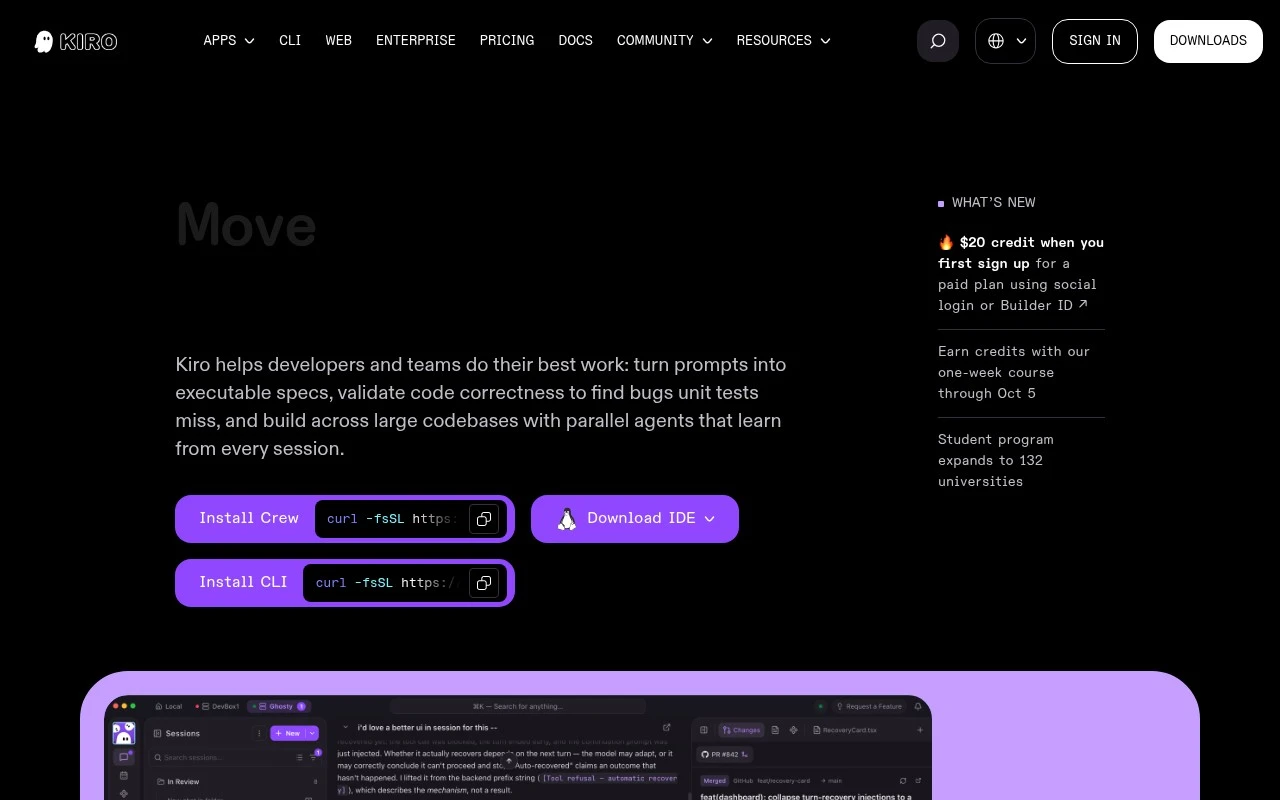
Kiro is an AI-powered IDE for spec-driven software development that turns project ideas into requirements, design documents, tasks, and code changes. It supports agent workflows such as chat, autonomous coding, and hooks that run checks or updates during development.
Code Generation & CompletionAI Coding Agents

FYAI Score

7.9 / 10

FYAI rating based on features, pricing and integrations

Pricing:

Freemium

Best for:

Engineering teams turning specs into tested code changes

Score Breakdown

  • Ease of use7.1 / 10
  • Features8.2 / 10
  • Pricing8.0 / 10
  • Integrations8.9 / 10
  • Support7.3 / 10

PRODUCT PREVIEW

What this AI tool does

Kiro
Kiro is an AI coding and agentic engineering platform from AWS for developers and engineering teams that want software changes to begin with clear specifications, not just prompts. It is designed to turn an idea into requirements, technical design, implementation tasks, code changes, and verification steps, giving teams a more structured path from intent to shipped software. Instead of treating AI coding as a single prompt-to-code exchange, the platform centers the workflow on spec-driven development. A developer can describe what they want to build, then refine the resulting requirements and design before the system starts generating or modifying code. This makes it better suited to complex engineering work where behavior, constraints, and edge cases matter. For development teams, Kiro is best at connecting planning, implementation, and validation in one agentic workflow. Kiro can generate code, propose changes across a codebase, and organize implementation into tasks that are easier to review and track. That structure helps teams avoid the common problem of AI-generated code that looks plausible but is not clearly tied to the original product or engineering intent. Automated reasoning is a central part of the product’s identity. The tool is built to check whether the code matches the specified behavior, using techniques such as property-based testing and test generation to explore more than a few hand-written examples. In practice, that means the AI is not only asked to write code, but also to help prove that the code behaves as expected under defined conditions. In day-to-day engineering work, the workflow can fit into several places where developers already operate. It supports IDE, CLI, cloud, and CI/CD usage, so teams can bring agentic assistance into local development, automated pipelines, or larger engineering systems. Code review also becomes part of the story, because generated changes can be evaluated against the requirements and design that produced them. Model flexibility gives the platform a broader role than a single coding assistant tied to one model. Kiro can work with multiple AI models, which makes it useful for organizations that want to balance quality, cost, latency, governance, or internal model strategy. The emphasis is less on one-off autocomplete and more on coding agent orchestration across the software delivery lifecycle. The broader character of the product is pragmatic and engineering-led. Kiro is for teams that like the productivity promise of AI coding tools but need more traceability, reviewability, and confidence than free-form generation can provide. Its value is clearest when a project requires shared understanding, repeatable process, and verification that the implemented code still reflects the intended design.

Use cases

Best for

Coding Agent Orchestration

Kiro turns prompts into specs, designs, task plans, and code changes across IDE, CLI, cloud, and CI workflows.

Code Review

It checks code changes with automated reasoning and property based tests against the specified behavior.

Generate Code

It generates code changes from requirements, designs, and implementation tasks instead of a single prompt.

ANALYSIS

Strengths & limitations

Strengths
  • Strong fit for teams that want structured AI development because Kiro starts from requirements, architecture, and sequenced tasks before implementation.
  • Useful for larger engineering workflows because it supports parallel agents, local and cloud sessions, an IDE, a CLI, and CI/CD pull request review flows.
  • Distinctive for correctness-focused coding because it combines requirements checks with property-based tests that can find edge cases missed by normal unit tests.

Limitations
  • Less suitable for non-developers because Kiro is built around codebases, IDE and CLI workflows, tests, pull requests, and engineering concepts.
  • Heavier than a quick code-completion assistant because the spec-driven workflow adds planning, requirements, and task structure before implementation.
  • Credit-based model usage needs cost management because model choice, task complexity, and high-volume agentic work can affect consumption.

Evaluation

FYAI score breakdown

Our structured evaluation across five key criteria

7.9 / 10

Overall score

FYAI rating based on features, pricing and integrations

  • Ease of use7.1 / 10
  • Features8.2 / 10
  • Pricing8.0 / 10
  • Integrations8.9 / 10
  • Support7.3 / 10

What users say

Findings from public reviews, documentation and community sources.

  • Ease of use

    In a Reddit thread about Kiro thoughts, one user called Kiro "definitely a cool concept" after a month of use and also said Kiro is "definitely in its infancy."

  • Features

    Kiro’s own page says Kiro can turn prompts into "requirements, architectural designs, and sequenced tasks," implement with "parallel agents," run property-based tests, and run a headless CLI in CI/CD to review PRs and fix bugs.

  • Pricing

    Kiro’s pricing page lists four tiers: Free includes 50 credits, Pro is $20/month for 1,000 credits, Pro+ is $40/month for 2,000 credits, and Power is $200/month for 10,000 credits. Kiro’s pricing page lists add-on credits at $0.04/credit.

  • Integrations

    Kiro’s own page lists ACP compatibility, MCP, Open VSX extensions, and "over 500 popular CLIs."

  • Support

    Kiro’s pricing page includes a self-serve Common Questions section covering how pricing works, model usage, signup credits, and credit mechanics.

Who is this for?

Best for developers or teams that want prompts turned into requirements, architectural designs, and sequenced tasks, with a headless CLI in CI/CD to review PRs and fix bugs. Less suited to users who want a simple flat-rate coding subscription, because Kiro uses credits across tiers from Free with 50 credits to Power at $200/month for 10,000 credits, with add-on credits at $0.04/credit.

PRODUCT PREVIEW

Feature highlights

Generate Code from Specs

Turns prompts into requirements, designs, tasks, and code changes.

AI Code Review

Checks behavior with automated reasoning and property-based tests.

Agent Orchestration

Coordinates IDE, CLI, cloud, and CI/CD workflows across models.

COMPARE

Discover curated alternatives worth comparing

Compare similar AI tools based on features, pricing and use cases

9.1/ 10Based on 49 reviews

Kilo Code

Code Generation & CompletionDebugging
Plans, edits, debugs, and reviews code across IDEs and cloud
Best for:
Software developers
Pricing
Freemium

8.1/ 10Based on 44 reviews

OpenCode

Code Generation & CompletionDebugging
Runs coding agents in terminal, IDE, or desktop with any LLM
Best for:
Software developers
Pricing
Paid

8.3/ 10Based on 68 reviews

Gemini Code Assist

Code Generation & CompletionTesting & Refactoring
Completes code, edits codebases, and answers dev questions
Best for:
Software developers
Pricing
Freemium

Kiro

Start building from clear intent today. See why engineering teams choose Kiro to move from idea to reliable code with confidence.

FAQ

Frequently asked
questions

Everything you need to know about this AI tool,
its features, pricing, use cases, and limitations.

Who is Kiro best suited for?
Kiro is best suited for software developers and engineering teams that want AI support across planning, implementation, testing, and pull request workflows. It fits codebases where requirements, architecture, task sequencing, code changes, and correctness checks matter more than simple autocomplete or one-off code generation.
Is Kiro free, and what should teams know about its paid usage?
Kiro uses a freemium pricing model, so teams can start with free access and should plan for usage limits as work scales. Because agentic coding can consume credits based on model choice, task complexity, and volume, engineering teams should monitor usage during larger implementation, review, and test-generation workflows.
How does Kiro compare with other AI coding tools?
Kiro is more structured than many AI coding assistants because it starts from executable specs, requirements, architecture, and planned tasks before making code changes. It is a stronger fit for spec-driven development and agent orchestration, while simpler tools may be better for quick completions, snippets, or lightweight code suggestions.
How much setup effort does Kiro require?
Kiro may require more onboarding than a basic code-completion tool because teams need to work with specs, tasks, tests, repositories, and development workflows. Its IDE, CLI, cloud, and CI/CD options can support different environments, but teams should expect some process alignment before using it effectively at scale.
What are the main limitations of Kiro?
Kiro is less suitable for non-developers or teams that only need quick code snippets because it is built around engineering workflows, codebases, tests, and pull requests. Its spec-driven approach adds planning overhead, and high-volume agentic work can require active credit and cost management.
What privacy and compliance questions should teams ask before using Kiro?
Teams evaluating Kiro should review how it handles source code, repository access, cloud sessions, CI/CD data, prompts, generated outputs, and agent activity logs. Buyers in regulated environments should confirm current security controls, data retention terms, access permissions, and compliance documentation directly with Kiro before connecting sensitive codebases.