OpenCode
Curated ToolThis tool is part of our curated AI directory. We only include tools that meet our standards for relevance, usability and real-world value.

OpenCode

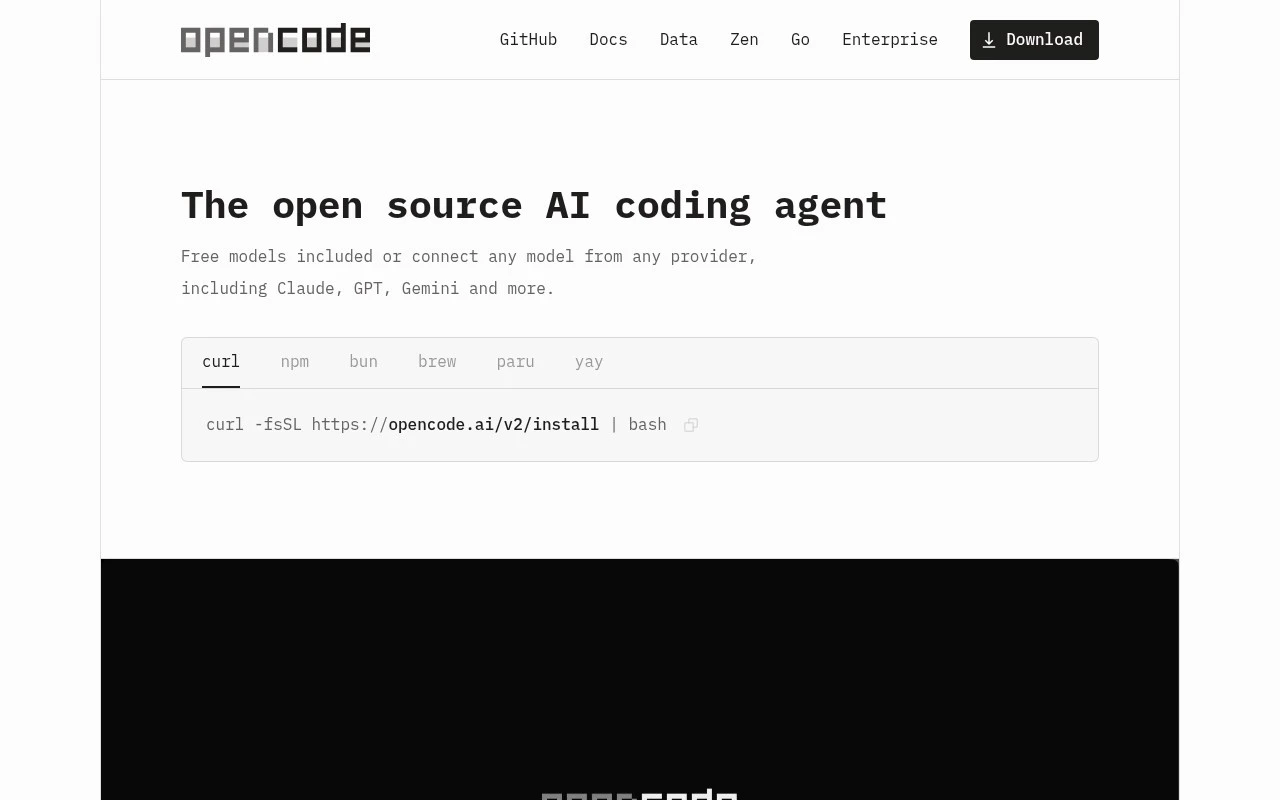
OpenCode is an open-source AI coding agent for the terminal that can read and edit code, run commands, and help implement or debug software projects using language models.
Code Generation & CompletionDebugging

OpenCode

FYAI Score

8.1 / 10

Based on 44 reviews

Pricing:

Paid

Best for:

Developers who want AI coding help inside terminal, IDE, or desktop workflows

Score Breakdown

  • Ease of use8.2 / 10
  • Features8.0 / 10
  • Pricing7.7 / 10
  • Integrations8.6 / 10
  • Support8.2 / 10

PRODUCT PREVIEW

What this AI tool does

OpenCode
OpenCode is an open source AI coding agent for developers who want code-aware assistance inside the tools they already use. It is designed for programmers who prefer to stay close to their existing terminal, desktop, or IDE workflow while using AI to generate code, debug code, explain unfamiliar files, and support code refactoring across real projects. For developers, the appeal is not only that it can write snippets or answer questions, but that it behaves more like a coding collaborator embedded in the development environment. It can work from project context, respond to tasks across a codebase, and help move from intent to implementation without requiring a separate chat-only workspace. A central part of the OpenCode story is flexibility. The tool runs in the terminal, as a desktop app, and through an IDE extension, which makes it suitable for developers with different habits and setups. Someone who lives in the command line can use it there, while another developer can keep the same agentic assistance closer to an editor-based workflow. Model choice is another defining feature. Through Models.dev, it supports more than 75 LLM providers, including local models, giving teams and individual developers room to choose based on cost, latency, privacy expectations, or model preference. It also supports login with GitHub Copilot and ChatGPT Plus or Pro accounts, which makes it easier for users who already pay for AI coding or chat tools to bring those accounts into a more integrated coding agent experience. Code awareness comes from its use of LSP context, which helps the assistant understand structure, symbols, and project-level information more effectively than a generic prompt box. That matters when a developer is asking for changes that depend on how files relate to one another, or when the task involves navigating existing architecture rather than generating isolated code. OpenCode is best at providing AI coding assistance that feels connected to the codebase rather than detached from it. Parallel sessions make the tool useful for developers who want to explore multiple tasks or threads of work at once. One session might investigate a bug, another might draft a refactor, and another might sketch a feature implementation. This supports a more experimental workflow where AI can help with several branches of thinking without collapsing everything into a single conversation. Privacy and control are also part of its positioning. OpenCode says it does not store code or context data, which is an important claim for developers and teams that are cautious about sending source code to cloud tools. Combined with support for local models, the platform fits users who want AI help but still care about where their code and context go. In practice, OpenCode sits between a terminal-native coding assistant, an IDE-aware agent, and a model-flexible developer tool. It is not framed as a no-code builder or a simple autocomplete utility, but as an open source agent for real software work. For developers who want AI assistance without abandoning their preferred environment, OpenCode offers a practical way to bring modern LLM capabilities into everyday coding.

Use cases

Best for

Generate Code

OpenCode generates code from terminal, desktop, or IDE prompts using LSP context and the LLM provider you choose.

Code Refactoring

OpenCode uses LSP context to inspect your project and propose edits for renaming, restructuring, and cleanup.

Debug Code

OpenCode reads project context and error output, then suggests code fixes in parallel terminal, desktop, or IDE sessions.

ANALYSIS

Strengths & limitations

Strengths
  • Open source licensing fits developers and teams that want inspectable tooling rather than a closed coding assistant.
  • Broad model support fits teams that want to choose between included models, local models, major LLM providers, GitHub Copilot, or ChatGPT accounts.
  • Terminal, IDE, and desktop availability fits developers who want the same coding agent across multiple parts of their workflow.

Limitations
  • Less suitable for non-developers because OpenCode is centered on code projects, developer environments, and tools such as terminals, IDEs, and LSPs.
  • Teams using external model providers still need to manage provider accounts, model costs, and data policies outside OpenCode.
  • Less suitable as an all-in-one software delivery platform because its scope is AI coding assistance rather than project management, CI/CD, hosting, or issue tracking.

Evaluation

FYAI score breakdown

Our structured evaluation across five key criteria

8.1 / 10

Overall score

Based on 44 reviews

  • Ease of use8.2 / 10
  • Features8.0 / 10
  • Pricing7.7 / 10
  • Integrations8.6 / 10
  • Support8.2 / 10

What users say

Findings from public reviews, documentation and community sources.

  • Ease of use

    OpenCode docs provide a getting-started path with an install script, package-manager options, provider configuration via `/connect`, and project initialization with `/init`. OpenCode docs include practical examples for planning, building, undoing, and sharing sessions, while onboarding assumes comfort with terminals, API keys, and project-level setup.

  • Features

    OpenCode product page lists terminal, desktop, and IDE availability, plus LSP loading and multi-session agents. OpenCode product page says OpenCode supports “75+ LLM providers through Models.dev, including local models,” and lists GitHub Copilot and ChatGPT Plus/Pro login.

  • Pricing

    Standard Compute lists OpenCode Go at “$10/mo” and other time-based options such as “$12 per 5 hours, $30 per week, $60 per month.” OpenCode product page says “Free models included or connect any model.”

  • Integrations

    OpenCode product page lists GitHub Copilot login, ChatGPT Plus/Pro login, “75+ LLM providers through Models.dev,” and local models. OpenCode product page lists availability as a terminal interface, desktop app, and IDE extension.

  • Support

    OpenCode docs cover prerequisites, installation across major environments, configuration, initialization, common workflows, undo/redo, sharing, and customization.

Who is this for?

Best for developers who want model choice across local and hosted AI coding workflows, with OpenCode product page listing “75+ LLM providers through Models.dev, including local models.” Less suited to users who want near-zero-friction setup, because OpenCode docs' onboarding assumes comfort with terminals, API keys, and project-level setup.

PRODUCT PREVIEW

Feature highlights

Generate Code in Flow

Write, edit, and explain code without leaving your coding workflow.

LSP-Aware Refactoring

Uses language server context for smarter code refactoring suggestions.

75+ Model Choices

Connect many LLM providers, local models, or eligible AI subscriptions.

COMPARE

Discover curated alternatives worth comparing

Compare similar AI tools based on features, pricing and use cases

9.1/ 10Based on 49 reviews

Kilo Code

Code Generation & CompletionDebugging
Plans, edits, debugs, and reviews code across IDEs and cloud
Best for:
Software developers
Pricing
Freemium

7.9/ 10FYAI score

Kiro

Code Generation & CompletionAI Coding Agents
Plans, implements, tests, and reviews spec-driven code changes
Best for:
Software developers
Pricing
Freemium

8.3/ 10Based on 68 reviews

Gemini Code Assist

Code Generation & CompletionTesting & Refactoring
Completes code, edits codebases, and answers dev questions
Best for:
Software developers
Pricing
Freemium

OpenCode

Start coding with an AI agent that fits your workflow. Explore OpenCode and move from idea to pull request with more focus and less friction.

FAQ

Frequently asked
questions

Everything you need to know about this AI tool,
its features, pricing, use cases, and limitations.

Who is OpenCode best for?
OpenCode is best for software developers and engineering teams that want an open source AI coding agent inside their existing development workflow. It is suited to writing, editing, refactoring, and debugging code from a terminal, IDE extension, or desktop app, especially when teams want flexible model choice.
Is OpenCode free or paid?
OpenCode is positioned as a paid tool, but model access may depend on how a team connects it to LLM providers or existing accounts. Buyers should evaluate the cost of OpenCode alongside any separate charges from external model providers, local infrastructure, GitHub Copilot, or ChatGPT accounts.
How does OpenCode compare with other AI coding assistants?
OpenCode stands out from many AI coding assistants because it is open source and supports multiple ways to run coding-agent workflows. It may be a better fit for teams that value inspectable tooling, terminal-based workflows, and model flexibility, while other tools may focus more on a single IDE or hosted experience.
How hard is it to set up OpenCode?
OpenCode is likely easiest to adopt for developers already comfortable with terminals, IDEs, project context, and LLM provider configuration. Setup effort depends on whether a team uses included models, local models, external providers, or existing Copilot or ChatGPT accounts, plus how it wants to integrate sessions into daily workflows.
What are the main limitations of OpenCode?
OpenCode is less suitable for non-developers because it is centered on code projects, developer environments, terminals, IDEs, and related tooling. It is also not an all-in-one software delivery platform, so teams still need separate systems for project management, CI/CD, hosting, issue tracking, and broader engineering operations.
What should teams know about OpenCode data privacy and compliance?
Teams should review data handling based on the models and accounts they connect to OpenCode. Using external LLM providers, GitHub Copilot, or ChatGPT accounts can introduce separate provider terms, retention policies, and compliance requirements, while local model use may change the operational and security responsibilities for the team.