Curated ToolThis tool is part of our curated AI directory. We only include tools that meet our standards for relevance, usability and real-world value.

Augment Code

Coordinates AI coding agents for PRs, reviews, and testing

Code Generation & CompletionDebugging
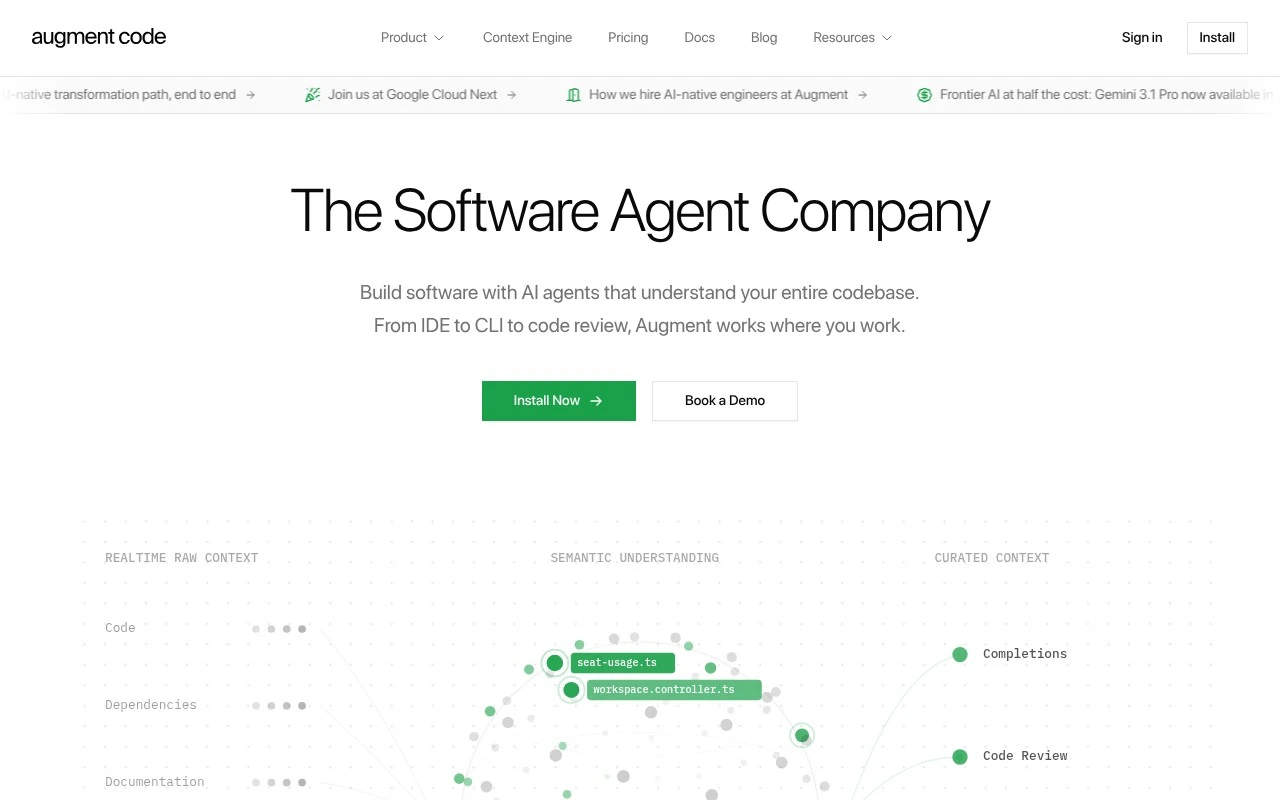
Augment Code’s Cosmos platform is presented as a unified agents platform for software engineering organizations. It provides agent runtimes, codebase context, workflow triggers, shared memory, integrations, sandboxed execution, and reusable “experts” that can own parts of the development lifecycle from triage through pull request, review, and verification. Its emphasis is organizational coordination, context management, model routing, and governance for AI software agents, rather than a single standalone coding chatbot.

FYAI Score

8.3 / 10

Based on 10 reviews + FYAI product analysis

Pricing:

Freemium

Best for:

Engineering orgs coordinating AI agents across the SDLC

Score Breakdown

  • Ease of use7.8 / 10
  • Features8.8 / 10
  • Pricing8.6 / 10
  • Integrations8.1 / 10
  • Support8.2 / 10

PRODUCT PREVIEW

What this AI tool does

Augment Code is an AI tool designed to help developers work with existing code more efficiently. It focuses on understanding the context of a codebase and assisting with common tasks like drafting changes, clarifying what a section of code does, or suggesting improvements while you stay in control of what gets applied. This tool is useful when you need quick, readable explanations of unfamiliar code, help refactoring for maintainability, or a second pass on logic and edge cases. It can also support writing tests or documentation by turning code intent into clear text, which can be helpful for onboarding and reviews. Because it operates as an assistant rather than an automatic rewrite engine, augment-code fits teams that want AI support without changing their development workflow. It’s best used as a companion during coding, review, and debugging, where you can evaluate suggestions against your project’s standards and requirements.

Use cases

Best for

Coding Agent Orchestration

Coordinate multiple AI agents with shared memory, workflow triggers, and model routing across triage, PR creation, review, and verification.

Code Review

Augment Code runs review agents with codebase context and sandboxed execution to comment on diffs and verify fixes before merge.

Application Modernization

Use agent experts with repository context and integrations to refactor legacy modules, update dependencies, and validate changes in a sandbox.

ANALYSIS

Strengths & limitations

Strengths
  • Covers multiple stages of the software development lifecycle, including triage, PR authoring, review, testing, incident response, security fixes, and migrations.
  • Includes a Context Engine intended to map codebase structure and give agents only task-relevant context, which the site positions as reducing token cost.
  • Targets enterprise deployment requirements such as integrations, sandboxed execution, auditability, access controls, data residency, BYOK, and deployment options.
Limitations
  • The public page is heavily enterprise- and sales-oriented, so practical setup effort, pricing, and day-to-day user experience are not fully clear from the provided content.
  • Many performance claims are presented as marketing metrics and would need validation in a buyer’s own repositories and workflows.
  • May be more platform than an individual developer or small team needs if they only want a lightweight code completion or chat assistant.

Evaluation

FYAI score breakdown

Our structured evaluation across five key criteria

8.3 / 10

Overall score

Based on 10 reviews + FYAI product analysis

  • Ease of use7.8 / 10
  • Features8.8 / 10
  • Pricing8.6 / 10
  • Integrations8.1 / 10
  • Support8.2 / 10

What users say

Findings from public reviews, documentation and community sources.

  • Ease of use

    The Augment site positions managed rollout as “Our Cloud Managed · Zero setup,” and a Reddit review says Augment “understands project structure and codebase relationships better than most alternatives.”

  • Features

    The Augment site lists SDLC features including Incident Management, Ticket to PR, Security Remediation, and Migrations. The same site describes shipped experts such as “PR Author,” “Deep Code Review,” “Verify Tester,” and “Build your own.”

  • Pricing

    The Augment pricing page lists the Business plan as “$100 /month flat, no per-seat charge,” with “up to 50 seats” and “$100/mo of usage.” The Augment pricing FAQ specifies usage components including LLM at provider list price, compute, and “a flat 40% fee on LLM usage,” with top-ups pay-as-you-go.

  • Integrations

    The Augment docs name external services including “GitHub, Linear, Jira, Confluence, Notion, Sentry, and Stripe,” and Augment lists common workflow integrations as “Slack · GitHub · Jira · CI.” The Augment pricing page includes “MCP & Native Tools.”

  • Support

    The Augment pricing page lists “Dedicated support” on Enterprise. The Augment site navigation includes Docs, Status Page, Trust Center, Security, and “Talk to Sales.”

Who is this for?

Best for engineering teams adopting managed coding-agent workflows, the Augment site lists Incident Management, Ticket to PR, Security Remediation, and Migrations, and the Business plan includes “up to 50 seats.” Less suited to buyers who need costs to stay flat as usage grows, the Augment pricing FAQ says usage includes LLM at provider list price, compute, and “a flat 40% fee on LLM usage,” with top-ups pay-as-you-go.

PRODUCT PREVIEW

Feature highlights

Unified agent runtime

Run reusable experts that handle triage, PRs, reviews, and checks.

Shared codebase memory

Keep agents aligned with org context, history, and decisions.

Governed execution

Route models, enforce policies, and run actions in sandboxes.

COMPARE

Discover curated alternatives worth comparing

Compare similar AI tools based on features, pricing and use cases

8.3/ 10Based on 68 reviews

Gemini Code Assist

Code Generation & CompletionTesting & Refactoring
AI coding assistant for code completion, edits, and explanations
Best for:
Software developers
Pricing
Freemium

9.1/ 10Based on 46 reviews

GitHub Copilot

Code Generation & CompletionTesting & Refactoring
AI coding assistant for code suggestions, chat, and reviews
Best for:
Software developers
Pricing
Freemium

8.9/ 10Based on 6 reviews

Cline

Code Generation & CompletionDebugging
Agentic coding runtime that edits files and runs commands
Best for:
Software developers
Pricing
Free

Ship higher-quality software faster with AI agents that understand your codebase. See how Augment Code helps your org turn engineering intent into reliable delivery.

FAQ

Frequently asked
questions

Everything you need to know about this AI tool,
its features, pricing, use cases, and limitations.

What teams and workflows is Augment Code a good fit for?
Augment Code fits best when you want AI agents to run repeatable engineering workflows across the SDLC—like PR review, test generation, bug triage, security fixes, and migrations—rather than only assisting individual developers. It’s typically a stronger match for orgs with established repos, CI, and ticketing processes where automation can be standardized. If your main need is lightweight in-editor code completion, a developer-centric assistant may be simpler.
Does Augment Code have a free plan, and what are the typical paid-plan constraints?
Augment Code is positioned as an enterprise product, and self-serve free-tier details may be limited or unavailable compared with developer-first tools. Expect paid plans to be tied to seats and/or usage, plus enterprise features like SSO and audit logs. Confirm evaluation access, pricing units, and any agent-run limits (e.g., workflow runs or compute) during a trial.
How does Augment Code compare to GitHub Copilot, Sourcegraph Cody, or Cursor?
Copilot, Cody, and Cursor are often optimized for individual productivity inside the IDE, while Augment Code emphasizes orchestrating agents that can coordinate work across systems and teams. Augment Code’s Context Engine is designed to provide targeted codebase context and reduce token usage, which can matter on large repos. If you don’t need cross-tool workflow automation (tickets/CI/security), the IDE-first options can be faster to adopt.
How quickly can Augment Code be set up, and what onboarding work should I expect?
Because Augment Code is enterprise- and workflow-oriented, it can require more process alignment and integration work than a plug-and-play coding assistant. Reported performance or cost improvements are vendor-provided, so you’ll want to validate them on your own codebase and CI constraints. You may also need clear ownership for approvals, rollback, and change management when agents propose or apply fixes.
What should I check for data privacy, security, and compliance with Augment Code?
Augment Code highlights enterprise controls such as SAML/OIDC/SCIM, RBAC, audit logs, BYOK, data residency, sandboxing, and deployment options—verify which are included in your tier. Ask what code and metadata are stored, retention periods, and whether customer data is used for model training. Also confirm how access is scoped per repo/project and how agent actions are logged for audits.