Curated ToolThis tool is part of our curated AI directory. We only include tools that meet our standards for relevance, usability and real-world value.

Relevance AI

Build and manage autonomous AI agents with tool integrations

Workflow AutomationIntegration Automation

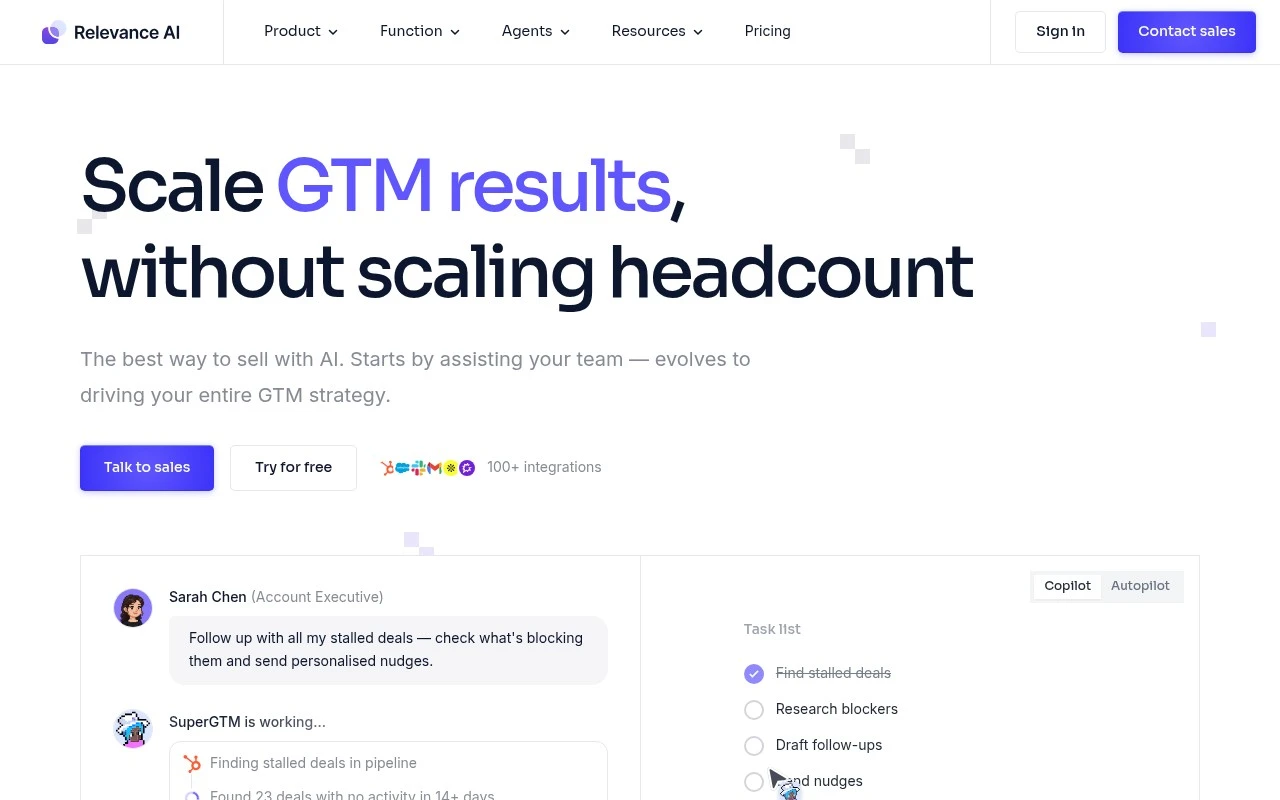
Relevance AI is an enterprise AI-agent platform for teams that want domain experts and technical operators to build agents that run business playbooks across tools like CRM and email systems. The platform supports plain-language agent creation, no-code editing, programmatic building via MCP, evaluations, monitoring, escalation review, version control, role-based access controls, and other governance features. Its positioning is strongest for GTM and operational teams moving from one-off AI assistance toward autonomous, managed workflows.

FYAI Score

8.4 / 10

Based on 20 reviews

Pricing:

Freemium

Best for:

GTM and ops teams building governed AI agents across CRM and email

Score Breakdown

  • Ease of use8.3 / 10
  • Features9.1 / 10
  • Pricing7.1 / 10
  • Integrations9.0 / 10
  • Support8.7 / 10

PRODUCT PREVIEW

What this AI tool does

Relevance AI is an AI tool designed to help teams work with text and other unstructured data in a more organized way. It focuses on turning raw content into structured information that can be searched, compared, and analyzed, which is useful when you have large volumes of documents, messages, or user feedback. In practice, it can support workflows like categorizing and labeling content, finding similar items, and building datasets for downstream analysis or applications. This makes it a practical option for product, research, and operations teams that need a clearer view of what’s inside their data without manually reviewing everything. For someone evaluating relevanceai, the main value is in simplifying how unstructured information is processed and made usable. It’s best suited to informational needs where you want to understand what the tool does, what kinds of data it can handle, and how it might fit into an existing data or analytics workflow.

Use cases

Best for

Agent Building

Relevance AI lets teams build AI agents in plain language, then add tools, evaluations, and monitored deployments with version control.

Lead Scoring

Score leads by having an agent pull CRM and email signals, apply rules or LLM judgments, and write the score back to your CRM.

Workflow Automation

Automate business playbooks by running agents that trigger actions across CRM and email, with escalation review and role-based access controls.

ANALYSIS

Strengths & limitations

Strengths
  • Supports multiple build modes: natural-language agent generation, no-code drag-and-drop editing, and programmatic development through MCP.
  • Designed for governed deployment, with evaluations, monitoring, RBAC, auditability, versioning, and human review or escalation workflows.
  • Focused on practical business workflows, especially GTM use cases such as lead scoring, enrichment, outreach, and qualification.
Limitations
  • The official page is enterprise- and GTM-oriented, so it may be more platform than needed for individuals or simple single-purpose automations.
  • Successful use appears to depend on teams defining playbooks, quality standards, evaluations, and oversight processes rather than simply turning on a generic assistant.
  • The provided site text does not give enough detail on pricing, implementation effort, or limits for smaller teams.

Evaluation

FYAI score breakdown

Our structured evaluation across five key criteria

8.4 / 10

Overall score

Based on 20 reviews

  • Ease of use8.3 / 10
  • Features9.1 / 10
  • Pricing7.1 / 10
  • Integrations9.0 / 10
  • Support8.7 / 10

What users say

Findings from public reviews, documentation and community sources.

  • Ease of use

    G2's review signal describes Relevance AI as having a "user-friendly interface" and handling unstructured data "effortlessly," while Relevance AI's product page emphasizes a "Drag & drop no-code builder" and an AI copilot that can wire agents from a description.

  • Features

    Relevance AI's features page lists no-code agent/workflow/eval builders, sandboxed Python/Javascript execution, major LLM access, and RAG ingestion. Relevance AI's features page also lists orchestration, triggers, approvals, evals, autoscaling, retries, and enterprise governance such as SOC 2, GDPR, SSO/SAML and RBAC.

  • Pricing

    Relevance AI's pricing page presents an Enterprise plan with "Unlimited Agents & Tools," "Unlimited Users & Projects," "2,000+ Integrations," and a "Dedicated Account Manager." Relevance AI's pricing page uses a "Talk to sales" purchasing motion rather than published per-seat or usage pricing.

  • Integrations

    Relevance AI's features page claims "1,000+ pre-built app integrations," managed OAuth/API-key flows, custom MCP server registration, and API/webhook triggers. Relevance AI's features page names Google Drive, Notion, Salesforce, Jira, Slack and Teams among sync/channel integrations.

  • Support

    Relevance AI's pricing page describes an "embedded deployment team" that helps customers get live in six weeks or less and then "trains your team to build" new agents. Relevance AI's Enterprise plan includes a "Dedicated Account Manager," according to the pricing page.

Who is this for?

Best for enterprise teams building AI-agent automations with guided rollout, Relevance AI's pricing page describes an "embedded deployment team" that helps customers get live in six weeks or less. Best for workflows that need connected data and apps, Relevance AI's features page claims "1,000+ pre-built app integrations" and names Google Drive, Notion, Salesforce, Jira, Slack and Teams. Less suited to buyers who need upfront cost comparison, Relevance AI's pricing page uses a "Talk to sales" purchasing motion rather than published per-seat or usage pricing.

PRODUCT PREVIEW

Feature highlights

Playbook AI agents

Build agents that execute repeatable workflows across business tools.

Evals & monitoring

Test, track, and review agent performance before and after launch.

Enterprise governance

RBAC, version control, and escalation review for safe operations.

COMPARE

Discover curated alternatives worth comparing

Compare similar AI tools based on features, pricing and use cases

9.0/ 10Based on 3.056 reviews

Zapier

Workflow AutomationIntegration Automation
Connects apps to automate multi-step workflows and actions
Best for:
Operations teams
Pricing
Freemium

8.6/ 10Based on 779 reviews

Workato

Workflow AutomationIntegration Automation
Orchestrates workflows across business apps via MCP integrations
Best for:
IT & Security teams
Pricing
Free trial

8.9/ 10Based on 7.771 reviews

Uipath

Workflow AutomationIntegration Automation
Automates workflows with AI agents, robots, and document processing
Best for:
Operations teams
Pricing
Freemium

Turn messy data into clear answers faster. Start with relevance ai today and help your team make confident, data-driven decisions in less time.

FAQ

Frequently asked
questions

Everything you need to know about this AI tool,
its features, pricing, use cases, and limitations.

What types of automation use cases is relevance ai a good fit for?
relevance ai tends to fit teams that want to automate analysis and generate repeatable insights from large or frequently updated datasets. It’s a practical choice when you need dashboards/visual summaries for stakeholders and want to connect multiple data sources without rebuilding your pipeline. If your work is mostly ad‑hoc analysis or highly bespoke modeling, you may find it less flexible than code-first approaches.
Does relevance ai have a free plan, and what are the typical limitations compared to paid tiers?
relevance ai commonly offers a free or trial option, but it’s usually constrained by usage caps (e.g., data volume, runs/credits, or feature access). Paid plans generally unlock higher limits, more integrations, and team features like collaboration and governance controls. Before committing, confirm whether the free tier supports your required connectors and the scale of your datasets.
How does relevance ai compare with other automation and analytics tools?
Compared with BI tools (e.g., dashboard-first platforms), relevance ai is more oriented toward automating analysis workflows rather than only visualizing curated metrics. Versus code-centric stacks (Python notebooks, custom pipelines), it can reduce build time but may offer fewer customization paths for edge cases. If you’re choosing between similar tools, compare connector coverage, workflow automation depth, and how easily outputs can be operationalized.
How quickly can a team get relevance ai running, and what onboarding effort should you expect?
Customization can be limited for organizations that need highly specific transformations, bespoke models, or non-standard reporting logic. Pricing can also be a deciding factor if your usage grows quickly or you have many users. Additionally, the platform may not replace a full data warehouse/ETL stack if you need deep data engineering controls.
What should we check regarding data privacy, security, and compliance when using relevance ai?
Verify where relevance ai processes and stores data, what encryption and access controls are available, and whether it supports SSO and role-based permissions for your team. If you handle regulated data, confirm relevant compliance posture (e.g., SOC 2/ISO claims, data retention options, and audit logs) and whether you can limit data sent to the platform. It’s also worth checking how third-party integrations are authorized and whether you can revoke tokens centrally.