Curated ToolThis tool is part of our curated AI directory. We only include tools that meet our standards for relevance, usability and real-world value.

Procesio

Automates and governs business workflows with process orchestration.

Workflow AutomationIntegration Automation
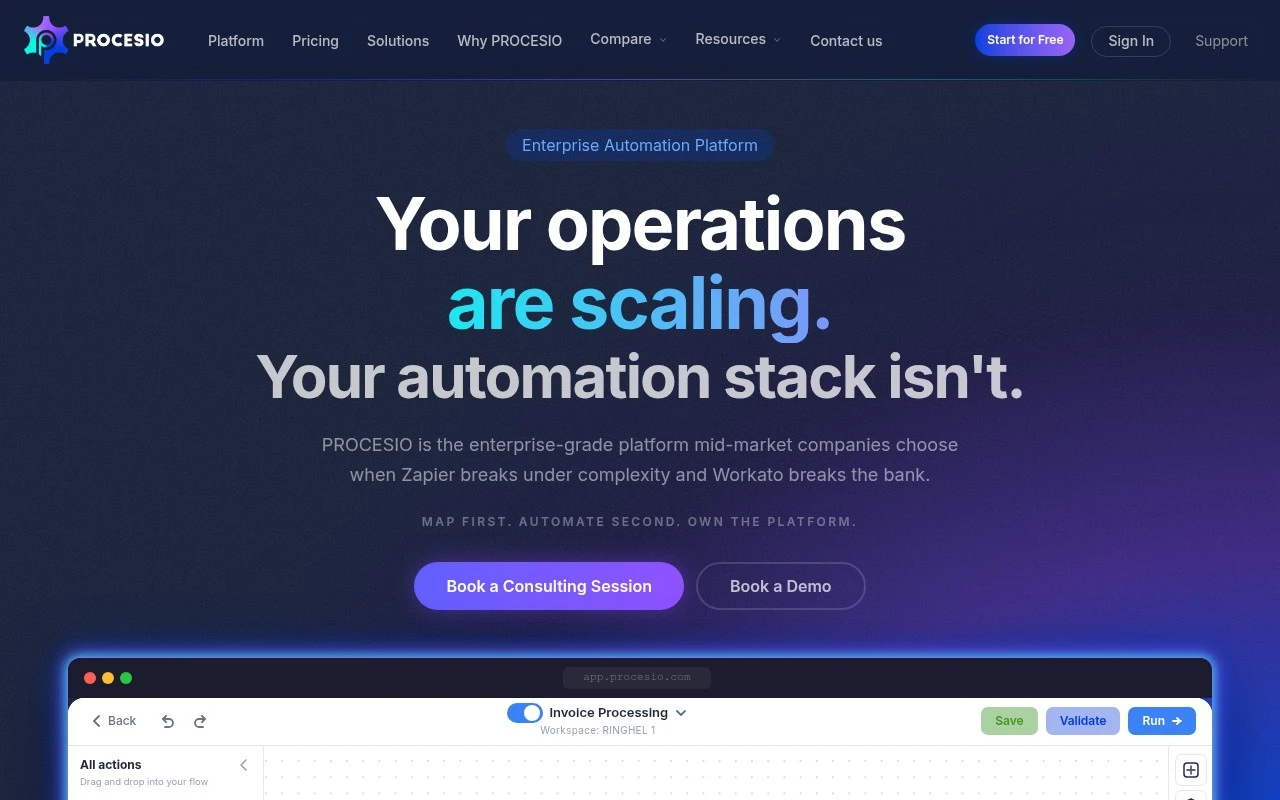
Procesio is an enterprise automation platform for mapping, building, and operating business processes. It combines a drag-and-drop workflow designer with developer scripting in JavaScript, Python, and C#, and is positioned for organizations that need more control, governance, and deployment flexibility than simple SaaS automation tools provide.

FYAI Score

8.3 / 10

Based on 33 reviews

Pricing:

Freemium

Best for:

Enterprise IT and ops teams automating governed, complex processes

Score Breakdown

  • Ease of use8.2 / 10
  • Features8.3 / 10
  • Pricing8.8 / 10
  • Integrations7.9 / 10
  • Support8.1 / 10

PRODUCT PREVIEW

What this AI tool does

Procesio is an automation platform designed to help teams connect apps, data, and internal tools into repeatable workflows. It provides a structured way to build and run processes that move information between systems, reducing the need for manual handoffs and ad‑hoc scripts. In practice, it’s used to orchestrate tasks such as syncing records, triggering actions based on events, and coordinating multi-step operations across different services. This can be useful for operations, IT, and product teams that need reliable workflow automation with clear execution logic. For anyone researching procesio, the key idea is that it focuses on turning routine business processes into managed workflows that can be monitored and adjusted over time. It’s typically evaluated when an organization wants more consistency and visibility than simple one-off integrations, without building everything from scratch.

Use cases

Best for

Workflow Automation

Procesio maps and runs business workflows using a drag and drop designer plus JavaScript, Python, or C# steps.

Integration Automation

Build integration flows that connect apps and databases by orchestrating API calls and scripted transformations in Procesio.

ANALYSIS

Strengths & limitations

Strengths
  • Supports both no-code workflow building and full-code scripting within the same automation platform.
  • Offers enterprise-oriented controls such as SSO, 2FA, encrypted credential storage, EU hosting, monitoring, and on-premise deployment options.
  • Emphasizes process discovery and ROI planning before automation through its Business Process Optimization Framework.
Limitations
  • Likely more complex than necessary for individuals or small teams that only need simple app-to-app automations.
  • The official positioning is strongly enterprise and consulting-led, which may not suit buyers looking for a purely self-serve automation tool.
  • The page emphasizes APIs and standard protocols rather than a large catalog of named prebuilt SaaS connectors.

Evaluation

FYAI score breakdown

Our structured evaluation across five key criteria

8.3 / 10

Overall score

Based on 33 reviews

  • Ease of use8.2 / 10
  • Features8.3 / 10
  • Pricing8.8 / 10
  • Integrations7.9 / 10
  • Support8.1 / 10

What users say

Findings from public reviews, documentation and community sources.

  • Ease of use

    G2 says PROCESIO has “a clear and intuitive dashboard,” and the PROCESIO product page emphasizes a “visual builder” and “interactive drag-and-drop canvas.” PROCESIO is positioned for “technical users” and supports custom code.

  • Features

    The PROCESIO product page describes “unlimited workflows,” “200+ pre-built nodes,” scripting in JS/C#/Python, and cloud/hybrid/self-hosted deployment. The PROCESIO product page also lists forms, approvals, document processing, scheduled jobs, webhooks, audit/activity logs, and SSO.

  • Pricing

    The PROCESIO pricing page lists a Free Community plan, Professional at “€10 /h/mo per processing hour / month,” and Business and Enterprise as custom-priced plans. The PROCESIO pricing page states unlimited processes, users, and workspaces on every plan.

  • Integrations

    The PROCESIO product page states PROCESIO can connect through “built-in connectors, REST API & Webhooks.” The PROCESIO product page also references “PROCESIO SDK for any custom integration” and credential management.

  • Support

    The PROCESIO pricing page says Community includes “Community support,” Professional includes “Customer support,” Business includes “Expert technical support,” and Enterprise adds “Dedicated support consultants” and “Engineering team access.”

Who is this for?

Best for technical users who need workflow automation with custom code. PROCESIO lists scripting in JS/C#/Python and cloud/hybrid/self-hosted deployment. Less suited to teams that want a large named-app marketplace, PROCESIO cites “built-in connectors, REST API & Webhooks” and “PROCESIO SDK for any custom integration,” so integrations can involve API, webhook, or SDK setup.

PRODUCT PREVIEW

Feature highlights

Workflow Designer

Map and build end-to-end processes with a visual drag-and-drop canvas.

Multi-language Scripts

Extend workflows with JavaScript, Python, and C# for custom logic.

Governed Operations

Run automations with controls, visibility, and deployment flexibility.

COMPARE

Discover curated alternatives worth comparing

Compare similar AI tools based on features, pricing and use cases

9.0/ 10Based on 3.056 reviews

Zapier

Workflow AutomationIntegration Automation
Connects apps to automate multi-step workflows and actions
Best for:
Operations teams
Pricing
Freemium

8.6/ 10Based on 779 reviews

Workato

Workflow AutomationIntegration Automation
Orchestrates workflows across business apps via MCP integrations
Best for:
IT & Security teams
Pricing
Free trial

8.9/ 10Based on 7.771 reviews

Uipath

Workflow AutomationIntegration Automation
Automates workflows with AI agents, robots, and document processing
Best for:
Operations teams
Pricing
Freemium

Start automating the work that slows your team down. See why operations teams choose Procesio to run faster, cleaner workflows with fewer errors.

FAQ

Frequently asked
questions

Everything you need to know about this AI tool,
its features, pricing, use cases, and limitations.

What types of automation is Procesio a good fit for?
Procesio tends to fit teams that need repeatable, multi-step business workflows that touch several apps (e.g., operations, finance, HR, and customer support handoffs). It’s a stronger choice when you want non-technical users to own and adjust workflows without constant developer involvement. If your needs are mostly simple “if-this-then-that” triggers, lighter automation tools may be faster and cheaper.
Does Procesio have a free plan, and what are the typical limitations compared to paid tiers?
Procesio is generally positioned as a paid business automation platform, and any free access (if offered) is usually limited to evaluation rather than long-term production use. The main differences you’ll typically see in paid tiers are higher run/usage limits, more integrations or connectors, and stronger governance features (roles, environments, auditability). If you need predictable costs for low-volume automations, compare pricing carefully against simpler tools.
How does Procesio compare with tools like Zapier, Make, or Power Automate?
Compared with Zapier/Make, Procesio is usually better suited to structured, end-to-end process automation where you want clearer workflow management and scalability beyond basic triggers. Against Power Automate, Procesio can be a better fit when you’re not centered on Microsoft 365 and want broader third-party integration flexibility. Your decision often comes down to connector coverage for your stack and how much governance you need.
How long does it take to set up Procesio, and what onboarding effort should I expect?
Procesio can require more upfront configuration, which may feel heavy if you only need a handful of simple automations. Some advanced capabilities may have a learning curve for users new to automation design and monitoring. Pricing can be less attractive for very small teams compared to basic automation products.
What should I check about data handling, privacy, and compliance before using Procesio?
Verify where Procesio processes and stores data, how credentials/tokens are managed for connected apps, and whether encryption is applied in transit and at rest. Ask about audit logs, role-based access controls, and options for data retention or deletion to match your internal policies. If you operate in regulated environments, confirm available compliance documentation and whether subprocessors are disclosed.