Curated ToolThis tool is part of our curated AI directory. We only include tools that meet our standards for relevance, usability and real-world value.

Manus AI

Manus AI is a general-purpose autonomous AI agent that plans and executes multi-step tasks in a cloud workspace, using web browsing, code execution, and file handling to produce deliverables such as research reports, spreadsheets, websites, and scripts.
Workflow AutomationRPA & Browser Automation

FYAI Score

7.4 / 10

Based on 176 reviews

Pricing:

Freemium

Best for:

Builders and ops teams automating real workflows end to end

Score Breakdown

  • Ease of use7.1 / 10
  • Features7.4 / 10
  • Pricing7.0 / 10
  • Integrations8.5 / 10
  • Support7.4 / 10

PRODUCT PREVIEW

What this AI tool does

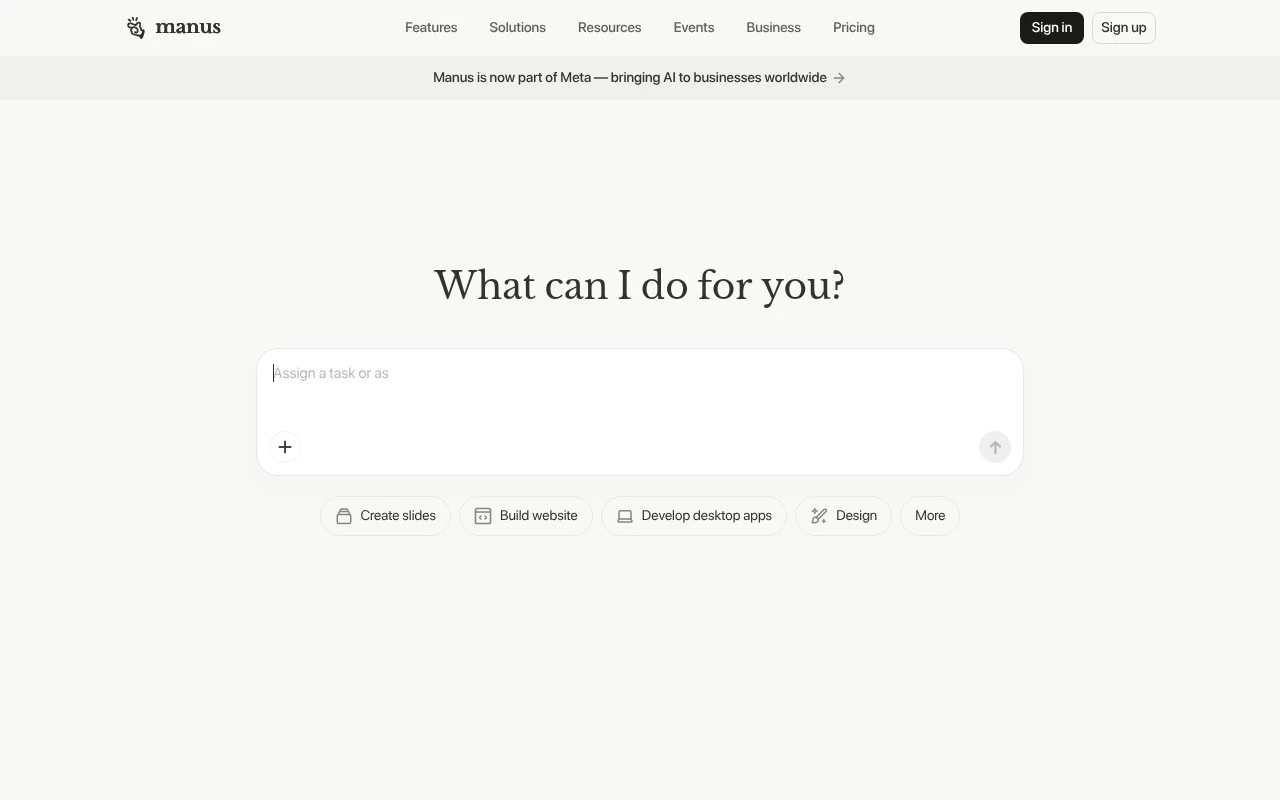
Manus AI is a hands-on AI action engine for people and teams who want an assistant that can execute digital work, not only answer questions. Available at manus.im, it presents itself as a platform for turning instructions into finished tasks across research, content creation, design, coding, browser activity, and workflow automation. Manus AI is best understood as an agentic workspace for moving from intent to output with less manual coordination. Rather than behaving like a single-purpose chatbot, the platform is positioned around action. A user can ask for a slide deck, a website, a desktop app prototype, a research summary, or a generated media asset, and the system is designed to work through the steps needed to produce it. That makes its story less about isolated prompts and more about delegated execution. For teams, Manus AI is aimed at operators, founders, marketers, product builders, researchers, and technical users who need practical work completed across multiple tools. Its official capabilities include mail and Slack integration, team plans, and API access, which suggest a product designed to sit inside real workflows rather than remain a standalone novelty. The platform’s value is strongest when a task requires several small actions, decisions, or handoffs. Creative work is one of its most visible entry points. Presentation generation, AI design, generate images, and music generation give users ways to produce campaign material, concepts, decks, and media assets without starting from a blank page. The emphasis is not only on generating content, but on packaging it into usable formats that can support communication, planning, or production. Software and web creation form another important part of the platform’s identity. Website generation, generate code, desktop app development, and app prototyping position the tool as useful for people who want to explore product ideas quickly or create functional drafts before involving a full development process. It can serve as a bridge between a concept and a working artifact, especially for early-stage experimentation. Research-heavy tasks show how the agentic model can be useful beyond creative output. The browser operation capability allows the system to navigate online information, gather context, and support structured investigation. In this mode, the tool is closer to a digital assistant that can browse, compare sources, and organize findings than to a simple writing aid. Operationally, the platform’s browser and workflow features connect it with the broader category of rpa browser automation. This matters for repetitive digital work, where opening pages, extracting information, updating records, or coordinating messages can consume more time than the underlying decision-making. By combining automation with natural-language instruction, it tries to make task execution more accessible to non-specialists while still offering API paths for technical teams. The product’s character is ambitious because it combines many AI tool categories under one action-oriented interface. It touches content generation, design, coding, research, communication, and automation, but the unifying idea is delegation. Users describe what they need done, and the system attempts to plan and carry out the work across the relevant modes. In practice, Manus AI is most compelling for users who think in outcomes rather than individual app commands. It is not merely a writing assistant, image generator, code helper, or automation script builder, although it overlaps with all of those. Its central promise is to make AI feel more like a capable digital worker that can help complete projects, prototypes, and everyday business tasks from a single starting point.

Use cases

Best for

Workflow Automation

Automate multi-step tasks by having Manus AI operate the browser, send email, and post updates to Slack via integrations.

Generate Images

Generate images from text prompts using Manus AI’s image generation feature for design mockups and creative assets.

Website Generation

Create a website by prompting Manus AI to generate pages and assets and then assemble them into a working site.

ANALYSIS

Strengths & limitations

Strengths
  • Best suited to users who want one AI workspace for varied digital execution because it spans productivity, creative, research, browser, and software-building tasks.
  • Useful for teams moving from chat-based AI to action-oriented workflows because it can operate across tools such as browser sessions, mail, Slack, and APIs.
  • Strong fit for startups and small teams that need rapid prototypes because it can generate assets such as slides, websites, apps, images, and music from a single platform.

Limitations
  • Less suitable for buyers who only need one narrow automation task because Manus AI’s broad agent-style workspace can add more scope and setup than a specialist tool.
  • Teams with strict data-access controls need clear internal governance because browser operation, mail, Slack, and workflow integrations can involve sensitive business information.
  • Freemium pricing is less suitable for sustained high-volume use because heavier automation, collaboration, and API workflows can push teams beyond the free tier.

Evaluation

FYAI score breakdown

Our structured evaluation across five key criteria

7.4 / 10

Overall score

Based on 176 reviews

  • Ease of use7.1 / 10
  • Features7.4 / 10
  • Pricing7.0 / 10
  • Integrations8.5 / 10
  • Support7.4 / 10

What users say

Findings from public reviews, documentation and community sources.

  • Ease of use

    A Reddit reviewer describes using Manus as a non-programmer and says, “Overall I rate Manus 6/10 mostly because the website builder is really good,” while also saying the agent “keeps making mistakes” and is unreliable enough that “they’d be fired.”

  • Features

    Manus docs describe Manus as an “autonomous general AI agent” that can plan and execute work in a “sandbox environment” with “internet access,” a “persistent file system,” and the ability to “install software and create custom tools.”

  • Pricing

    A G2 reviewer says “Manus AI agent is super expensive” and that the model is “really costly,” with “only 1,000 credits at a time.” The Manus pricing page emphasizes “Flexible options” and a “free trial.”

  • Integrations

    Zapier states, “Instantly connect Manus with the apps you use everyday,” and says Manus “integrates with 9000 other apps on Zapier.” The Manus product navigation surfaces Slack integration and API.

  • Support

    The Manus documentation page is framed as “Learn about Manus and how to get started,” and Manus product navigation includes “Docs,” “Updates,” “Help center,” and “Trust center.”

Who is this for?

Best for users who need an agent to plan and execute work across connected apps, Manus docs describe Manus as an “autonomous general AI agent,” and Zapier says Manus “integrates with 9000 other apps on Zapier.” Less suited to cost-sensitive or reliability-sensitive users, a G2 reviewer says Manus is “super expensive” with “only 1,000 credits at a time,” and a Reddit reviewer says the agent “keeps making mistakes.”

PRODUCT PREVIEW

Feature highlights

Action workflows

Execute multi-step tasks across tools, not just generate text.

Browser automation

Operate the web to research, fill forms, and complete actions.

Build apps & sites

Create slides, websites, and desktop apps from a single prompt.

COMPARE

Discover curated alternatives worth comparing

Compare similar AI tools based on features, pricing and use cases

9.0/ 10Based on 3,056 reviews

Zapier

Workflow AutomationIntegration Automation
Connects AI agents to apps, automates workflows, adds IT control
Best for:
Operations teams
Pricing
Freemium

8.6/ 10Based on 779 reviews

Workato

Workflow AutomationIntegration Automation
Connects AI agents to business apps, automates MCP workflows
Best for:
IT & Security teams
Pricing
Free trial

8.9/ 10Based on 7,771 reviews

Uipath

Workflow AutomationIntegration Automation
Automates workflows, extracts data, orchestrates AI agents
Best for:
Operations teams
Pricing
Freemium

Start producing accurate legal and business documents in less time. See why legal teams choose Manus AI to streamline drafting and reduce costly mistakes.

FAQ

Frequently asked
questions

Everything you need to know about this AI tool,
its features, pricing, use cases, and limitations.

Who is Manus AI best for?
Manus AI is best for individuals, teams, startups, and businesses that want an AI agent to execute practical digital work rather than only answer questions. It fits use cases such as slide creation, research, browser-based tasks, website or app prototyping, creative asset generation, and team workflows connected to tools like mail or Slack.
Can I use Manus AI for free, and what do paid plans change?
Manus AI uses a freemium pricing model, so users can start with free access and upgrade when they need more capacity or business-oriented features. Paid use is more relevant for teams, heavier workflows, integrations, API access, SSO, or operational needs. Check manus.im for current plan limits and availability.
How does Manus AI compare with other AI automation tools?
Manus AI is best compared with AI agent and workflow automation tools, not just chatbots or single-purpose generators. Its advantage is breadth across slides, websites, apps, creative assets, research, browser operations, mail, and Slack workflows. Specialized tools may still be stronger for one narrow task, such as advanced design, coding, or RPA.
How long does Manus AI take to set up?
Manus AI’s main trade-off is that it covers many task types, but buyers should validate depth, reliability, and workflow fit before relying on it for critical operations. Its broad scope spans design, coding, research, browser automation, and team workflows, which means performance may vary depending on the exact task and complexity.
What should teams check before using Manus AI with company data?
Teams should review Manus AI’s data handling, access controls, integration permissions, and compliance posture before connecting sensitive workflows. This is especially important for browser operations, mail, Slack, API use, research tasks, and files used to generate business materials. Buyers should confirm retention policies, workspace controls, SSO options, and current security documentation on manus.im.