Curated ToolThis tool is part of our curated AI directory. We only include tools that meet our standards for relevance, usability and real-world value.

Langchain AI

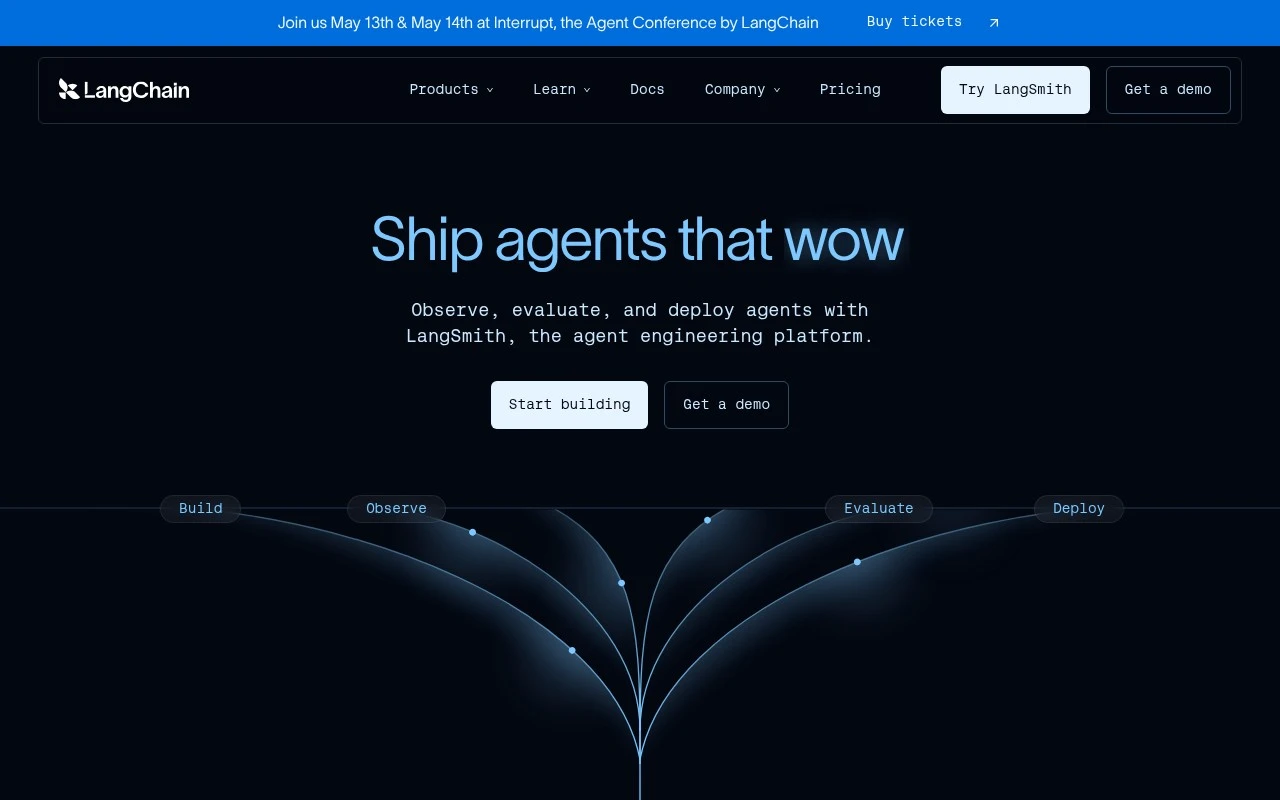
Build, trace, evaluate, debug, deploy, and monitor LLM agents.

Automation
LangChain is best understood from its current site as a developer-focused ecosystem for building and operating AI agents. Its commercial platform, LangSmith, supports the agent development lifecycle with observability, evaluation, deployment, monitoring, and issue diagnosis, while its open-source frameworks provide different levels of control for creating agents with various model providers.

FYAI Score

8.5 / 10

Based on 109 reviews

Pricing:

Freemium

Best for:

Developers building and operating production AI agents

Score Breakdown

  • Ease of use7.1 / 10
  • Features9.0 / 10
  • Pricing8.8 / 10
  • Integrations9.3 / 10
  • Support8.5 / 10

PRODUCT PREVIEW

What this AI tool does

Langchain AI is a developer-focused tool for building applications that use large language models in a more structured way. It helps you connect model prompts and responses with external data sources and application logic, making it easier to move from a simple prototype to a working system. A common use case is creating LLM-powered workflows such as question answering over your own documents, chat experiences that reference up-to-date information, or assistants that can call tools and APIs. It is typically used in Python or JavaScript environments and fits teams looking for an informational, code-first approach to designing and maintaining reliable LLM applications.

Use cases

Best for

Agent Run Tracing

Trace and debug multi-step agent runs with Langchain AI using LangSmith logs of prompts, tool calls, and intermediate outputs.

Agent Evaluation Scoring

Convert production traces into eval datasets and score agents with human review, automated checks, and LLM-as-judge in LangSmith.

Long-Running Agent Deployment

Deploy long-running agents with LangGraph threads, memory, checkpointing, streaming outputs, and human-in-the-loop interrupts.

ANALYSIS

Strengths & limitations

Strengths
  • Covers multiple stages of the agent lifecycle, including building, testing, deployment, observability, and evaluation.
  • Framework-agnostic tracing and SDK support for Python, TypeScript, Go, and Java make it usable with different agent stacks.
  • Strong fit for production agent teams because it connects real-world traces, debugging, evaluation, and deployment workflows.
Limitations
  • The platform is oriented toward engineering teams and may be too technical for users looking for a simple no-code AI assistant builder.
  • The official site emphasizes LangSmith heavily, so users specifically looking for only the open-source LangChain framework may need to distinguish between the platform and the frameworks.
  • Getting full value likely requires integrating tracing, evaluations, and deployment workflows into an existing agent stack.

Evaluation

FYAI score breakdown

Our structured evaluation across five key criteria

8.5 / 10

Overall score

Based on 109 reviews

  • Ease of use7.1 / 10
  • Features9.0 / 10
  • Pricing8.8 / 10
  • Integrations9.3 / 10
  • Support8.5 / 10

What users say

Findings from public reviews, documentation and community sources.

  • Ease of use

    A Product Hunt review says LangChain can feel “too deep, too wrapped, and over-designed” and that “simple things can require too much code.” Reddit notes LangChain is “way smoother now” but “can still feel a bit bulky if your needs are simple.”

  • Features

    LangChain’s site lists observability, evaluation, deployment, and durable checkpointing for agent-development workflows. LangChain’s site also lists Fleet agents, Engine, sandboxes, and tracing.

  • Pricing

    LangChain’s pricing page lists Developer as “$0 / seat per month” with 5k base traces/month, Plus as “$39 / seat per month” with 10k base traces/month, and Enterprise as custom. LangChain’s pricing page also lists usage-based details for traces, deployments, Fleet runs, Engine, and sandboxes.

  • Integrations

    LangChain’s integration documentation states “1000+ integrations.” LangChain’s product page describes Python, TypeScript, Go, and Java SDKs plus OpenTelemetry and framework-agnostic tracing.

  • Support

    LangChain’s pricing page says Developer includes “Community support,” Plus includes “Email support,” and Enterprise includes “Support SLA,” trainings, architectural guidance, and access to deployed engineers. LangChain also has a dedicated docs area.

Who is this for?

Best for teams building AI-agent workflows that need observability, evaluation, deployment, and durable checkpointing in one development stack. The “1000+ integrations” and Python, TypeScript, Go, and Java SDKs also fit teams connecting agent workflows across multiple tools and languages. Less suited to simple automation needs, a Product Hunt review says “simple things can require too much code,” and Reddit says LangChain “can still feel a bit bulky if your needs are simple.”

PRODUCT PREVIEW

Feature highlights

Agent frameworks

Compose tools, prompts, and memory across many model providers.

Tracing & observability

Trace runs end-to-end to debug agent behavior and failures.

Eval & monitoring

Evaluate quality, monitor in prod, and catch regressions early.

COMPARE

Discover curated alternatives worth comparing

Compare similar AI tools based on features, pricing and use cases

9.0/ 10Based on 3.056 reviews

Zapier

Workflow AutomationIntegration Automation
Connects apps to automate multi-step workflows and actions
Best for:
Operations teams
Pricing
Freemium

8.6/ 10Based on 779 reviews

Workato

Workflow AutomationIntegration Automation
Orchestrates workflows across business apps via MCP integrations
Best for:
IT & Security teams
Pricing
Free trial

8.9/ 10Based on 7.771 reviews

Uipath

Workflow AutomationIntegration Automation
Automates workflows with AI agents, robots, and document processing
Best for:
Operations teams
Pricing
Freemium

Build reliable LLM apps faster with Langchain AI. Start shipping agents and RAG workflows your team can trust today.

FAQ

Frequently asked
questions

Everything you need to know about this AI tool,
its features, pricing, use cases, and limitations.

Is Langchain AI a good fit for content marketing teams and digital agencies, or is it more developer-focused?
Langchain AI is best when you need to automate multi-step content workflows (research → draft → revise → publish) and connect them to existing systems. It tends to suit teams that can handle some technical setup or have developer support, rather than purely non-technical writers. If you mainly need a simple writing assistant with minimal configuration, other tools may be faster to adopt.
Does Langchain AI have a free plan, and what are the practical limitations compared to paid usage?
Langchain AI is typically used via a combination of open-source components and paid services (e.g., hosting/monitoring) plus your LLM/API costs. You can prototype cheaply, but production use often adds costs for model usage, observability, and infrastructure. When comparing tools, check whether pricing is bundled (all-in) or whether you’ll manage separate vendor bills.
How does Langchain AI compare with alternatives like Zapier, Make, or dedicated AI writing platforms?
Compared with Zapier/Make, Langchain AI gives more control over LLM prompting, retrieval, and agent-like logic, but usually requires more engineering effort. Compared with dedicated AI writing tools, it’s less “out-of-the-box” for editorial workflows, yet more flexible for custom pipelines and integrations. Choose it if customization and system integration matter more than a polished writing UI.
How quickly can a team get Langchain AI running, and what onboarding effort should you expect?
Output quality and brand voice consistency often still require human review, especially for high-stakes pages. Complex workflows can become harder to debug than single-step tools, and reliability depends on model behavior and upstream APIs. It’s a strong fit when you can invest in testing and iteration rather than expecting consistent results on day one.
What should we consider about data privacy and compliance when using Langchain AI in a marketing workflow?
Langchain AI commonly routes data to third-party LLM providers, so your privacy posture depends on the model vendor, logging settings, and what you store in memory/vector databases. For regulated or sensitive content, confirm where data is processed, retention policies, and whether prompts/outputs are used for model training. Also review access controls and audit logging if multiple clients or brands share the same environment.