Curated ToolThis tool is part of our curated AI directory. We only include tools that meet our standards for relevance, usability and real-world value.

Ifttt

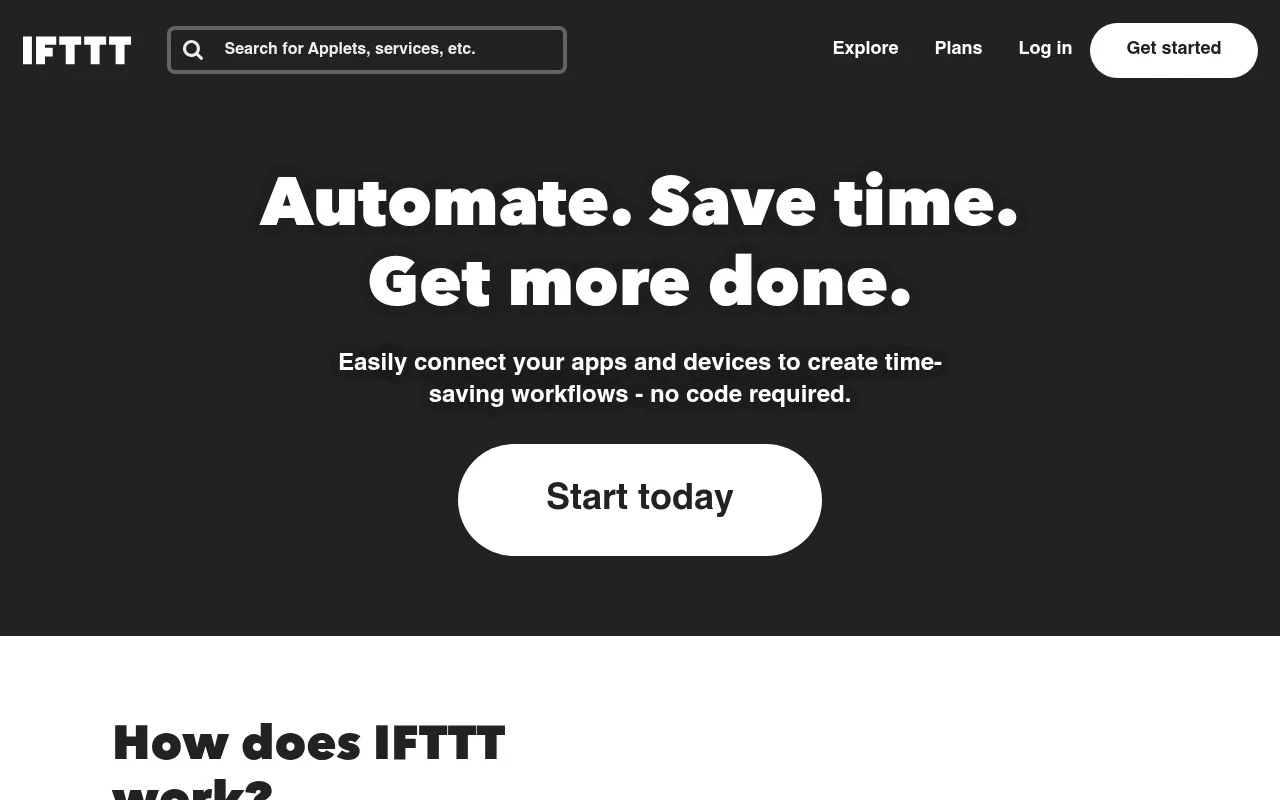
Ifttt is an automation service that connects apps, web services, and smart devices through applets that run actions when specific triggers occur. It can automate tasks such as syncing files, posting updates, logging data, or controlling connected home devices.
Workflow AutomationData & Spreadsheet

FYAI Score

8.2 / 10

Based on 220 reviews

Pricing:

Freemium

Best for:

People automating apps and smart home devices without coding

Score Breakdown

  • Ease of use9.3 / 10
  • Features7.9 / 10
  • Pricing7.3 / 10
  • Integrations8.7 / 10
  • Support7.4 / 10

PRODUCT PREVIEW

What this AI tool does

Ifttt is a no-code automation platform for people who want apps, services, and connected devices to work together through simple trigger-and-action rules. Its central idea is the Applet, a small automation that watches for something to happen in one place and then runs one or more actions somewhere else. That makes Ifttt useful for lightweight workflow automation, integration automation, notifications, data logging, and smart home routines without requiring users to write code. At its core, the platform turns everyday digital events into connected sequences. A new RSS item can post to Discord, a form entry can be saved to a spreadsheet, a phone location change can adjust a smart home device, or a calendar event can trigger a reminder in another app. The value is not in replacing full business process software, but in reducing the small manual steps that happen between tools. For individuals, creators, and small teams, Ifttt is for connecting common web services, mobile apps, and devices when a full automation stack would feel too complex. It supports more than 1,000 apps, services, and devices, including Google tools, Webhooks, Discord, Telegram, Slack, Spotify, RSS, Android, iOS, and many smart home products. This broad connector library is what gives the platform its everyday flexibility, since users can often find a ready-made Applet for a familiar service and adapt it to their needs. Smart home automation is one of the clearest examples of how the tool fits into daily life. Lights, plugs, thermostats, security systems, voice assistants, and sensors can be linked with online events, mobile actions, or location changes. Instead of treating the smart home as a set of isolated brand ecosystems, the platform acts as a practical bridge between devices and services that may not otherwise communicate directly. Beyond simple one-step recipes, more advanced Applets can include timing, conditions, multiple actions, filter code, and AI-assisted steps. This gives experienced users more control over when an automation should run and what should happen next, while still keeping the experience closer to configuration than programming. Calendar automation, spreadsheet automation, messaging workflows, and Webhooks-based connections all benefit from this middle ground between simplicity and customization. The platform’s character is pragmatic rather than enterprise-heavy. It is designed for people who want to connect tools quickly, test an idea, and keep useful automations running in the background. A user might start with a public Applet, modify it for a personal workflow, and later combine triggers, filters, and actions into a more tailored setup. Ifttt is best at lightweight cross-app automation where speed, breadth of integrations, and ease of setup matter more than deep process orchestration. It works well when the goal is to connect consumer apps, productivity tools, social channels, feeds, messaging platforms, mobile devices, and smart home systems with minimal friction. For users who want small automations that quietly remove repetitive work from everyday digital life, Ifttt remains one of the most recognizable and accessible platforms in the category.

Use cases

Best for

Integration Automation

Create trigger action links between apps using Webhooks, RSS, or chat events so updates in one service run actions in another.

Smart Home Automation

Ifttt runs Applets that react to smart home triggers like motion or location to control lights, thermostats, and plugs automatically.

Workflow Automation

Automate routine tasks by scheduling Applets and adding conditions or filter code to post, log, or notify across your apps.

ANALYSIS

Strengths & limitations

Strengths
  • Best suited to individuals and small teams connecting everyday apps and smart devices, because its catalogue covers over 1,000 supported services.
  • Easy to adopt for non-technical users, because ready-made Applets and no-code customization reduce the need to build automations from scratch.
  • Useful for lightweight AI-assisted workflows, because prompts, notes, RSS items, emails, and documents can be routed into AI services for summaries, drafts, translations, and social content.

Limitations
  • Less suitable for complex enterprise automation, because advanced orchestration, governance, and deeply customized business logic are outside its lightweight Applet model.
  • Automations depend on third-party service connections, so changes to supported apps, device platforms, APIs, or account permissions can affect what a workflow can do.
  • Freemium limits make it less suitable for heavier automation needs unless users are prepared to pay for higher usage, more actions, and advanced customization features.

Evaluation

FYAI score breakdown

Our structured evaluation across five key criteria

8.2 / 10

Overall score

Based on 220 reviews

  • Ease of use9.3 / 10
  • Features7.9 / 10
  • Pricing7.3 / 10
  • Integrations8.7 / 10
  • Support7.4 / 10

What users say

Findings from public reviews, documentation and community sources.

  • Ease of use

    G2 says users praise IFTTT for its “ease of use,” and Software Advice says IFTTT is “easy to set up and use.” IFTTT’s product page describes Applets as no-code automations that can be connected “in a minute or less.”

  • Features

    IFTTT’s product page says it offers “100,000s of ready-made options,” custom Applets, filter code, multiple actions, and AI-assisted workflows.

  • Pricing

    Reddit cites IFTTT “basic free accounts” as limited to “a maximum of 3 custom applets” and lists pricing at “$9.99 per month.” Trustpilot sentiment highlights dissatisfaction around changed free-account functionality.

  • Integrations

    IFTTT’s integrations page says it connects “1,000+ apps” and names services such as Webhooks, Discord, Philips Hue, and Ring.

  • Support

    G2 shows IFTTT at 4.5/5 from 117 reviews. G2 review excerpts say users praise IFTTT for its “ease of use.”

Who is this for?

Best for consumers and prosumers who want no-code automations across smart-home, mobile, productivity, and social services, IFTTT’s product page says Applets can be connected “in a minute or less,” and the integrations page says it connects “1,000+ apps.” Less suited to users who need many custom automations on a free account, Reddit cites “basic free accounts” as limited to “a maximum of 3 custom applets,” with pricing at “$9.99 per month.”

PRODUCT PREVIEW

Feature highlights

Trigger→Action Applets

Run actions across apps when something happens in another service.

1,000+ integrations

Connect popular apps, web services, and smart devices in one place.

Advanced workflows

Add conditions, schedules, filter code, and multiple actions per Applet.

COMPARE

Discover curated alternatives worth comparing

Compare similar AI tools based on features, pricing and use cases

9.0/ 10Based on 3,056 reviews

Zapier

Workflow AutomationIntegration Automation
Connects AI agents to apps, automates workflows, adds IT control
Best for:
Operations teams
Pricing
Freemium

8.6/ 10Based on 779 reviews

Workato

Workflow AutomationIntegration Automation
Connects AI agents to business apps, automates MCP workflows
Best for:
IT & Security teams
Pricing
Free trial

8.9/ 10Based on 7,771 reviews

Uipath

Workflow AutomationIntegration Automation
Automates workflows, extracts data, orchestrates AI agents
Best for:
Operations teams
Pricing
Freemium

Join millions using Ifttt to automate the busywork. Connect your apps and devices so everyday tasks run themselves and you get time back.

FAQ

Frequently asked
questions

Everything you need to know about this AI tool,
its features, pricing, use cases, and limitations.

Who is Ifttt best suited for?
Ifttt is best suited for individuals, creators, smart home users, small businesses, and productivity-focused teams that want simple no-code automations. It works well for connecting calendars, spreadsheets, email, Slack, Notion, Todoist, RSS feeds, webhooks, mobile features, and smart home devices without building custom software.
Can I use Ifttt for free, and when would I need a paid plan?
Ifttt uses a freemium pricing model, so users can start with a free option and upgrade when they need more capability. Paid use is typically more relevant for people running multiple Applets, using more advanced workflow behavior, or relying on automations for recurring personal or business processes.
How does Ifttt compare with other automation tools?
Ifttt is strongest for straightforward trigger-and-action automations across everyday apps, web services, mobile features, and smart home devices. Compared with more advanced workflow automation platforms, it is usually easier to start with but less suited to highly customized business processes, complex branching logic, or full internal application workflows.
How long does it take to set up Ifttt?
Ifttt’s main limitation is that each automation depends on the triggers and actions exposed by the connected services. This makes it effective for common tasks like saving data, syncing notifications, publishing content, and controlling devices, but less flexible for deeply customized workflows, advanced logic, or business process automation.
What should I consider about privacy and data handling in Ifttt?
Ifttt workflows can move data between third-party services, so users should review permissions, connected accounts, and the sensitivity of any information being automated. This is especially important when routing notes, emails, documents, RSS items, or prompts to AI services for summaries, translations, proofreading, or content generation.