Curated ToolThis tool is part of our curated AI directory. We only include tools that meet our standards for relevance, usability and real-world value.

Crewai

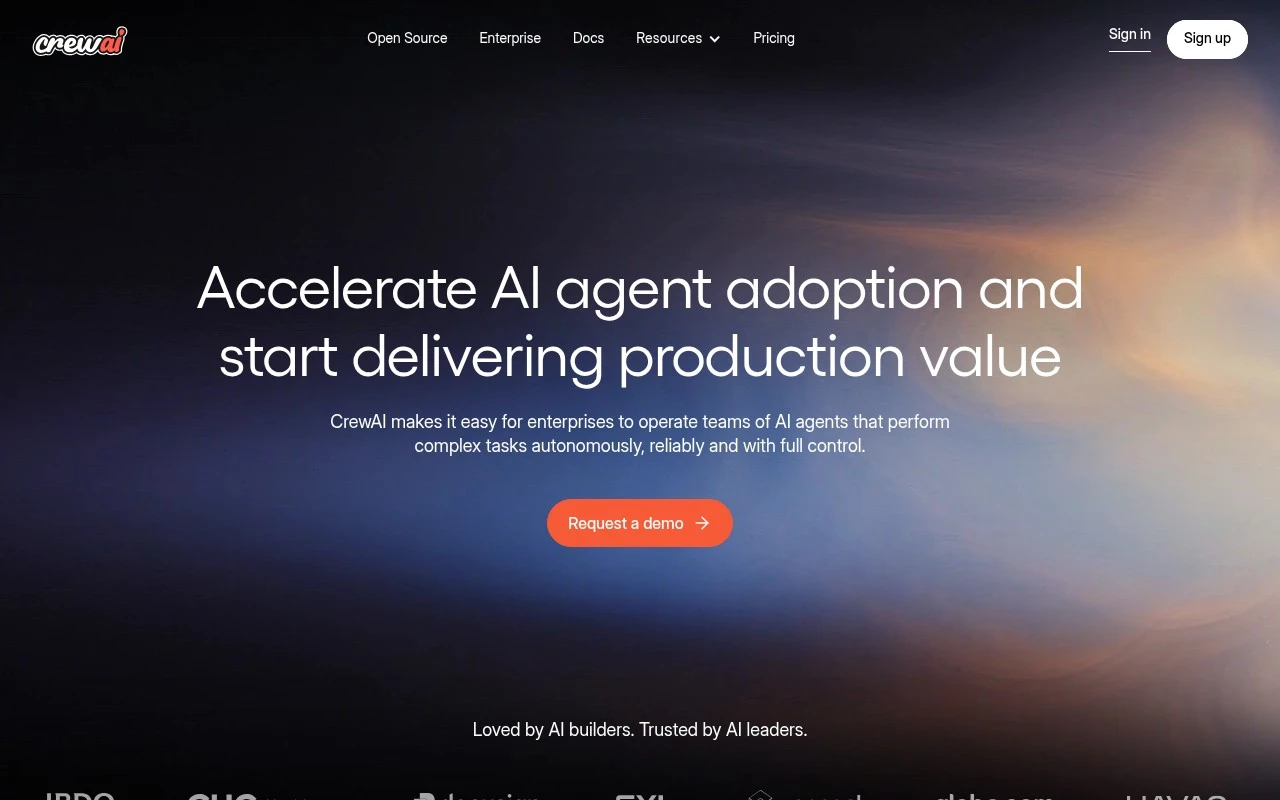
Crewai is an open-source framework for building multi-agent AI workflows, where role-based agents collaborate on tasks using defined processes and connected tools.
Workflow Automation

FYAI Score

8.2 / 10

Based on 2 reviews + FYAI product analysis

Pricing:

Freemium

Best for:

Enterprise AI teams building and operating multi-agent workflows

Score Breakdown

  • Ease of use8.2 / 10
  • Features8.3 / 10
  • Pricing7.9 / 10
  • Integrations8.1 / 10
  • Support8.7 / 10

PRODUCT PREVIEW

What this AI tool does

Crewai is an enterprise-oriented multi-agent platform for teams that want to discover, build, deploy, and manage AI agent workflows across the full automation lifecycle. Crewai is designed for organizations moving beyond isolated prompts or prototypes into governed, repeatable workflow automation where multiple agents can collaborate on defined business tasks. At its core, the platform treats agent building as both a design problem and an operational discipline. Teams can map what should be automated, create agent workflows visually or in code, and then move those workflows toward production without switching to a separate stack. That makes it useful for product, operations, AI, and engineering teams that need a shared environment rather than a one-off scripting setup. For non-technical users, no-code and visual tools make it easier to shape processes, assign responsibilities to agents, and understand how a workflow should behave. For developers, the code-first path includes CLI access, APIs, and Python export, so agent workflows can be versioned, extended, and integrated with existing systems. Crewai is for enterprises that need both accessibility for business teams and enough technical depth for software teams to control implementation. Where the platform becomes most distinctive is in the transition from experimentation to production. Crewai is best at supporting multi-agent automation in environments where governance, observability, and control matter as much as the initial build. Instead of leaving teams with a demo that works only in a notebook, it provides the operational layer needed to monitor, test, and improve agent behavior over time. Production management is shaped around accountability. Tracing helps teams understand what happened inside an agent workflow, while cost accounting connects usage to business and operational decisions. Role-based access control, audit trails, and human-in-the-loop controls give organizations a way to decide who can change workflows, who can approve sensitive actions, and how exceptions should be handled. Runtime policy hooks add another layer for teams that need agents to operate inside internal rules, compliance boundaries, or customer-specific requirements. Evaluation and model testing help teams compare behavior, catch regressions, and make changes with more confidence. In practice, the platform positions agents less as autonomous black boxes and more as managed software components that can be reviewed, constrained, and improved. A typical use case might begin with identifying a repetitive business process, such as triage, research, report generation, internal operations support, or cross-system coordination. The workflow can then be decomposed into agent roles, connected to tools and data sources, tested against expected outputs, and deployed with controls around cost, access, and approval. This lifecycle view is central to the product’s identity. Because multi-agent systems can become complex quickly, the platform’s value is not only in creating agents but in making their collaboration understandable. It gives teams a structured way to define responsibilities, observe decisions, and refine outcomes rather than relying solely on prompt experimentation. That is especially important in organizations where AI automation must be explainable to stakeholders outside the development team. Overall, Crewai is a platform for making agentic workflow automation practical inside real organizations. Its character is enterprise-focused, lifecycle-oriented, and governance-aware, combining agent building tools with the production infrastructure needed to operate AI workflows responsibly. For teams that want to move from isolated automation ideas to managed multi-agent systems, it provides a bridge between experimentation and durable deployment.

Use cases

Best for

Agent Building

Crewai lets you design multi-agent workflows with visual tools or Python, then export, test, and deploy them with tracing and RBAC.

Workflow Automation

Automate business processes by orchestrating agents via APIs and policy hooks, with audit trails, cost accounting, and human approvals.

ANALYSIS

Strengths & limitations

Strengths
  • Supports both no-code and code-first development, so mixed technical and operations teams can collaborate on agent workflows without being forced into one interface.
  • Production governance features such as tracing, cost accounting, RBAC, audit trails, policy hooks, evaluations, and human-in-the-loop controls make it well suited to enterprise agent deployments.
  • Python export, CLI, APIs, and model testing support help teams move agent workflows from prototypes into maintainable production systems.

Limitations
  • Less suitable for teams that only need a simple chatbot or one-off automation because the platform is designed around full multi-agent lifecycle management.
  • Nontechnical teams may face a setup burden because the strongest use cases involve workflow design, runtime policies, evaluations, and production operations.
  • Freemium pricing is best treated as a starting point because serious production use can require paid-plan decisions around usage, collaboration, and governance needs.

Evaluation

FYAI score breakdown

Our structured evaluation across five key criteria

8.2 / 10

Overall score

Based on 2 reviews + FYAI product analysis

  • Ease of use8.2 / 10
  • Features8.3 / 10
  • Pricing7.9 / 10
  • Integrations8.1 / 10
  • Support8.7 / 10

What users say

Findings from public reviews, documentation and community sources.

  • Ease of use

    A Reddit user describes CrewAI as “Developer-friendly” and “Lightweight,” and the notes state CrewAI supports both a “No-code visual editor” and “sophisticated CLI or APIs.” CrewAI provides both no-code and code-first paths for onboarding and technical control.

  • Features

    CrewAI’s own page describes Discovery for identifying automations, visual and API-based multi-agent workflow building, and a Control Plane with tracing/RBAC/audit/human-in-the-loop controls. CrewAI’s own page also references optimization with training, multi-LLM testing, evaluations, and cost accounting.

  • Pricing

    CrewAI’s pricing page lists the Basic plan as “Free” with “50 workflow executions/month,” GitHub integration, visual editor, and AI copilot. CrewAI’s pricing page lists Enterprise as “Custom” with private infrastructure, support/training, and 50 development hours/month.

  • Integrations

    CrewAI’s pricing page lists GitHub integration, standard tools and triggers, enterprise connectors, OpenTelemetry, SSO with “MS Entra, Okta,” and workflow chat via “Slack/Teams.” CrewAI’s docs describe connecting services through an Integrations flow using OAuth and an Enterprise Token.

  • Support

    CrewAI’s pricing page lists Community support on Basic. CrewAI’s pricing page lists Enterprise support as “Dedicated,” “Slack/Teams,” “On-site,” “Training,” “Deployment,” “Onboarding,” and “Development.”

Who is this for?

Best for teams that want both no-code and developer-controlled automation. CrewAI supports a “No-code visual editor” plus “sophisticated CLI or APIs.” Less suited to teams that need fully self-serve enterprise purchasing, CrewAI’s pricing page lists Enterprise as “Custom,” so enterprise buying is quote-based rather than published as a fixed self-serve plan.

PRODUCT PREVIEW

Feature highlights

Agent lifecycle

Discover, build, deploy, and manage agents end-to-end in one place

No-code to code-first

Visual builder, CLI, APIs, and Python export for flexible development

Governed production

Tracing, RBAC, audit trails, policies, and human-in-the-loop controls

COMPARE

Discover curated alternatives worth comparing

Compare similar AI tools based on features, pricing and use cases

9.0/ 10Based on 3,056 reviews

Zapier

Workflow AutomationIntegration Automation
Connects AI agents to apps, automates workflows, adds IT control
Best for:
Operations teams
Pricing
Freemium

8.6/ 10Based on 779 reviews

Workato

Workflow AutomationIntegration Automation
Connects AI agents to business apps, automates MCP workflows
Best for:
IT & Security teams
Pricing
Free trial

8.9/ 10Based on 7,771 reviews

Uipath

Workflow AutomationIntegration Automation
Automates workflows, extracts data, orchestrates AI agents
Best for:
Operations teams
Pricing
Freemium

Move work forward with AI agents that coordinate tasks and deliver results. Start building reliable workflows with Crewai today.

FAQ

Frequently asked
questions

Everything you need to know about this AI tool,
its features, pricing, use cases, and limitations.

Who is Crewai best suited for?
Crewai is best suited for AI builders, developers, automation teams, and enterprise AI leaders moving agent workflows into production. It fits teams that need multi-agent automation across tickets, chats, apps, and internal workflows, with governance, monitoring, evaluation, and optimization rather than one-off task automation.
Does Crewai have a free plan, and what should I expect from paid plans?
Crewai uses a freemium pricing model, so teams can expect some level of free access alongside paid options. Buyers evaluating production use should review current plan details on crewai.com, especially for governance, deployment, observability, approval workflows, and enterprise administration requirements.
How does Crewai compare with other workflow automation and agent-building tools?
Crewai stands out by covering the full agent workflow lifecycle, from discovering automation opportunities to building, deploying, governing, monitoring, and improving agents. Simpler alternatives may be a better fit for lightweight automations, while Crewai is more relevant for teams managing production multi-agent systems.
How quickly can a team get started with Crewai?
Crewai’s main trade-off is that it appears oriented toward serious production agent operations rather than casual or simple automations. Some procurement, setup, pricing, and deployment details may require direct engagement with the company, and buyers should validate implementation depth for their specific technical and governance needs.
What should I check about Crewai for data privacy and compliance?
Teams evaluating Crewai should assess how its governance features align with their internal privacy, security, and compliance requirements. Crewai highlights controls such as RBAC, audit trails, human approval gates, tracing, and runtime policy checks, but buyers should confirm current certifications, data retention, deployment options, and integration security directly with Crewai.