Curated ToolThis tool is part of our curated AI directory. We only include tools that meet our standards for relevance, usability and real-world value.

Browse AI

No-code web scrapers and monitors to extract and track site data

RPA & Browser Automation
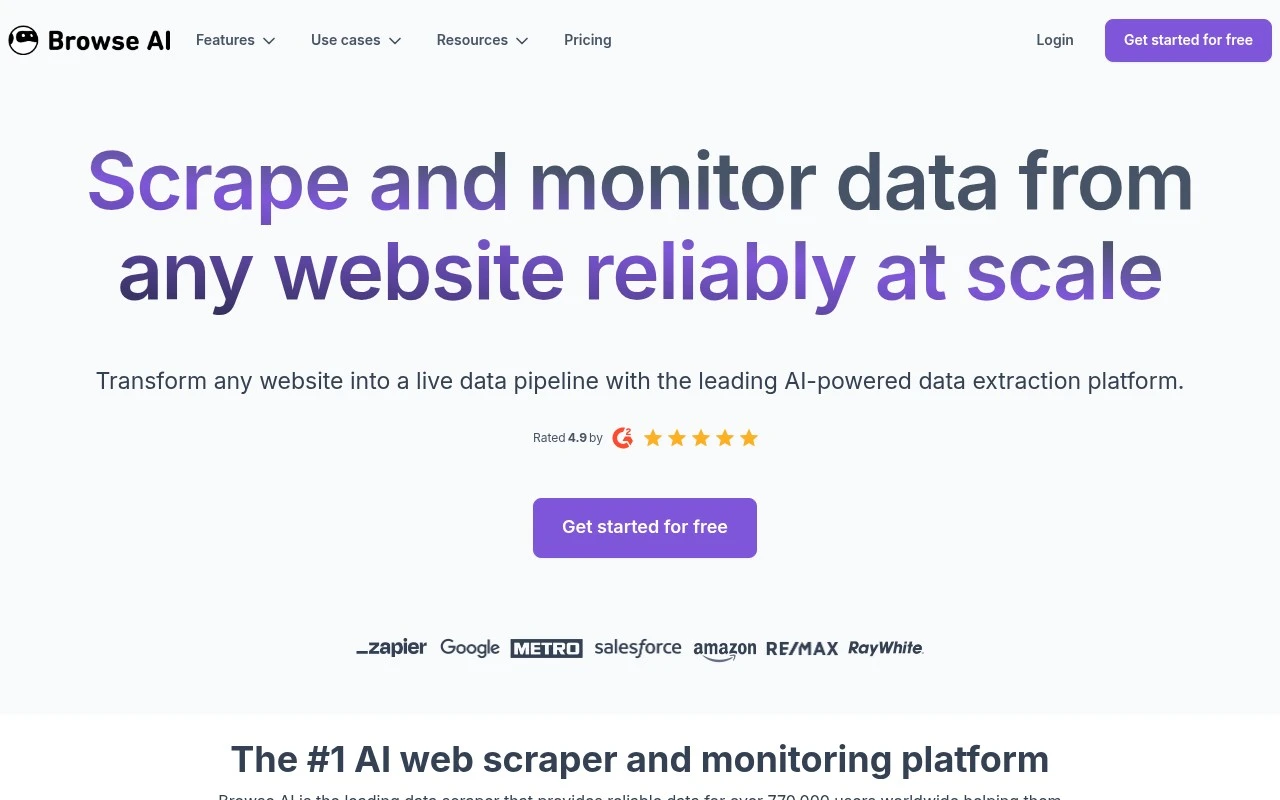
Browse AI is a no-code web scraping and website monitoring tool. Users train a scraper or monitor by pointing and clicking on website data, then run it on a schedule, extract records across pages and subpages, and export or connect the results to other systems. The platform emphasizes reliability features such as dynamic content capture, human-like browser actions, proxy management, retries, rate limiting, and site layout monitoring. It also offers prebuilt scraping robots and managed enterprise web scraping services.

FYAI Score

9.0 / 10

Based on 63 reviews

Pricing:

Freemium

Best for:

Ops and data teams automating web data collection and monitoring

Score Breakdown

  • Ease of use9.3 / 10
  • Features8.7 / 10
  • Pricing8.9 / 10
  • Integrations9.0 / 10
  • Support9.3 / 10

PRODUCT PREVIEW

What this AI tool does

Browse AI is an AI tool designed to help people collect and monitor information from websites without needing to write code. It’s commonly used when you want to turn web pages into structured data you can review, export, or use in other workflows, such as tracking product listings, job posts, or changes to specific pages over time. In practice, you point the tool at a site, indicate what information matters, and it learns how to capture similar data from the same source. This can be useful for teams that need regular updates from multiple websites, or for individuals who want a repeatable way to gather online information for research and reporting. Because websites can change, results may vary depending on how a page is built and how often it updates. It’s a good fit for informational tasks where you need consistent snapshots of web content and a way to keep that content organized.

Use cases

Best for

Dynamic Web Data Extraction

Browse AI records clicks, searches, form fills, and navigation to scrape structured data from dynamic webpages.

Scheduled Website Change Monitoring

Run scrapers hourly, daily, weekly, or monthly to detect page changes and deliver updated extracted data.

Scraped Data Workflow Automation

Send scraped results to APIs, webhooks, downloads, or integrations to trigger automated workflows in other tools.

ANALYSIS

Strengths & limitations

Strengths
  • Point-and-click setup makes web scraping and monitoring accessible to users without coding experience.
  • Supports scheduled monitoring, change detection, deep scraping across many pages, and dynamic interactions such as forms and dropdowns.
  • Provides multiple ways to use extracted data, including API, webhook, exports, integrations, and enterprise managed services.
Limitations
  • Its core value is web data extraction and monitoring, so it is not a general-purpose AI agent or analytics platform by itself.
  • Claims of scraping almost any website still imply that individual sites may need testing, especially where layouts, access controls, or anti-bot measures are complex.
  • Advanced reliability, scale, security, and managed-service needs may require enterprise-level setup rather than simple self-service use.

Evaluation

FYAI score breakdown

Our structured evaluation across five key criteria

9.0 / 10

Overall score

Based on 63 reviews

  • Ease of use9.3 / 10
  • Features8.7 / 10
  • Pricing8.9 / 10
  • Integrations9.0 / 10
  • Support9.3 / 10

What users say

Findings from public reviews, documentation and community sources.

  • Ease of use

    G2's review signal says users “consistently praise the ease of use,” and Capterra’s public snippet describes Browse AI as “incredibly easy to use” with “prebuilt robots” and “easy no-code settings.”

  • Features

    Browse AI’s own page describes no-code scraping and monitoring, website-change alerts that “automatically adapt,” dynamic-content capture, and “200+ prebuilt robots.”

  • Pricing

    Browse AI’s pricing page lists four tiers: Free, Personal $19/month, Professional $69/month, and Premium starting at $500/month. Browse AI’s pricing page states limits for websites, users, credits, add-on websites, and support levels.

  • Integrations

    Browse AI says it can “integrate scraped data with 7,000+ tools and apps,” and the pricing table lists Google Sheets, Airtable, REST API, and Webhooks.

  • Support

    G2’s public signal says users praise “outstanding customer support,” and Browse AI’s pricing page lists Basic email support, Priority email support, fully managed onboarding, ongoing data management, and a Dedicated Account Manager for Premium.

Who is this for?

Best for teams that need no-code web scraping and monitoring, Browse AI’s own page lists no-code scraping and monitoring, website-change alerts that “automatically adapt,” and “200+ prebuilt robots.” Best for workflows that need downstream automation, because Browse AI says it can “integrate scraped data with 7,000+ tools and apps.” Less suited to higher-scale managed use on a fixed self-serve budget, the pricing page lists Premium starting at $500/month.

PRODUCT PREVIEW

Feature highlights

No-code scraping

Train a robot by clicking page elements—no code required.

Scheduled monitoring

Run on a schedule and get alerts when website data changes.

Reliable extraction

Handles dynamic pages with retries, proxies, and rate limits.

COMPARE

Discover curated alternatives worth comparing

Compare similar AI tools based on features, pricing and use cases

9.0/ 10Based on 3.056 reviews

Zapier

Workflow AutomationIntegration Automation
Connects apps to automate multi-step workflows and actions
Best for:
Operations teams
Pricing
Freemium

8.6/ 10Based on 779 reviews

Workato

Workflow AutomationIntegration Automation
Orchestrates workflows across business apps via MCP integrations
Best for:
IT & Security teams
Pricing
Free trial

8.9/ 10Based on 7.771 reviews

Uipath

Workflow AutomationIntegration Automation
Automates workflows with AI agents, robots, and document processing
Best for:
Operations teams
Pricing
Freemium

Start turning websites into live, reliable data feeds. Join teams using Browse AI to track changes, spot trends, and make faster decisions with up-to-date web data.

FAQ

Frequently asked
questions

Everything you need to know about this AI tool,
its features, pricing, use cases, and limitations.

What types of projects is Browse AI a good fit for?
Browse AI works well for recurring web data collection like price monitoring, lead list building, job listings tracking, and pulling structured fields from directories or product pages. It’s a strong choice when you need scheduled runs and exports to spreadsheets or integrations without writing code. If your targets are heavily protected sites or require complex multi-step interactions, you may need a more developer-centric scraper.
How do Browse AI’s free and paid plans differ in practice?
The free tier is typically best for testing a few robots and validating that your target pages can be extracted reliably, but it’s limited in run volume and automation features. Paid plans generally add higher task/run limits, more frequent scheduling, and additional integrations or export options. If you expect many monitored pages or frequent refreshes, estimate monthly run counts before choosing a tier.
How does Browse AI compare with alternatives like Octoparse, Apify, or ParseHub?
Browse AI is usually faster to start for non-technical users and common “extract these fields” workflows, especially when scheduling is the main need. Apify tends to be more flexible for complex scraping and anti-bot scenarios but often requires more technical setup. Octoparse/ParseHub can be strong for visual workflows too, so the deciding factors are typically anti-scraping resilience, scale, and how often your target sites change.
How quickly can I set up a working scraper in Browse AI?
Browse AI can struggle with sites that use strong anti-scraping defenses, frequent layout changes, or complex JavaScript-driven interactions. Subscription costs can rise if you need high-frequency monitoring across many pages. You should also expect occasional maintenance when the target website structure changes and breaks an extraction.
What should I consider about data handling, privacy, and compliance when using Browse AI?
Treat scraped data as potentially sensitive: avoid collecting personal data unless you have a clear legal basis and a defined retention policy. Check whether your use complies with the target site’s terms and applicable regulations (e.g., GDPR/CCPA) before scheduling large-scale extraction. If you need strict controls, confirm where data is stored, who can access it in your workspace, and what export/integration paths are enabled.