Curated ToolThis tool is part of our curated AI directory. We only include tools that meet our standards for relevance, usability and real-world value.

Apify

Runs web scrapers and crawlers to extract fresh website data

RPA & Browser Automation
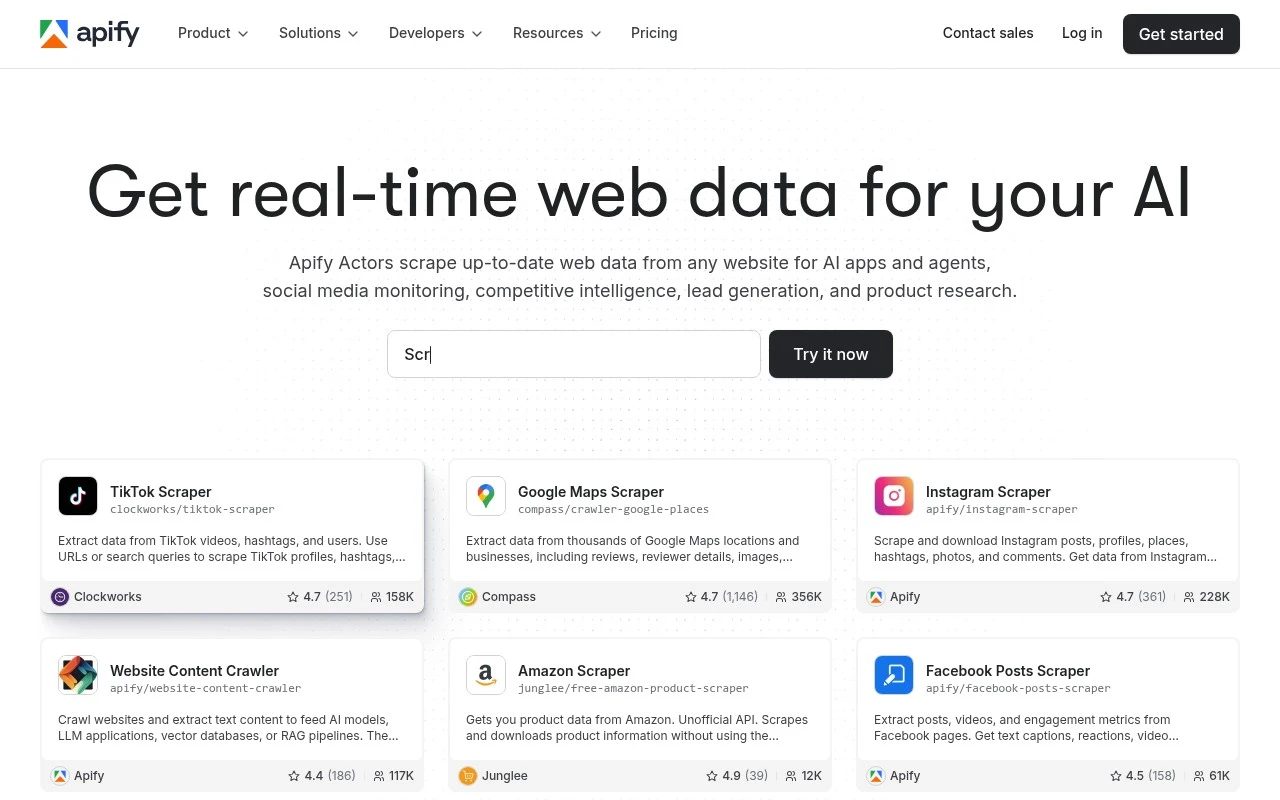
Apify is a web automation and data extraction platform centered on a marketplace of Actors: reusable tools that scrape websites, crawl content, automate browser tasks, and connect results to APIs, apps, and AI workflows. Users can run existing Actors, create their own with JavaScript or Python tooling, or have custom Actors built for specific use cases.

FYAI Score

9.1 / 10

Based on 604 reviews

Pricing:

Freemium

Best for:

Developers and data teams automating web scraping at scale

Score Breakdown

  • Ease of use8.6 / 10
  • Features9.3 / 10
  • Pricing9.2 / 10
  • Integrations9.2 / 10
  • Support9.2 / 10

PRODUCT PREVIEW

What this AI tool does

Apify is a platform for building and running web automation and data extraction workflows. It’s commonly used when you need to collect information from websites at scale, monitor changes over time, or automate repetitive browsing tasks in a controlled way. In practice, you can use it to create scripts that navigate pages, handle dynamic content, and output structured data for analysis or integration with other systems. It also supports scheduling and running jobs in the cloud, which can be helpful for recurring tasks like tracking listings, gathering research data, or maintaining datasets. For teams, apify can serve as a shared environment to develop, deploy, and manage these automations with consistent inputs and outputs. As with any web scraping or automation approach, it’s important to consider site terms, legal requirements, and responsible request rates when collecting data.

Use cases

Best for

Run Ready-Made Scrapers

Run marketplace Actors to scrape Google Maps, Instagram, TikTok, Facebook, websites, and e-commerce pages into structured datasets.

Custom Scraping Actors

Build and deploy Apify Actors for scraping or browser automation, then schedule runs, monitor logs, and scale executions in the cloud.

Data for AI Pipelines

Export extracted content and structured web data via API or storage to feed AI agents, vector databases, or RAG pipelines.

ANALYSIS

Strengths & limitations

Strengths
  • Large marketplace of ready-to-run Actors for common scraping and monitoring tasks.
  • Supports developer workflows with APIs, scheduling, monitoring, cloud deployment, proxies, and integrations with tools such as Playwright, Puppeteer, Selenium, Scrapy, LangChain, and LlamaIndex.
  • Useful for AI data pipelines because it can crawl and extract web content for LLM apps, vector databases, and RAG systems.
Limitations
  • Best suited to web data and automation use cases, not a general-purpose AI model or standalone analytics platform.
  • Custom or unusual scraping workflows may require coding, Actor development, or paid custom implementation.
  • Results can depend on the quality, maintenance, and fit of individual Actors and on the accessibility of the target websites.

Evaluation

FYAI score breakdown

Our structured evaluation across five key criteria

9.1 / 10

Overall score

Based on 604 reviews

  • Ease of use8.6 / 10
  • Features9.3 / 10
  • Pricing9.2 / 10
  • Integrations9.2 / 10
  • Support9.2 / 10

What users say

Findings from public reviews, documentation and community sources.

  • Ease of use

    G2 reports 4.7/5 from 533 reviews and says users praise Apify for its “ease of use and reliable automation,” including quickly setting up and managing complex web scraping tasks. Apify is described as a developer-oriented automation platform.

  • Features

    Apify describes a marketplace of “52,200 tools” for business automation, including ready-made scrapers, custom Actors, cloud deployment, and monitoring.

  • Pricing

    Apify pricing lists four plans, from Free at $0 with $5 usage to Business at $999/month, plus detailed compute-unit, proxy, storage, and add-on rates.

  • Integrations

    Apify highlights API-based runs, scheduling, and integrations with tools and AI workflows, plus MCP connectors for Notion, Slack, GitHub, and more. Apify names developer ecosystem support including Python, JavaScript, Playwright, and LangChain.

  • Support

    Apify pricing says Free includes community support, Starter includes chat support, Scale includes priority chat, and Business includes an account manager. Apify points users to Web Scraping Academy courses, code templates, extensive guides, and a Discord community of more than 15,000 members.

Who is this for?

Best for developers and teams building web scraping or browser-automation workflows. Apify lists “52,200 tools” plus custom Actors, API runs, scheduling, cloud deployment, and monitoring. Less suited to teams that want flat SaaS pricing, Apify pricing uses compute-unit, proxy, storage, and add-on rates, so costs depend on usage details rather than only a fixed plan price.

PRODUCT PREVIEW

Feature highlights

Actor Marketplace

Run ready-made scrapers and automations for popular sites in minutes.

Build Custom Actors

Create your own in JavaScript or Python for any workflow or site.

APIs & Data Exports

Deliver results via API, webhooks, or datasets to your stack.

COMPARE

Discover curated alternatives worth comparing

Compare similar AI tools based on features, pricing and use cases

9.0/ 10Based on 3.056 reviews

Zapier

Workflow AutomationIntegration Automation
Connects apps to automate multi-step workflows and actions
Best for:
Operations teams
Pricing
Freemium

8.6/ 10Based on 779 reviews

Workato

Workflow AutomationIntegration Automation
Orchestrates workflows across business apps via MCP integrations
Best for:
IT & Security teams
Pricing
Free trial

8.9/ 10Based on 7.771 reviews

Uipath

Workflow AutomationIntegration Automation
Automates workflows with AI agents, robots, and document processing
Best for:
Operations teams
Pricing
Freemium

Join thousands of teams turning the web into reliable data. Start collecting, monitoring, and automating workflows with Apify today.

FAQ

Frequently asked
questions

Everything you need to know about this AI tool,
its features, pricing, use cases, and limitations.

When is Apify a good fit for AI workflows, and when is it not?
Apify fits best when you need fresh web data—crawling sites, extracting structured fields, and feeding results into RAG pipelines, vector databases, or agent workflows. It’s also useful for recurring collection jobs (e.g., listings, reviews, social profiles) where scheduling and monitoring matter. It’s not the right choice if you primarily need model training, BI-style analytics, or data that’s already available via stable APIs.
What’s the difference between Apify’s free usage and paid plans in practice?
Apify typically offers limited free usage/credits suitable for testing Actors and small runs, while paid plans scale with compute, storage, and proxy/network usage. Costs can rise with heavy browser automation, frequent schedules, or large crawls, so it’s worth estimating run frequency and page volume. Some marketplace Actors may have their own pricing or usage constraints in addition to platform limits.
How does Apify compare with alternatives like Scrapy, Playwright/Puppeteer, or browser automation platforms?
Compared to DIY stacks like Scrapy or Playwright, Apify trades some flexibility for faster deployment, hosted execution, built-in scheduling, and a marketplace of ready Actors. Versus general browser automation tools (e.g., RPA), Apify is more web-data oriented, with datasets, proxies, and API-first runs designed for extraction at scale. If you need full control over infrastructure and anti-bot strategy, a self-hosted approach may be preferable.
How quickly can a team get Apify running for a real data pipeline?
Apify is centered on web extraction, so it won’t replace a data warehouse, analytics suite, or model platform. Reliability can vary by target site and by marketplace Actor quality, and maintenance is often needed when websites change layouts or defenses. Complex scraping may require coding, proxy tuning, and careful run-cost management.
What should I know about data handling, privacy, and compliance when using Apify?
You’re responsible for ensuring your use complies with website terms, applicable laws, and internal policies, especially when collecting personal data. Apify runs jobs in the cloud and stores outputs in datasets by default, so teams should review retention settings, access controls, and where data is exported next (e.g., LLM apps or vector DBs). For regulated environments, confirm whether Apify’s hosting region, security features, and contractual terms meet your requirements before production use.