Curated ToolThis tool is part of our curated AI directory. We only include tools that meet our standards for relevance, usability and real-world value.

LMNT AI

API for AI speech, voice cloning, and low-latency streaming

AI VoiceoverVoice Cloning
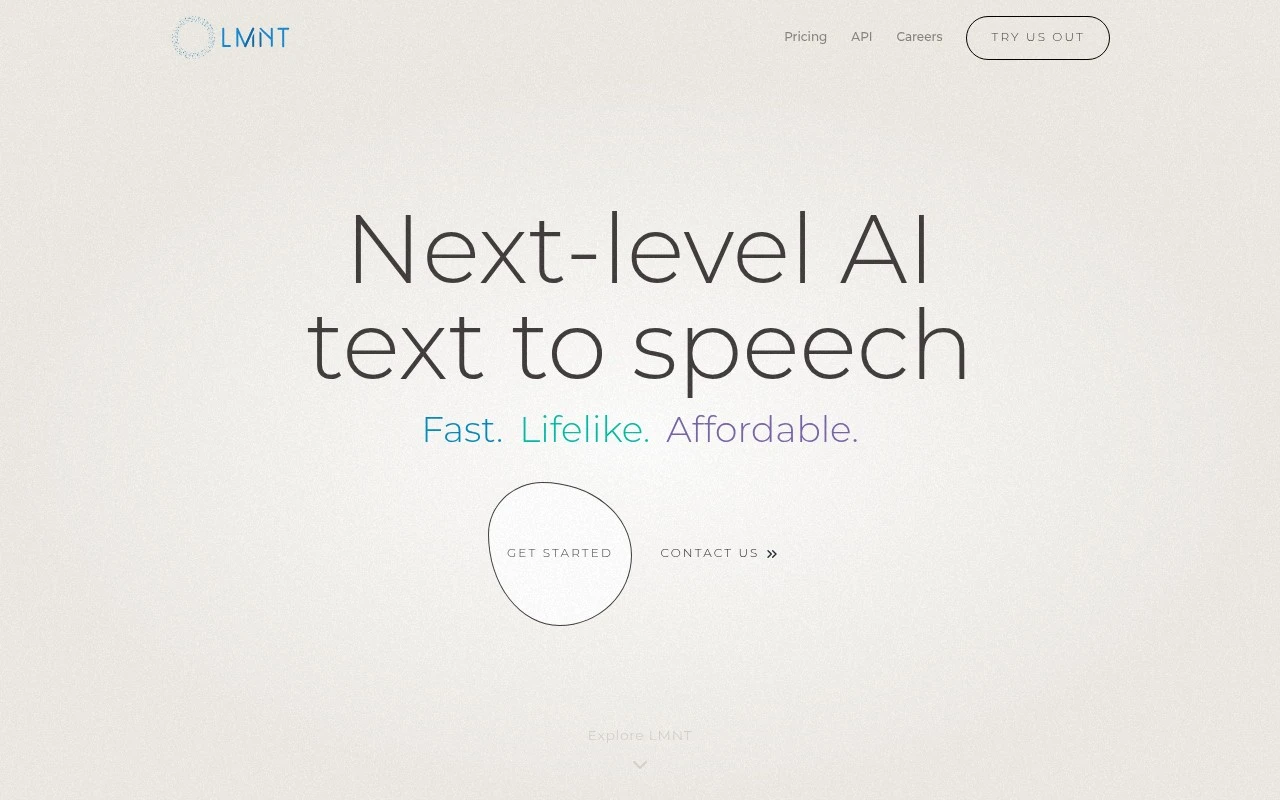
LMNT AI AI is a text-to-speech and voice cloning service focused on fast, lifelike, affordable speech generation. Its site highlights studio-quality voice clones from a 5-second recording, support for 31 languages, 150-200ms low-latency streaming, and an API intended for conversational apps, agents, and games.

FYAI Score

8.3 / 10

FYAI rating based on features, pricing and integrations

Pricing:

Usage-based

Best for:

Developers building real-time voice agents, apps, and games

Score Breakdown

  • Ease of use8.4 / 10
  • Features7.9 / 10
  • Pricing9.3 / 10
  • Integrations7.8 / 10
  • Support8.0 / 10

PRODUCT PREVIEW

What this AI tool does

LMNT AI is an AI tool page entry intended to help readers quickly understand what the tool is and why someone might look it up. Because the available context does not specify an official introduction or a primary use case, this description focuses on setting expectations and explaining how to interpret the listing. On a typical AI tool page, you would expect to find a short overview of what the tool does, who it is for, and the kinds of tasks it supports, along with practical details such as access method, pricing model, and any notable limitations. If you are researching lmnt for informational purposes, the most useful next step is to confirm its intended workflow and inputs/outputs from the tool’s official documentation or product site. If you share a link to the tool, a one-sentence summary, or the main problem it solves, this page description can be updated to reflect its actual purpose and provide clearer guidance for evaluating whether it fits your needs.

Use cases

Best for

Clone Voice

Clone a studio quality voice from a 5 second recording and generate new speech in that voice for apps or games.

Text to Speech

LMNT AI converts text into lifelike speech with low latency streaming and supports multiple languages via API.

Generate Voiceover

Generate voiceover audio from scripts by synthesizing natural narration and exporting the spoken output for videos or ads.

ANALYSIS

Strengths & limitations

Strengths
  • Supports low-latency streaming, with the site claiming 150-200ms performance for interactive use cases.
  • Offers voice cloning from short audio samples and multilingual speech across 31 listed languages.
  • Provides a developer API, playground, example prompts, and enterprise plans for higher-scale or custom needs.
Limitations
  • The product is primarily API-oriented, so non-technical users may need developer support for production use.
  • It is focused on speech generation rather than full voice-agent orchestration, conversation design, or application hosting.
  • The provided site content gives limited detail on voice governance, editing workflows, or advanced production controls beyond speech generation.

Evaluation

FYAI score breakdown

Our structured evaluation across five key criteria

8.3 / 10

Overall score

FYAI rating based on features, pricing and integrations

  • Ease of use8.4 / 10
  • Features7.9 / 10
  • Pricing9.3 / 10
  • Integrations7.8 / 10
  • Support8.0 / 10

What users say

Findings from public reviews, documentation and community sources.

  • Ease of use

    LMNT's homepage emphasizes quick onboarding with a free playground, "Get started in seconds," and voice cloning from "a 5 second recording."

  • Features

    LMNT's product page lists "studio-quality voice clones," "31 languages," "150-200ms low latency streaming," and an API for conversational apps, games, and agents.

  • Pricing

    LMNT's pricing page lists four tiers: Free with "15K characters," Indie at "$10 / mo" with "200K characters," Pro at "$49 / mo," and Premium at "$199 / mo." LMNT's pricing page also publishes overage rates and states "No concurrency or rate limits."

  • Integrations

    LMNT promotes building with its "Developer API," and Relevance AI states that it "integrates seamlessly with LMNT" for custom AI voices in automated workflows.

  • Support

    LMNT's homepage presents support resources through "Docs" plus community and developer links including "Discord" and "GitHub."

Who is this for?

Best for developers building voice features into conversational apps, games, or agents, LMNT's product page lists an API, "31 languages," and "150-200ms low latency streaming." Less suited to teams that do not want to work through developer resources, because LMNT's cited connectivity and support paths are a "Developer API," "Docs," "Discord," and "GitHub."

PRODUCT PREVIEW

Feature highlights

5s Voice Cloning

Create studio-quality voice clones from as little as 5 seconds.

Low-Latency Streaming

Stream lifelike speech in ~150–200ms for real-time conversations.

TTS API for Agents

API built for conversational apps, agents, and interactive games.

COMPARE

Discover curated alternatives worth comparing

Compare similar AI tools based on features, pricing and use cases

7.4/ 10Based on 30 reviews

Zencastr

Podcast Editing
Edits audio/video via text, transcribes, and makes social clips
Best for:
Audio & podcast creators
Pricing
Freemium

8.5/ 10Based on 16 reviews

Wondercraft

Short-form VideoVideo Editing
Turns text or audio into editable AI-generated videos and audio
Best for:
Video creators
Pricing
Freemium

8.6/ 10Based on 130 reviews

Wellsaid

AI Voiceover
Generates realistic AI voiceovers from scripts with voice controls
Best for:
Audio & podcast creators
Pricing
Paid only

Create polished voiceovers in minutes, not hours. See why teams choose LMNT AI to ship more audio content faster and keep every message on-brand.

FAQ

Frequently asked
questions

Everything you need to know about this AI tool,
its features, pricing, use cases, and limitations.

Is LMNT AI a good fit for marketing voiceovers, training modules, or product demos?
LMNT AI is best suited for scripted voiceovers where you need consistent brand tone across ads, explainer videos, onboarding, and training content. It’s a practical choice when you want fast turnaround without booking voice talent. If your content relies heavily on subtle emotion or improvisation, you may find human narration (or a tool with stronger expressive controls) works better.
Does LMNT AI have a free plan, and what are the typical limitations of paid tiers?
LMNT AI is generally offered as a subscription service, and access is usually tied to usage limits such as minutes/credits and feature gating by tier. If there is a free trial, it’s typically intended for evaluation and may restrict export options, voice selection, or total generation time. For high-volume production, compare the effective cost per finished minute across plans.
How does LMNT AI compare with other voiceover tools like ElevenLabs, Play.ht, or Descript?
LMNT AI is positioned around producing polished voiceovers quickly, while tools like Descript emphasize editing workflows and project-based audio/video production. ElevenLabs and Play.ht often compete on voice library breadth, cloning options, and fine-grained control over expressiveness. When comparing, focus on voice quality for your target language/accent, licensing terms for commercial use, and how much post-editing you expect to do.
How fast can a team get started with LMNT AI, and what onboarding effort should you expect?
Even with high-quality output, LMNT AI may not capture the full emotional nuance of a human performance for sensitive or highly dramatic content. Real-time editing during generation can be limited, so you may need additional post-production for timing, emphasis, or corrections. Subscription pricing can become a factor if you produce large volumes of audio each month.
What should I check about LMNT AI’s data handling, privacy, and compliance before using it for business content?
Review LMNT AI’s terms for how scripts, generated audio, and any uploaded assets are stored, retained, and used (including whether data is used to improve models). Confirm account controls, access management, and whether you can delete content on request. If you work in regulated environments, verify available documentation (e.g., DPA, SOC 2/ISO claims, GDPR support) and where data is processed.