Curated ToolThis tool is part of our curated AI directory. We only include tools that meet our standards for relevance, usability and real-world value.

Async

Creates and edits videos via AI prompts, templates, and uploads

AI VoiceoverAudio Enhancement
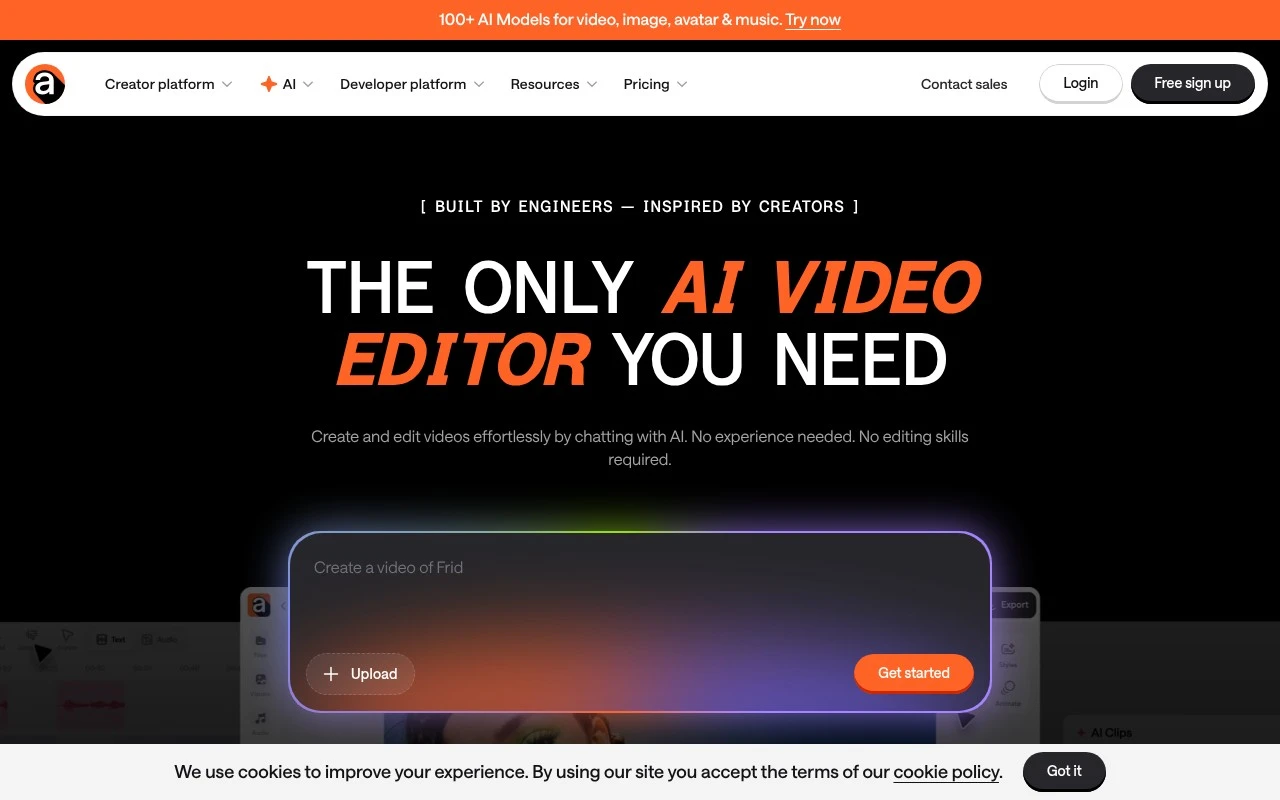
Async is an AI video editor for making videos through prompts, uploaded media, and prebuilt templates. It supports generating videos, editing footage, cutting social clips, adding subtitles, translating and dubbing content, creating voiceovers, cleaning audio, recording podcasts, and making thumbnails in one online workflow. The product is positioned for creators and teams that want to produce ads, podcasts, interviews, explainers, travel vlogs, wedding videos, and social content without learning complex editing software.

FYAI Score

8.2 / 10

Based on 252 reviews

Pricing:

Freemium

Best for:

Creators and teams producing social videos, ads, and podcasts

Score Breakdown

  • Ease of use8.6 / 10
  • Features9.1 / 10
  • Pricing7.5 / 10
  • Integrations7.1 / 10
  • Support8.1 / 10

PRODUCT PREVIEW

What this AI tool does

Async is an AI tool designed to help you work with asynchronous tasks and workflows in a clearer, more manageable way. It supports informational use cases where you need to understand how async operations behave, reason about timing and dependencies, or translate a high-level goal into steps that can run concurrently. You can use it to explore concepts like non-blocking execution, event loops, and concurrency patterns, or to draft and refine code and explanations for async behavior in common programming contexts. The tool is intended for practical guidance and learning support, helping you move from questions about asynchronous logic to concrete, readable outputs you can adapt to your project.

Use cases

Best for

Edit Video

Edit footage by trimming clips, adding subtitles, cleaning audio, and exporting social cuts in Async’s online editor.

Video Translation

Translate videos by generating subtitles and dubbing new voice tracks in another language while keeping timing aligned.

Generate Video

Generate a video from a prompt, uploaded media, or a template, then auto-assemble scenes with voiceover and captions.

ANALYSIS

Strengths & limitations

Strengths
  • Combines multiple video tasks in one workflow, including generation, editing, subtitles, dubbing, voiceover, clipping, audio cleanup, and thumbnails.
  • Uses a chat-based interface and templates, making it approachable for users without editing experience.
  • Supports repurposing long-form recordings into short-form clips for platforms such as TikTok, Instagram Reels, YouTube Shorts, and LinkedIn.
Limitations
  • The public site does not provide much detail about advanced manual editing controls or timeline-level precision.
  • Pricing, free-plan limits, export quality, and usage restrictions are not described in the provided page text.
  • The page describes broad AI video capabilities but does not specify integrations, supported input formats, or collaboration feature depth.

Evaluation

FYAI score breakdown

Our structured evaluation across five key criteria

8.2 / 10

Overall score

Based on 252 reviews

  • Ease of use8.6 / 10
  • Features9.1 / 10
  • Pricing7.5 / 10
  • Integrations7.1 / 10
  • Support8.1 / 10

What users say

Findings from public reviews, documentation and community sources.

  • Ease of use

    Async’s website says users can “Just chat with Async” and “don’t need to learn complicated video editing software.” G2 shows 4.7/5 from 186 reviews for Async.

  • Features

    Async’s website lists “Edit video with AI,” “Generate voiceover,” “Translate & Dub,” and “Record a podcast.” Async’s website also lists audio cleanup and audio editing among its creation tools.

  • Pricing

    Async’s pricing page lists five tiers, from Free to Business. Async’s pricing page lists “10 lifetime” credits on Free and “450 / month,” “1200 / month,” and “3000 / month” credits on paid tiers.

  • Integrations

    Async’s website says Async can create clips for “TikTok, Instagram Reels, YouTube Shorts, LinkedIn, and other platforms.” Async’s pricing page references “Host & Publish podcasts.”

  • Support

    Async’s own page quotes a G2 user saying “The customer service is also top rate.” A G2 review snippet includes a complaint about “lots of bugs and no customer support.”

Who is this for?

Best for creators who want a chat-based workflow for social clips, voiceover, dubbing, or podcasts, Async’s website says users can “Just chat with Async” and create clips for “TikTok, Instagram Reels, YouTube Shorts, LinkedIn, and other platforms.” Less suited to teams that need automated or marketplace-style integrations, the supplied evidence does not show a broader native integration catalog, API, or marketplace-style ecosystem.

PRODUCT PREVIEW

Feature highlights

Prompt video editor

Generate and edit videos from prompts, uploads, or templates.

Voice & audio cleanup

Record, enhance audio, and create voiceovers in one workflow.

Translate & dub

Auto subtitles, translation, and dubbing for global reach.

COMPARE

Discover curated alternatives worth comparing

Compare similar AI tools based on features, pricing and use cases

7.4/ 10Based on 30 reviews

Zencastr

Podcast Editing
Edits audio/video via text, transcribes, and makes social clips
Best for:
Audio & podcast creators
Pricing
Freemium

8.5/ 10Based on 16 reviews

Wondercraft

Short-form VideoVideo Editing
Turns text or audio into editable AI-generated videos and audio
Best for:
Video creators
Pricing
Freemium

8.6/ 10Based on 130 reviews

Wellsaid

AI Voiceover
Generates realistic AI voiceovers from scripts with voice controls
Best for:
Audio & podcast creators
Pricing
Paid only

Turn ideas into polished videos in minutes—just chat your edits. See why creators and teams use Async to ship more content, faster.

FAQ

Frequently asked
questions

Everything you need to know about this AI tool,
its features, pricing, use cases, and limitations.

What is Async best suited for compared with other voice and video tools?
Async is a strong fit if you want one conversational workflow to go from a prompt or recording to clips, captions, translations/dubs, voiceovers, thumbnails, and basic audio cleanup. It’s especially relevant for repurposing long-form content (podcasts, webinars, interviews) into short social edits. If you need frame-accurate editing, complex motion graphics, or a traditional timeline-first workflow, you may prefer a dedicated editor.
Does Async have a free plan, and what limitations should I expect on paid tiers?
Async’s public site doesn’t clearly list a free plan, pricing, or usage limits. When comparing tools, confirm whether credits/minutes apply to transcription, dubbing, voiceover generation, and exports separately. Also ask about watermarking, maximum upload length, export resolution, and how many versions you can generate per project.
How does Async compare to Descript, Opus Clip, or CapCut for repurposing content?
Async positions itself as an all-in-one, chat-driven workflow that covers clipping, captions, dubbing/translation, voiceovers, and audio cleanup in one place. Descript tends to be stronger for text-based editing and collaborative review, while Opus Clip is more narrowly optimized for automated short-form clipping. CapCut is often better for hands-on, manual control and effects, but may require more editing effort for multi-language dubbing and end-to-end automation.
How quickly can I get from a recording to publishable clips in Async?
Async’s site doesn’t spell out how precise the editing controls are (timeline tools, fine cuts, keyframes, or detailed export settings), which can matter for professional post-production. AI dubbing and voiceovers can vary in naturalness and pronunciation, so you’ll likely need review and occasional re-renders. If your team depends on integrations, role-based access, or predictable quotas, verify those details before committing.
What should I check about data privacy and compliance when using Async?
Because Async processes uploaded recordings and generated transcripts, confirm what content is stored, for how long, and whether you can delete projects and derived assets (captions, dubs, voiceovers). Ask whether customer data is used to train models, and whether there are options for opting out. If you have compliance requirements (e.g., GDPR, SOC 2, HIPAA), request documentation and clarify where data is processed and hosted.