Curated ToolThis tool is part of our curated AI directory. We only include tools that meet our standards for relevance, usability and real-world value.

Adobe Podcast

AI cleans and enhances spoken voice recordings for clearer audio

Audio Enhancement
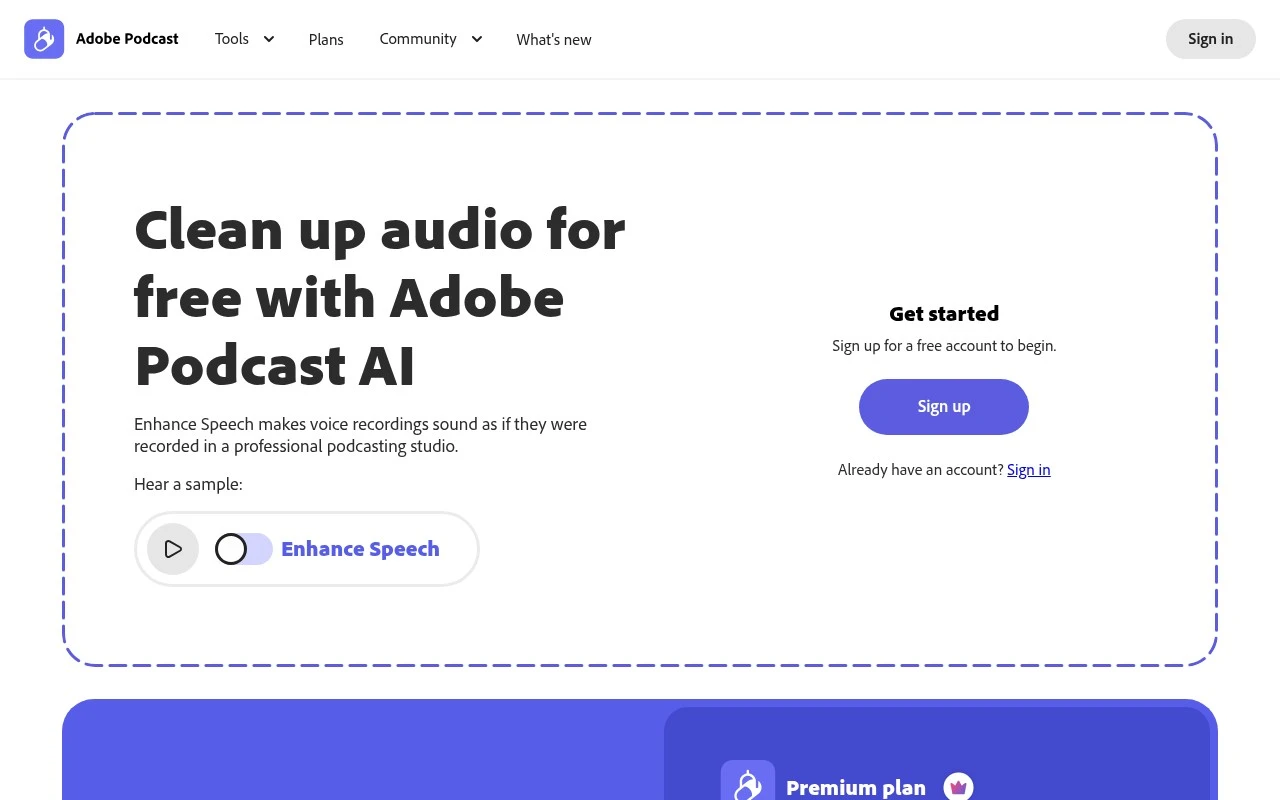
Adobe Podcast Enhance Speech is a free AI audio filter from Adobe for cleaning up spoken audio. Its stated purpose is to improve voice recordings so they sound like they were recorded in a soundproofed studio, making it most relevant for podcasts, interviews, narration, and other speech-first content.

FYAI Score

7.8 / 10

Based on 15 reviews

Pricing:

Freemium

Best for:

Podcasters and creators polishing spoken audio fast

Score Breakdown

  • Ease of use8.8 / 10
  • Features7.3 / 10
  • Pricing8.2 / 10
  • Integrations7.1 / 10
  • Support7.2 / 10

PRODUCT PREVIEW

What this AI tool does

Adobe Podcast is an AI-powered audio tool designed to help creators improve the clarity and overall quality of spoken recordings. It’s commonly used for podcast episodes, voiceovers, interviews, and other dialogue-heavy content where background noise, uneven volume, or room echo can make speech harder to understand. The tool typically fits into a simple workflow: you upload or record audio, apply enhancement, and export a cleaned-up version for editing or publishing. It’s useful for people who want a straightforward way to polish voice audio without needing deep audio engineering knowledge. If you’re researching options for speech enhancement, adobepodcast can be a practical reference point for understanding what modern AI audio cleanup can do and where it may still require manual review, especially with challenging recordings or mixed audio that includes music and sound effects.

Use cases

Best for

Voice Recording Cleanup

Apply an AI speech enhancement filter to reduce noise and room echo in a spoken voice recording.

Studio-Like Podcast Audio

Adobe Podcast Enhance Speech processes podcast or interview tracks to suppress background noise and reverb for a cleaner sound.

Voiceover Audio Enhancement

Enhance narration, voiceovers, or dialogue by running the audio through an AI filter that reduces hiss, noise, and room tone.

ANALYSIS

Strengths & limitations

Strengths
  • Focused specifically on improving spoken audio quality.
  • Designed to make recordings sound more like studio audio.
  • Presented by Adobe as a free AI filter.
Limitations
  • The available source describes speech enhancement only, not full podcast editing or production.
  • It is intended for spoken audio rather than music or general sound design.
  • The source does not specify advanced controls, supported formats, limits, or batch-processing capabilities.

Evaluation

FYAI score breakdown

Our structured evaluation across five key criteria

7.8 / 10

Overall score

Based on 15 reviews

  • Ease of use8.8 / 10
  • Features7.3 / 10
  • Pricing8.2 / 10
  • Integrations7.1 / 10
  • Support7.2 / 10

What users say

Findings from public reviews, documentation and community sources.

  • Ease of use

    G2 summarizes user feedback as praising Adobe Podcast for noise reduction that enhances audio quality “effortlessly on all devices,” and Reddit users describe noisy-recording cleanup as happening “in a fraction of the time.”

  • Features

    Adobe’s FAQ describes Adobe Podcast as a browser-based tool to “record, transcribe, edit, and share” clear audio. Adobe Podcast evidence highlights Enhance Speech as a core AI audio feature.

  • Pricing

    The Adobe Podcast plans page lists a Premium plan at “$9.99/month” with a “30-day free trial,” and published plan details mention “1 hour max per day Studio.”

  • Integrations

    Adobe Podcast integration evidence frames the product as a “web-based tool” used in the browser, while an Adobe community request asks for better integration into “Premiere and Audition and even After Effects.”

  • Support

    A Reddit thread in r/Adobe includes a broader Adobe customer-service complaint describing customer service as taking “10+ email” exchanges.

Who is this for?

Best for creators who need browser-based cleanup of noisy speech recordings, G2 says users praise noise reduction that enhances audio quality “effortlessly on all devices,” and Reddit users describe noisy-recording cleanup as happening “in a fraction of the time.” Less suited to teams that need deep production-workflow integrations, Adobe Podcast integration evidence frames the product as a “web-based tool,” and an Adobe community request asks for better integration into “Premiere and Audition and even After Effects.”

PRODUCT PREVIEW

Feature highlights

Enhance Speech

AI cleans up voice so it sounds like a studio recording.

Noise & echo removal

Reduces background noise and room reverb for clearer speech.

Fast web workflow

Upload, enhance, and download improved audio in minutes.

COMPARE

Discover curated alternatives worth comparing

Compare similar AI tools based on features, pricing and use cases

7.4/ 10Based on 30 reviews

Zencastr

Podcast Editing
Edits audio/video via text, transcribes, and makes social clips
Best for:
Audio & podcast creators
Pricing
Freemium

8.5/ 10Based on 16 reviews

Wondercraft

Short-form VideoVideo Editing
Turns text or audio into editable AI-generated videos and audio
Best for:
Video creators
Pricing
Freemium

8.6/ 10Based on 130 reviews

Wellsaid

AI Voiceover
Generates realistic AI voiceovers from scripts with voice controls
Best for:
Audio & podcast creators
Pricing
Paid only

Make your voice recordings sound studio-clean in minutes. Try Adobe Podcast today and publish clearer podcasts, interviews, and narration with confidence.

FAQ

Frequently asked
questions

Everything you need to know about this AI tool,
its features, pricing, use cases, and limitations.

When is Adobe Podcast a good fit, and when should I pick something else?
Adobe Podcast is a strong choice when you mainly need to clean up spoken-word recordings (interviews, voiceovers, meeting audio) and make them sound more consistent. It’s less ideal if your project involves heavy music, complex mixes, or detailed multitrack editing—those typically require a DAW or a full podcast editor. If your priority is fast voice enhancement rather than production, it fits well.
Is Adobe Podcast free, and what limitations should I expect?
Adobe Podcast has offered a free web-based speech enhancement workflow, but limits can apply (such as usage caps, file length, or queue times) and may change over time. If you need guaranteed throughput for frequent episodes, check the current plan details and any Creative Cloud tie-ins before committing. For occasional cleanup, the free option is often enough.
How does Adobe Podcast compare with tools like Descript, Auphonic, or iZotope RX?
Adobe Podcast is more of a “one-click” speech enhancement filter, while Descript focuses on editing via transcript plus production features. Auphonic is geared toward loudness leveling and batch processing for podcast delivery, and iZotope RX is deeper for surgical repair (clicks, hum, spectral editing) but has a steeper learning curve. If you want minimal controls and quick voice polish, Adobe Podcast is usually the simplest of the group.
How fast can I get results with Adobe Podcast, and what setup is required?
AI cleanup can introduce artifacts (over-smoothing, pumping, or a slightly synthetic tone), particularly on noisy recordings or when multiple speakers overlap. It won’t fix issues like clipping, severe room echo, or very low-quality microphones as reliably as targeted restoration tools. For best results, you may still need basic mic technique and a reasonably controlled recording space.
What should I consider about privacy, data handling, and compliance when using Adobe Podcast?
Because Adobe Podcast processes audio via an online service, you should assume files are uploaded to Adobe’s servers for processing. For sensitive or regulated content, review Adobe’s current terms, retention practices, and any enterprise/admin controls before using it. If your compliance requirements prohibit cloud processing, an offline tool may be a safer choice.