Curated ToolThis tool is part of our curated AI directory. We only include tools that meet our standards for relevance, usability and real-world value.

Acoust

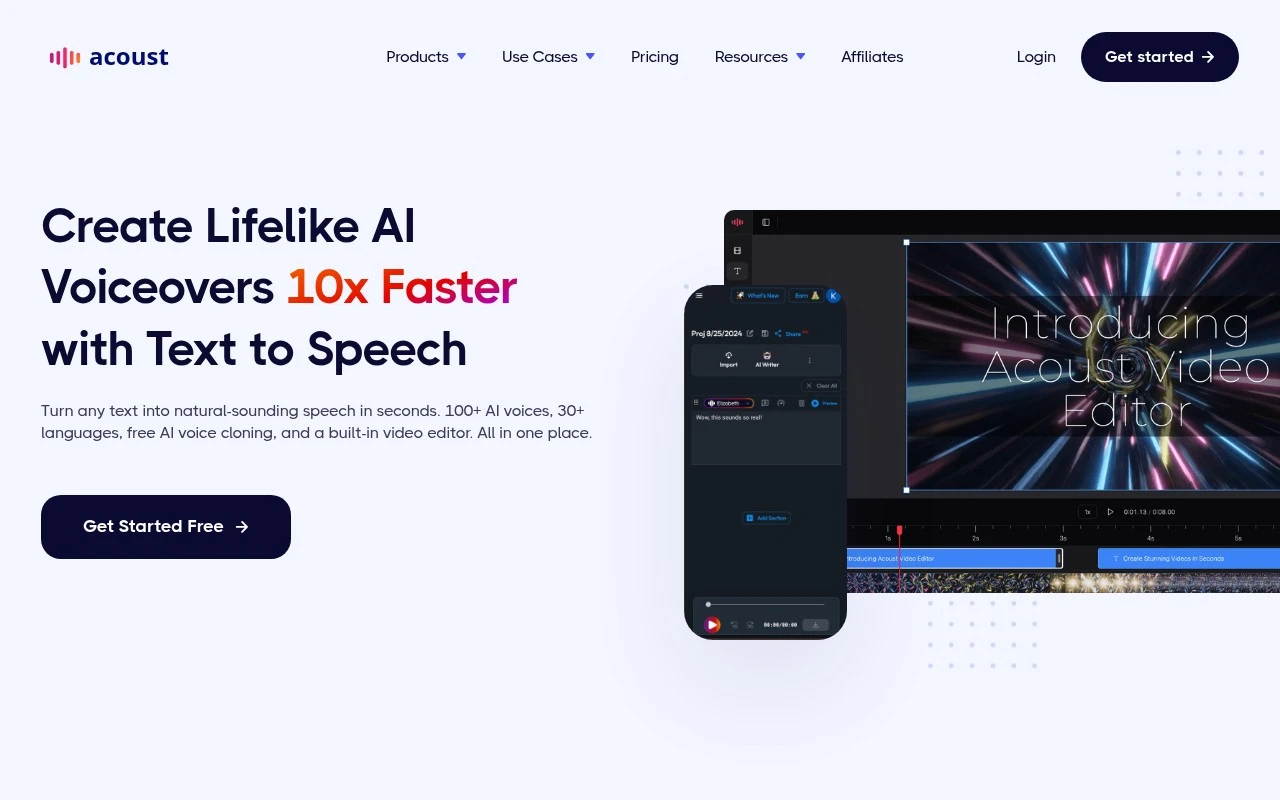
Acoust is an AI text-to-speech platform that helps users generate voiceover audio from scripts for videos, podcasts, e-learning, and other content.
AI VoiceoverVideo Dubbing & Translation

FYAI Score

7.9 / 10

Based on 2 reviews + FYAI product analysis

Pricing:

Free

Best for:

Creators and educators needing fast narration without recording

Score Breakdown

  • Ease of use7.8 / 10
  • Features8.1 / 10
  • Pricing8.8 / 10
  • Integrations7.0 / 10
  • Support7.7 / 10

PRODUCT PREVIEW

What this AI tool does

Acoust is an AI voice generation tool for converting written text into spoken audio, built for creators, educators, marketers, and media teams that need to generate voiceover without recording in a studio or hiring voice talent. It sits in the text to speech category, with a practical focus on turning scripts, lessons, product copy, and media narration into usable audio more quickly than traditional production allows. For people producing content regularly, the main appeal is speed and accessibility. A creator can move from a finished script to a narrated asset without setting up microphones, editing room noise, or coordinating with external speakers. Acoust is best at making voice production feel like a software workflow, where narration becomes something that can be drafted, revised, and regenerated as the content changes. Text to speech is especially useful when teams need consistent output across many pieces of content. Training materials, explainer videos, social posts, product walkthroughs, and short ads often require clear narration but do not always justify a full voiceover session. In that context, the platform helps reduce the gap between writing and publishing by making spoken audio available on demand. Acoust is for users who want professional-sounding narration without becoming audio engineers. Educators can turn written lessons into listenable resources, marketers can produce campaign voiceovers at a faster pace, and media teams can experiment with tone before committing to a final version. The tool is not positioned as a replacement for every human performance, but as a practical production layer for everyday narration needs. A key part of the product story is the use of synthetic voices to make audio creation more flexible. Instead of treating voiceover as a one-time recording, users can adjust text, change phrasing, and create new versions when a script evolves. This matters for teams that revise frequently, localize content, or need multiple voice styles for different audiences. Multilingual voice generation also broadens where the tool can fit. When content has to reach learners, viewers, or customers in more than one language, AI narration can make localization less dependent on separate recording sessions for every market. Acoust can therefore support global content workflows where spoken audio would otherwise be slow or costly to produce. The platform’s character is utilitarian rather than theatrical. Its value comes from helping people produce understandable, repeatable narration for common business, education, and creative uses. That makes it most relevant to users who care about turnaround time, consistency, and ease of production as much as they care about the voice itself. Compared with traditional voice production, the difference is not only cost, but control. A written script can become an audio draft quickly, and that draft can be refined without restarting the entire process. Acoust gives teams a way to treat voiceover as an editable digital asset, which is why it is useful in modern content pipelines where deadlines are short and formats change often.

Use cases

Best for

Text to Speech

Convert written text into spoken audio using AI voices for narration, accessibility, or reading content aloud.

Generate Voiceover

Use Acoust to generate a voiceover from a script and export the audio for videos, ads, or presentations.

Multilingual Voice

Create multilingual voice audio by generating speech from text in different languages for localized content.

ANALYSIS

Strengths & limitations

Strengths
  • Speeds up voiceover production because creators can turn finished scripts into narration without arranging recording sessions.
  • Best suited to solo creators, educators, and marketing teams because it removes the need to hire voice talent for routine narration work.
  • Free access lowers the barrier for individuals and small teams that want to experiment with AI-generated voiceovers before committing budget.

Limitations
  • Less suitable for projects that require a distinctive human performance because synthetic narration may not replace live acting, emotion, or presenter personality.
  • Less suitable for teams that need a complete audio production suite because its main role is voice generation rather than editing, mixing, or mastering full projects.
  • Less suitable for real-time voice applications because it is focused on producing narration from text rather than running live conversational voice systems.

Evaluation

FYAI score breakdown

Our structured evaluation across five key criteria

7.9 / 10

Overall score

Based on 2 reviews + FYAI product analysis

  • Ease of use7.8 / 10
  • Features8.1 / 10
  • Pricing8.8 / 10
  • Integrations7.0 / 10
  • Support7.7 / 10

What users say

Findings from public reviews, documentation and community sources.

  • Ease of use

    The Acoust website describes a browser-based workflow with “Turn any text into natural-sounding speech in seconds” and “No downloads.” The Acoust website includes customer quotes calling the platform “thoughtfully and logically designed” and “super easy.”

  • Features

    The Acoust website lists “100+ AI voices,” “30+ languages,” “AI voice cloning,” “AI Translation,” and advanced controls for “pauses, laughter, breathing, pitch, speed, emphasis.”

  • Pricing

    The Acoust pricing page lists a free plan, Pro at “$9 / month,” Premium at “$29 / month,” annual discounts, and published credit/minute limits. The Acoust pricing page says exports and commercial usage require paid plans and lists add-ons such as “$5 50K characters.”

  • Integrations

    The Acoust pricing page plan comparison lists “Import (YT, Webpage, Text Files, PDF),” “Public Share (Hosted),” and “Downloads Unlimited.”

  • Support

    The Acoust pricing page includes a detailed FAQ covering cancellation, limits, plan changes, commercial licensing, and enterprise options. The Acoust pricing page says Enterprise includes “Dedicated Support.”

Who is this for?

Best for creators who want browser-based text-to-speech without installing software, the Acoust website says “Turn any text into natural-sounding speech in seconds” and “No downloads.” Best for voice projects that need options beyond basic narration, the Acoust website lists “100+ AI voices,” “30+ languages,” “AI voice cloning,” and “AI Translation.” Less suited to teams that need automated or marketplace-style connectivity, the Acoust pricing page lists “Import (YT, Webpage, Text Files, PDF),” “Public Share (Hosted),” and “Downloads Unlimited,” so the cited workflow is import/export-centered.

PRODUCT PREVIEW

Feature highlights

Text-to-speech

Convert text into clear spoken audio for narration and voiceovers.

Rapid voice output

Generate voice tracks quickly to speed up content production cycles.

Voiceover-ready audio

Create consistent narration for videos, lessons, ads, and podcasts.

COMPARE

Discover curated alternatives worth comparing

Compare similar AI tools based on features, pricing and use cases

7.4/ 10Based on 30 reviews

Zencastr

Podcast Editing
Edits recordings like text, transcribes, and cuts social clips
Best for:
Audio & podcast creators
Pricing
Freemium

8.5/ 10Based on 16 reviews

Wondercraft

Short-form VideoVideo Editing
Creates editable videos and audio from text, prompts, media
Best for:
Video creators
Pricing
Freemium

8.6/ 10Based on 130 reviews

Wellsaid

AI Voiceover
Creates business voiceovers with voice and pronunciation controls
Best for:
Audio & podcast creators
Pricing
Paid only

Turn any script into a natural voiceover in minutes. Start creating polished audio for videos, training, and posts with Acoust today.

FAQ

Frequently asked
questions

Everything you need to know about this AI tool,
its features, pricing, use cases, and limitations.

Who is Acoust best suited for?
Acoust is best suited for creators and teams that need to turn written scripts into voice narration without recording a human speaker. It fits video producers, educators, marketers, podcasters, and content teams creating voiceovers for videos, courses, presentations, product explainers, ads, or other scripted audio formats.
Is Acoust free to use, and what should I check before relying on it?
Acoust is listed as a free text-to-speech and voiceover tool. Before using it for ongoing production, users should check acoust.io for current limits on voice generation, available voices, language options, export rights, and any restrictions that may affect commercial or high-volume projects.
How does Acoust compare with other AI voiceover tools?
Acoust competes with other AI text-to-speech tools that generate synthetic narration from written scripts. The right choice depends on voice quality, language coverage, licensing terms, export options, workflow fit, and whether the project needs simple narration or more advanced audio production features.
How quickly can I start making voiceovers with Acoust?
Acoust is strongest for scripted narration, but synthetic voices may not fully match the emotion, pacing, or nuance of a professional human voice actor. It may be less suitable for complex audio production workflows, performance-heavy storytelling, or projects where exact voice style and licensing terms are critical.
What privacy or compliance checks should teams make before using Acoust?
Teams should review Acoust’s data handling, retention, commercial usage, and compliance terms before uploading scripts that include confidential, regulated, or client-owned content. Buyers should also confirm where content is processed, who can access generated audio, and whether the tool’s policies match internal privacy and security requirements.